Baltasar and Blimunda by José Saramago
Baltasar and Blimunda by José Saramago opens in the bedchamber of King João V and Queen Maria Ana Josefa. The monarch needs an heir. A Franciscan friar promises success if the king builds a convent at Mafra. Intimacy, religion, and architecture enter one transaction.
The queen eventually bears a child, and the promise expands into a vast building project. Gold and diamonds from colonial Brazil support the king’s vision, while thousands of laborers supply the effort and suffering. A private vow creates a public burden.
Published in 1982 as Memorial do Convento, the novel appeared in English under a title that foregrounds its central couple. The two titles reveal its double structure. One remembers a monument and the society that constructed it. The other remembers two people official history would normally overlook.
The obsessive construction in 👉 The Spire by William Golding offers a revealing comparison. Golding concentrates on a churchman whose vision tests bodies and materials. José Saramago widens the scale, placing royal vanity, religious authority, colonial wealth, and anonymous labor inside the monument.
Baltasar and Blimunda is therefore historical fiction without reverence for official grandeur. The palace-convent survives, but the narrator asks whose hands moved its stones and whose deaths disappeared from its polished story. Architecture becomes an argument about memory.
Against the king’s monument, Baltasar and Blimunda imagines a flying machine secretly assembled by a priest, a wounded soldier, and a visionary woman. One project displays power. The other seeks freedom.
Seven Suns Meets Seven Moons
Baltasar Mateus returns from war without his left hand. The army no longer needs him, and civilian work is limited. His hook is practical, but it also displays what royal conflicts demand from ordinary bodies.
Blimunda enters his life during an auto-da-fé in Lisbon. Her mother, Sebastiana Maria de Jesus, has been condemned by the Inquisition and sent away. Amid public punishment, mother and daughter achieve a final moment of recognition. Father Bartolomeu Lourenço then brings Baltasar and Blimunda together.
Their names become Seven Suns and Seven Moons. Baltasar belongs to daylight, physical work, and the visible surfaces of things. Blimunda belongs to night, inward sight, and realities hidden from ordinary perception. Their differences form a partnership, not a hierarchy.
Love and political violence also intersect in 👉 A Tale of Two Cities by Charles Dickens. Dickens uses revolution and sacrifice, while Baltasar and Blimunda moves through absolutist Portugal. Neither novel pretends that lovers live outside history.
The relationship develops with unusual directness. It does not depend on prolonged courtship or legal ceremony. Shared work and mutual recognition create their bond. Baltasar does not treat Blimunda’s gift as something to own, while she sees his missing hand without reducing him to injury.
They meet where authority stages fear, yet their love creates trust beyond permission. Baltasar and Blimunda contrasts their equality with royal marriage and the Church’s control of bodies. The poor couple possesses less but inhabits life more fully.
Blimunda Sees Beneath the Skin
When Blimunda has not eaten, she can look inside people. She perceives illness, pregnancy, organs, and dark clouds of human will. Food closes this vision, so she carries bread when she wishes to return to ordinary sight.
Baltasar and Blimunda gives this magical gift practical and ethical weight. Seeing more does not grant unlimited power. Knowledge exposes suffering without necessarily providing a cure.
Blimunda also respects boundaries. Her love for Baltasar does not become an excuse to inspect him secretly. The restraint matters because the institutions around them constantly intrude into private life. The Inquisition investigates belief, the monarchy commands labor, and patriarchal custom defines women through obedience. Her vision differs because she can choose not to use it.
Father Bartolomeu needs the human wills she can perceive. Collected at the edge of separation from the body, they will provide the force his flying machine lacks. The marvelous element carries a political meaning. People dismissed as powerless contain the energy required for flight.
Blimunda gathers what history cannot measure. The dead and dying contribute not as royal subjects or laboring units, but through the irreducible force of wanting. Their wills make transcendence possible.
Her gift also changes the novel’s realism. Saramago describes hunger, disease, sexuality, and physical labor with concrete attention, then allows a woman to see the invisible within them. The fantastic does not escape the body. It reveals how much official descriptions leave unseen.
The Passarola Learns to Fly – Baltasar and Blimunda
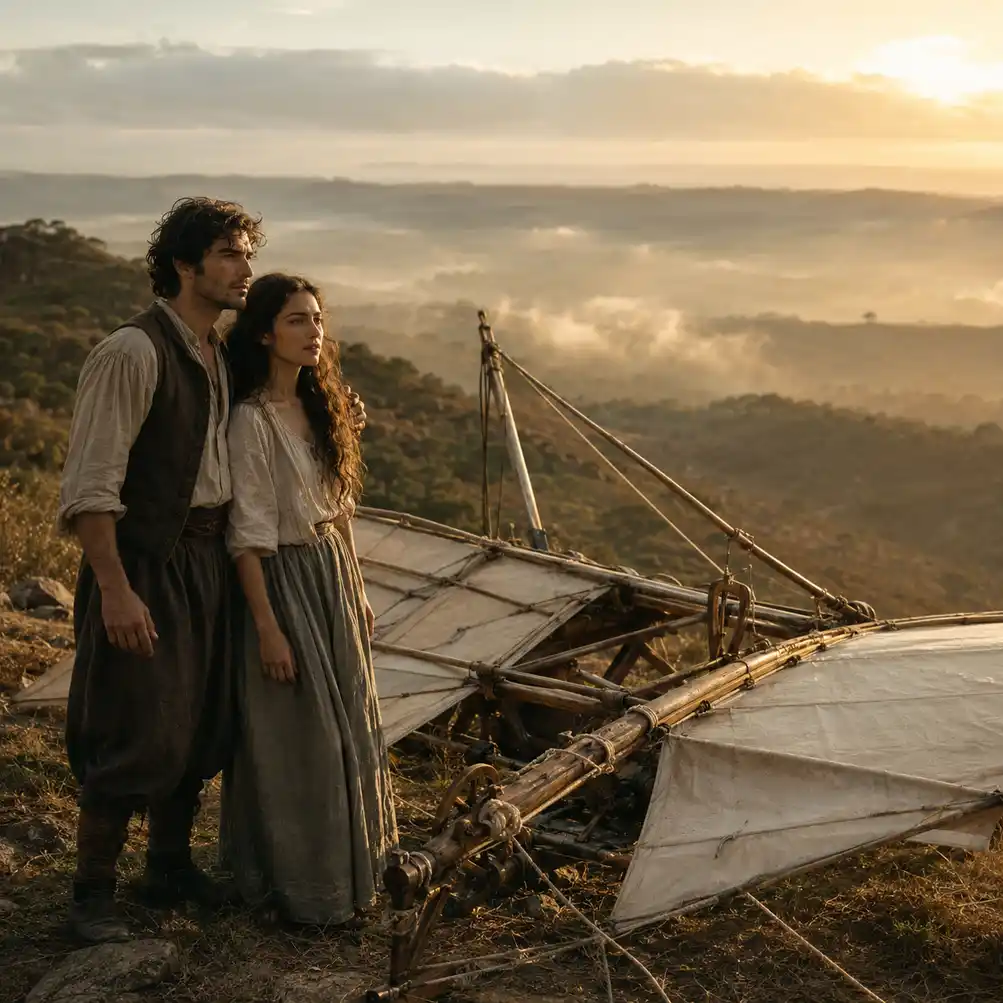
Father Bartolomeu Lourenço de Gusmão dreams of flight. Based on the historical priest and inventor, he gives the Passarola imaginative power beyond documented machinery. Wood, iron, sails, magnets, amber, and human wills converge in a fragile craft.
Baltasar contributes physical skill. His hook does not exclude him from creation; it becomes part of the work. Blimunda collects the wills that will lift the machine. Bartolomeu supplies the vision that joins materials to possibility. Flight is achieved through unequal gifts freely shared.
The early fascination with human flight in 👉 The Aviator by Antoine de Saint-Exupéry belongs to the technological world of modern aviation. Saramago’s machine is stranger and more allegorical, yet both works understand flight as labor, risk, imagination, and a change in how the earth can be seen.
When the Passarola rises, the scene releases the novel from the heavy structures of court and convent. From above, borders and hierarchies lose some of their authority. The builders briefly inhabit a perspective unavailable to the king, despite all his wealth.
The freedom remains precarious. Bartolomeu fears religious prosecution, and a flying machine powered by hidden wills cannot enter public life safely. The marvelous must hide from institutional certainty. What should enlarge human possibility appears as heresy to powers that depend on controlling explanation.
The flight is no simple triumph. In Baltasar and Blimunda, it becomes a collective dream built beside persecution, showing what ordinary people create beyond the commands of palace and Church.
Music Joins the Secret Workshop
Domenico Scarlatti, the Italian composer at the Portuguese court, moves between official culture and the secret Passarola. His harpsichord connects music with the work of Baltasar, Blimunda, and Bartolomeu without commanding it.
Scarlatti’s presence also complicates the novel’s social divisions. He serves the royal household, yet he can recognize imagination beyond the palace. Music travels where rank cannot. Sound crosses walls built by hierarchy.
The conflict between discovery and authority receives a different dramatic treatment in 👉 Life of Galileo by Bertolt Brecht. Galileo confronts institutions that regulate truth, while Father Bartolomeu moves among patronage, experiment, faith, and fear. Both works ask what happens when knowledge requires protection from the society that might benefit from it.
In Baltasar and Blimunda, music does more than symbolize intellectual freedom. After the exhausting collection of wills leaves Blimunda ill, Scarlatti’s playing helps call her back toward life. The scene joins body and art without presenting music as a miraculous cure. Recovery occurs through care, time, and repeated sound.
The secret workshop therefore gathers several kinds of making. Baltasar works with tools, Bartolomeu designs, Blimunda sees and collects, and Scarlatti plays. None of these activities is sufficient alone. Creation depends on forms of knowledge meeting as equals.
That collaborative model opposes the construction at Mafra. The convent is attributed to a king, although multitudes build it. The Passarola has no single owner who can honestly claim its achievement. Its flight belongs to a small community formed through trust.
Mafra Is Built from Bodies
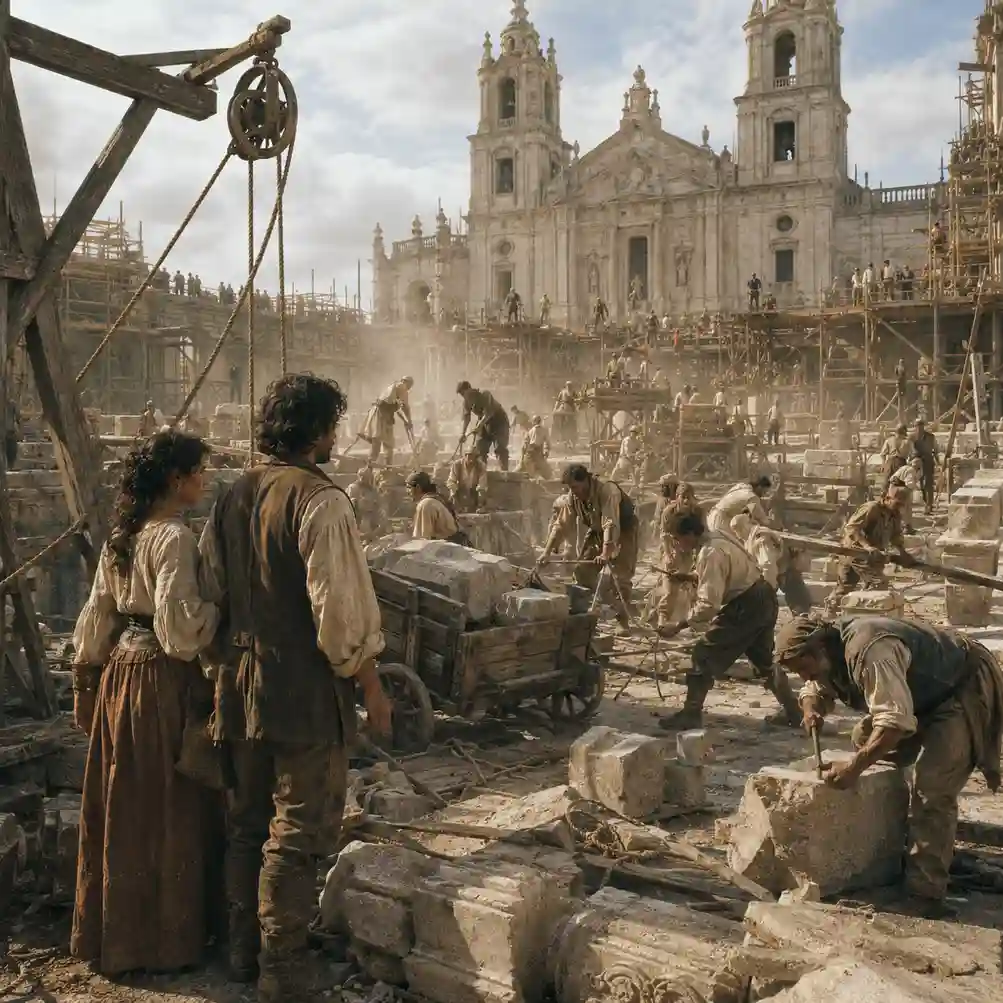
The convent draws workers, animals, timber, stone, and money toward Mafra. Men are compelled from across Portugal, families lose their labor, and bodies confront impossible loads. The king’s promise acquires literal weight.
One of the novel’s most memorable episodes follows the transport of an enormous stone destined for the building. Official history might record the completed architectural feature. Baltasar and Blimunda follows the hauling, danger, exhaustion, injury, and death required to move it. The monument’s beauty contains unrecorded pain.
The scene keeps returning from stone to flesh. Ropes, carts, animals, slopes, and royal deadlines become pressures on vulnerable bodies. What looks permanent at Mafra is purchased through lives that power considers replaceable.
Saramago interrupts the anonymity of mass labor by naming workers, including men who will leave almost no other trace. The gesture does not pretend that fiction can recover every life. It challenges a historical scale in which kings receive biographies while builders become numbers.
The neglected existence at the center of 👉 The Hour of the Star by Clarice Lispector belongs to twentieth-century Brazil rather than eighteenth-century Portugal. Both novels nevertheless question how literature can attend to people whom society barely sees without turning them into objects of pity.
Mafra exposes the economy of absolutism. Colonial resources finance royal ambition, religious prestige legitimizes it, and ordinary people absorb the physical cost. Power converts collective labor into a ruler’s signature.
The convent is not dismissed as visually meaningless. Its endurance creates the harder problem. Magnificent objects may result from unjust relations. To admire the finished structure without remembering its makers would complete the erasure that the novel resists.
A Narrator Walks Through Time
The narrative voice of Baltasar and Blimunda moves between characters, classes, centuries, and levels of knowledge. It describes royal ritual, enters a laborer’s fear, anticipates later history, and keeps past and present in conversation.
Long sentences carry dialogue with sparse conventional punctuation. Speakers may change inside a flowing paragraph, requiring attention to rhythm and verbal cues. At first, this style can feel demanding. Once its movement becomes familiar, it resembles an alert oral storyteller who refuses to keep narration, commentary, and speech in separate rooms.
The voice is intimate without pretending neutrality. It mocks royal vanity, questions religious authority, notices bodily discomfort, and grants dignity to characters excluded from official accounts. Humor prevents the historical setting from hardening into a museum display.
Ceremony can turn abruptly into appetite, sex, fatigue, or pain. These changes of register puncture the language of grandeur and remind readers that institutions claiming divine purpose still operate through ordinary bodies.
The narrator also avoids making the poor automatically virtuous or the powerful psychologically simple. Human appetite, tenderness, fear, vanity, and cruelty cross social positions, even though material power remains radically unequal.
This mobility allows Baltasar and Blimunda to unite several genres. It is a love story, historical novel, political satire, folk tale, philosophical fable, and fantasy of invention. The modes do not always merge quietly. Their friction is part of the design.
History becomes open to imaginative correction. Fiction cannot change who ordered the convent or who died building it. It can change where attention rests. By moving between palace, workshop, procession, and road, the narrator redistributes importance and constructs a memorial different from the king’s.
Quotes from Baltasar and Blimunda
- “We never ask ourselves whether there might not be some wisdom in madness, even while recognising that we are all a little mad.” This sentence dissolves the comfortable boundary between Bartolomeu’s supposed madness and society’s accepted reason. Moreover, the Passarola turns eccentricity into creative knowledge. Institutional sanity belongs to court and Inquisition, yet the dreamers understand cooperation, possibility, and freedom more clearly than their judges.
- “Then Blimunda said, Unless we open the sail, we shall go on climbing, and we might even collide with the sun.” Wonder does not interrupt Blimunda’s practical intelligence. While the priest exults and Baltasar weeps, she notices the machine’s immediate danger. Consequently, the line captures her central role: visionary power never detaches her from material reality, responsibility, or care for her companions.
- “The last man to be burned has his left hand missing.” The calm sentence makes recognition devastating. Baltasar’s defining absence identifies him among the Inquisition’s victims before the narration names him. Therefore, bodily loss, which once joined him to the Passarola’s construction, finally exposes state violence. Blimunda’s search ends not with explanation but with sight, memory, and a final act of guardianship.
Trivia for Baltasar and Blimunda
- The English title changes the emphasis: José Saramago published Memorial do Convento in 1982, while Giovanni Pontiero’s 1987 translation became Baltasar and Blimunda. The 🌐 author’s foundation presents the convent as history’s center and the lovers as its human counterweight.
- Two Portuguese prizes greeted the novel: In 1982, it received the Portuguese PEN Club Award and the Municipality of Lisbon Literary Prize. Moreover, its fusion of history, fantasy, and romance established the writer internationally.
- The novel restores laborers to history: Rather than celebrate king and architect, Baltasar and Blimunda follows workers who haul stone and sacrifice their bodies. This reversal invites comparison with 👉 The Hunchback of Notre Dame by Victor Hugo, which also questions a monument’s human cost.
- The lovers carry complementary names: Baltasar becomes Sete-Sóis, or Seven-Suns, while Blimunda becomes Sete-Luas, or Seven-Moons. Furthermore, his missing hand and her visionary sight turn apparent incompleteness into cooperation.
- Historical figures enter the invention: Bartolomeu Lourenço de Gusmão and Domenico Scarlatti join the lovers. Consequently, documented lives, imagined flight, and music share one plane, much as history and wonder mingle in 👉 One Hundred Years of Solitude by Gabriel Garcia Marquez.
- Punctuation reproduces oral momentum: Long comma-linked sentences absorb dialogue, commentary, and speaker changes. The Nobel Prize 🌐 excerpt demonstrates that rhythm during the Passarola’s ascent, while Pontiero preserves its demanding flow.
Nine Years Lead Back to the Fire
The Passarola’s freedom cannot last. Father Bartolomeu dies away from the project. Years later, the hidden machine rises unexpectedly with Baltasar aboard. He disappears from Blimunda’s life, repeating the separations imposed by political and religious violence.
Blimunda searches Portugal for nine years, transforming fidelity into action. She survives danger, uncertainty, and an attempted assault. Love persists without the comfort of knowledge.
Her search ends in Lisbon at another auto-da-fé, returning the novel to the form of public terror where the couple first met. Among those condemned to burn, she recognizes Baltasar. He has been captured and delivered to the machinery of religious punishment.
The ending of Baltasar and Blimunda does not rescue his body. As he dies, Blimunda gathers his will. She does not allow it to disappear upward. It remains with her, completing the bond between Seven Suns and Seven Moons without turning death into a painless spiritual reunion.
The final miracle preserves relation, not life. That distinction protects the scene from easy consolation. The same society that built a convent to display faith destroys the man who helped create flight.
The novel leaves two monuments. Mafra stands through stone, royal command, colonial wealth, and forgotten labor. The love of Baltasar and Blimunda survives through memory, shared work, and a will held close at the moment of destruction.
The second monument cannot be visited, owned, or attributed to a king. It expresses the hope of Baltasar and Blimunda: power cannot fully possess the human desire to see, create, love, and rise.