Captains of the Sands by Jorge Amado
Captains of the Sands begins before the children can speak. Reports and official letters describe a dangerous gang stealing across Salvador. Editors, police, judges, and charities exchange blame without accepting responsibility for the lives involved.
This dossier establishes the central conflict. Public language turns abandoned children into a threat. Reports record crime but exclude hunger, homelessness, and neglect. The boys become visible when property owners fear them.
Published in Portuguese in 1937 as Capitães da Areia, Captains of the Sands then crosses that boundary and enters the group’s abandoned waterfront warehouse. The criminals acquire names, loyalties, talents, wounds, and desires. Jorge Amado does not deny their thefts or violence. He asks what changes when judgment begins with their humanity rather than a police category.
Media narratives destroy complexity in 👉 The Lost Honor of Katharina Blum by Heinrich Böll. Its setting differs, but both books expose how official stories manufacture a convenient enemy for society.
The documents reveal society by what they omit. Their respectable language protects the adults who have normalized childhood misery. Once Captains of the Sands moves inside the warehouse, the opening accusations remain in the reader’s mind, but they can no longer provide the whole truth.
A Warehouse Becomes a Home
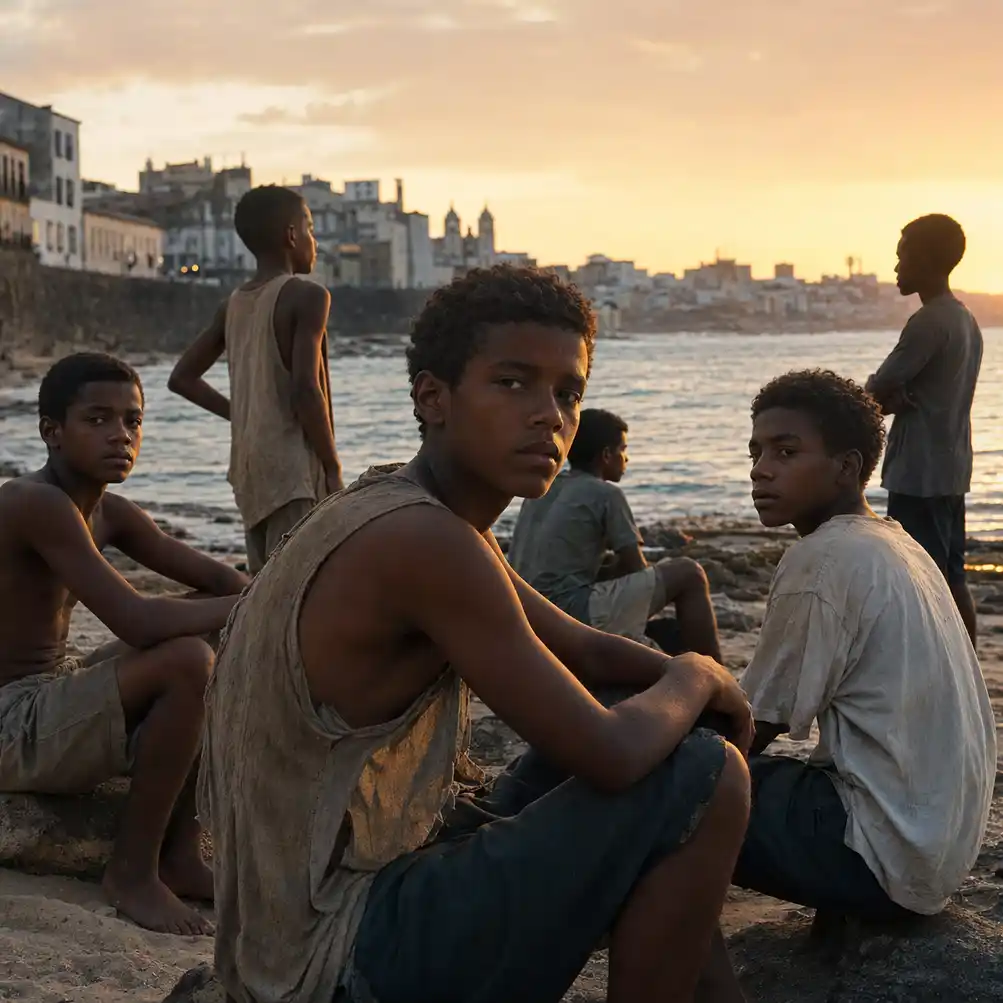
The Captains live in a derelict warehouse near Salvador’s docks. Sand covers the floor and possessions remain scarce. Yet the building provides what the city withholds: somewhere to sleep, organize, argue, and return.
Their community has rules and hierarchies. Stolen goods are shared, plans require cooperation, and betrayal threatens collective survival. The gang functions as an improvised family. Its bonds arise from necessity, but necessity does not make the affection false.
In 👉 The Grass Harp by Truman Capote, outsiders also create an unconventional household. Capote’s refuge is gentler. The warehouse in Captains of the Sands faces hunger, police, illness, and cruelty. Both books question who defines a legitimate home.
The group cannot fully replace parents, security, or education. Older boys exercise power over younger ones, fear often hides behind bravado, and tenderness lacks a stable language. Their independence is therefore double-edged. The streets offer movement and adventure, but the apparent freedom rests on exclusion.
Home exists because the boys protect one another. The warehouse gains emotional power without making homelessness desirable. The children create something valuable from space society has discarded. Its fragile order exposes how much organized care the surrounding city could have offered but chose not to provide.
Pedro Bala Leads the Unprotected
Pedro Bala, or Bullet, leads the gang while still an adolescent. He plans robberies, settles disputes, and knows hesitation can be dangerous. Leadership gives him confidence while demanding premature adulthood.
The other boys resist becoming one social type. Professor reads and draws. João Grande offers loyalty. Pirulito turns toward religion, while Volta Seca dreams of the cangaceiros. Sem-Pernas turns humiliation into cruelty. Each child develops a different survival language.
The boys listen because his authority emerges from shared risk rather than age or law. Even so, command can harden into dominance, and Pedro must learn the difference himself.
Adolescent estrangement speaks privately in 👉 The Catcher in the Rye by J.D. Salinger. Holden has material privilege, while Pedro leads unprotected children. Both novels show adult hypocrisy shaping youthful rebellion.
Captains of the Sands uses an ensemble rather than placing every meaning inside Pedro. The group’s variety prevents poverty from becoming personality. Similar conditions produce faith, art, anger, humor, tenderness, and violence.
Pedro learns that leadership can extend beyond theft. His father’s story connects him with dockworkers and resistance. Personal courage begins to acquire political direction. Development does not erase his crimes, but it reveals energy society sees only as danger.

Salvador Offers Beauty Without Shelter
Salvador is more than a backdrop in Captains of the Sands. Ports, beaches, churches, markets, mansions, and poor districts form a city divided by ownership. The boys survive by reading routes respectable citizens overlook.
Amado writes Bahia through heat, sea air, music, religion, hunger, and movement. Beauty and deprivation occupy the same streets. Salvador offers freedom while remaining structured to exclude these children.
Afro-Brazilian culture provides another community. Capoeira, Candomblé, celebration, José Pedro, and the mãe-de-santo Don’Aninha complicate any opposition between belief and rebellion. Spiritual traditions offer care where official morality fails.
The portrayal is affectionate, but it belongs to an early phase of the author’s work and sometimes turns social types into vivid emblems. Readers may notice romantic or political simplification. Even so, Captains of the Sands grants cultural authority to people whom elite institutions dismiss.
The boys possess knowledge of the city, although they possess almost nothing within it. Salvador belongs to them through memory, routes, friendships, and danger, but not through property or protection. That contradiction allows the setting to remain sensuous without becoming picturesque. The same sunlight illuminating the bay also exposes children whom the city has chosen not to shelter, even when they condemn it.
Dora Changes the Shape of the Gang
Dora loses her family and enters a community organized by boys. She becomes a sister, maternal figure, and eventually Pedro’s beloved. Her presence gives the gang forms of care it has missed.
This development brings warmth to Captains of the Sands, but it also creates questions. Dora is asked to carry several female roles at once. Her value often appears through the comfort, order, and tenderness she provides to boys. The novel recognizes her courage, yet it sometimes idealizes her through their emotional needs.
Pedro’s devotion to Dora contrasts with earlier sexual aggression. Love opens another future but cannot protect them from police, illness, or institutional power. They possess no safe private space.
The harshest episodes of Captains of the Sands prevent an easy celebration of youthful freedom. The boys can harm others as well as one another. Poverty explains the conditions of violence without making every act innocent. Compassion must coexist with moral discomfort. She also joins the gang’s dangers, so her role includes bravery and judgment rather than nurture alone.
Dora makes unmet needs visible. Beneath masculine boasting are children longing for dependable care. Captains of the Sands shows affection changing behavior without pretending one girl can repair social abandonment.
Institutions Teach Violence – Captains of the Sands
Police, courts, reform schools, and charities claim to correct the children. Capture instead brings beatings, hunger, isolation, and forced obedience. The system punishes behavior produced by neglect while preserving its causes.
Institutional cruelty also shapes 👉 Oliver Twist by Charles Dickens. Dickens uses melodrama, while Amado writes with Brazilian political urgency. Both ask why respectable society fears poor children more readily than it protects them.
Sem-Pernas embodies the consequences with particular force. His physical disability has made him a target of mockery and abuse. He infiltrates households by awakening pity, then helps the gang rob them. Humiliation becomes both wound and weapon. His cruelty is real, but it has a history. The reform school tries to break resistance rather than build trust. Pedro’s suffering shows official discipline reproducing the violence it condemns.
Captains of the Sands does not present every adult as an enemy. José Pedro, Don’Aninha, dockworkers, and other allies demonstrate that solidarity can cross age and institution. Their presence keeps the critique from becoming mechanically absolute.
Still, punishment cannot substitute for belonging. The boys return repeatedly to the warehouse because even its dangers offer more dignity than systems created in the name of their improvement and supposed protection.
Childhood Splinters into Many Futures
The episodic structure follows robberies, games, illness, desire, faith, capture, escape, and grief. Life initially feels timeless, but age and circumstance force the boys toward separate futures.
The Professor’s art, Pirulito’s faith, João Grande’s loyalty, Volta Seca’s outlaw dream, and Pedro’s politics become roads from the warehouse. The gang contains several unfinished lives. Society sees a criminal mass rather than diverging capacities.
Friendship under severe economic pressure also drives 👉 Of Mice and Men by John Steinbeck. Steinbeck’s novella is more compressed and fatalistic, but both books measure hope through bonds formed among people denied reliable security.
Not every path offers liberation. Some boys carry the violence of the streets into adult roles. Others find art, work, religion, or collective struggle. Their outcomes can feel politically shaped, especially as Pedro moves toward organized resistance. Yet the direction grows from experiences already present in the group.
Captains of the Sands functions as a collective coming-of-age novel. No graduation ends childhood cleanly. Adulthood arrives as dispersal. The family created through survival cannot remain unchanged because each member must confront the larger society. The sadness does not erase possibility. Imagining futures rejects the assumption that the boys’ identities became fixed when society called them delinquents.

Famous Quotes from Captains of the Sands
- “A liberdade é como o sol. É o bem maior do mundo.” Freedom becomes warmth, visibility, and the condition of life itself. However, the comparison also carries irony, because the boys’ freedom comes without food, shelter, or protection. The two plain sentences explain why confinement feels worse than deprivation to Pedro Bala, even when life outside exposes him to constant danger.
- “A greve é a festa dos pobres.” The sentence transforms a strike from economic interruption into collective celebration. Moreover, “festa” connects political action with the music, movement, and shared energy that animate the novel’s Bahia. Pedro’s developing class consciousness therefore grows from the gang’s existing loyalties rather than arriving as an abstract doctrine imposed from outside.
- “Nunca tivera uma alegria de criança. Se fizera homem antes dos dez anos para lutar pela mais miserável das vidas: a vida de criança abandonada.” These sentences describe Sem-Pernas without romanticizing premature toughness. In fact, adulthood appears as damage that society forces upon a child who never received safety or affection. His cruelty consequently emerges from social abandonment, although the narrative never erases the harm he causes.
Context-Rich Trivia for Captains of the Sands
- The novel provoked state censorship immediately: Jorge Amado released Capitães da Areia in 1937. Estado Novo authorities soon burned copies publicly, and the author’s literary foundation still foregrounds that scandal.
- A newspaper dossier opens the story: Reports and letters describe the boys through police, judicial, clerical, and elite perspectives before the narrator enters their warehouse. Consequently, Captains of the Sands shows how institutions manufacture the label “criminal.”
- Nicknames function as compressed biographies: Pedro Bala leads, Professor reads, Sem-Pernas carries bodily and emotional wounds, and Pirulito seeks religion. Therefore, the episodic structure turns a collective portrait into distinct coming-of-age stories.
- Freedom carries a painful double meaning: Street life releases the boys from institutions, yet exposes them to hunger, violence, and abandonment. That tension connects with 👉 A Clergyman’s Daughter by George Orwell, especially its unsentimental homelessness.
- Gregory Rabassa carried Bahia into English: The 🌐 Penguin Classics edition credits Rabassa as translator and Colm Tóibín as introduction writer. Meanwhile, the novel’s class anger and communal resilience invite comparison with 👉 The Grapes of Wrath by John Steinbeck.
- A family connection shaped the 2011 film: Cecília Amado, the novelist’s granddaughter, directed the Brazilian adaptation and used young performers from Salvador’s peripheral communities. Additionally, Bahia’s culture department notes that the film organizes one year around the festival of Iemanjá.
A Burned Book That Refused Silence
The political challenge of Captains of the Sands appeared immediately. In 1937, authorities publicly burned copies in Salvador as communist propaganda. Power tried to destroy a voice it could not comfortably classify.
Amado sides with abandoned children, Afro-Brazilian communities, workers, and collective resistance. The social message sometimes directs character development openly. Political conviction shapes the emotional design.
Yet the novel survives because it offers more than a thesis. Humor, adventure, sensual descriptions of Bahia, distinct characters, and genuine grief give its argument human form. Readers remember Pedro, Dora, Professor, and Sem-Pernas as people before they become examples.
Modern readers should approach the romance of freedom critically. Street life brings exhilaration, but also hunger, exploitation, sexual violence, illness, and death. The novel is strongest when both realities remain visible.
Its enduring demand is simple but radical: look at the children again. Do not begin with the police report, the stolen object, or the convenient label. Begin with the conditions, attachments, abilities, and pain that the label conceals.
Captains of the Sands turns a condemned gang into a community the reader cannot easily dismiss. That transformation explains why a book once placed in the fire continues to speak with such warmth and urgency.