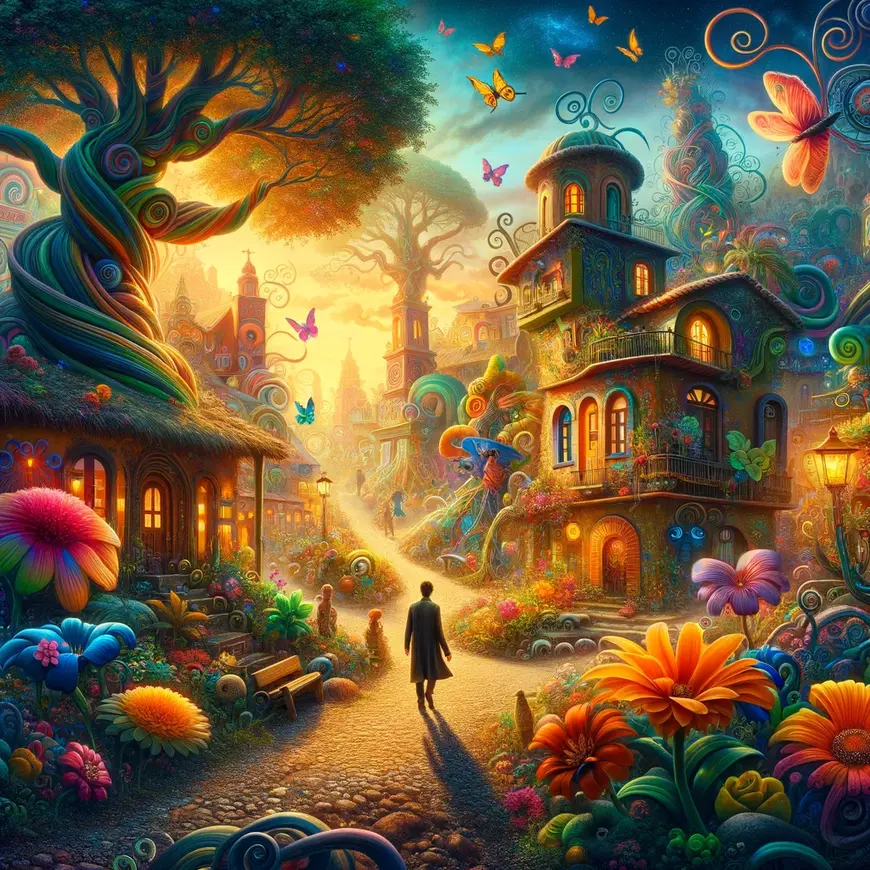
Chronicle of a Death Foretold by Gabriel García Márquez
From the first line, Chronicle of a Death Foretold makes its ending known, Santiago Nasar will be killed. There is no suspense in the “what,” only in the “how” and “why.” The narrative unfolds like a mosaic, with each tile placed by a different witness. We know the outcome, yet each retelling reshapes our understanding.
Gabriel García Márquez roots this murder in the codes of honor that bind the town. The brothers who commit it announce their intention openly, almost as if begging someone to stop them. But no one does. This creates the novel’s haunting paradox: the crime is both public and preventable, yet it happens exactly as foretold.
The narrator, reconstructing the events years later, treats time like a scattered deck of cards. He jumps between moments, perspectives, and memories, building a layered truth from unreliable fragments. This structure mirrors how real tragedies are remembered, never in neat order, but in flashes of sound, color, and feeling.
In these opening movements, the book’s power lies in how it transforms inevitability into tension. Even knowing Santiago’s fate, the reader feels each delayed warning, each missed chance, as a fresh blow. The inevitability becomes not a relief from suspense but its very source.
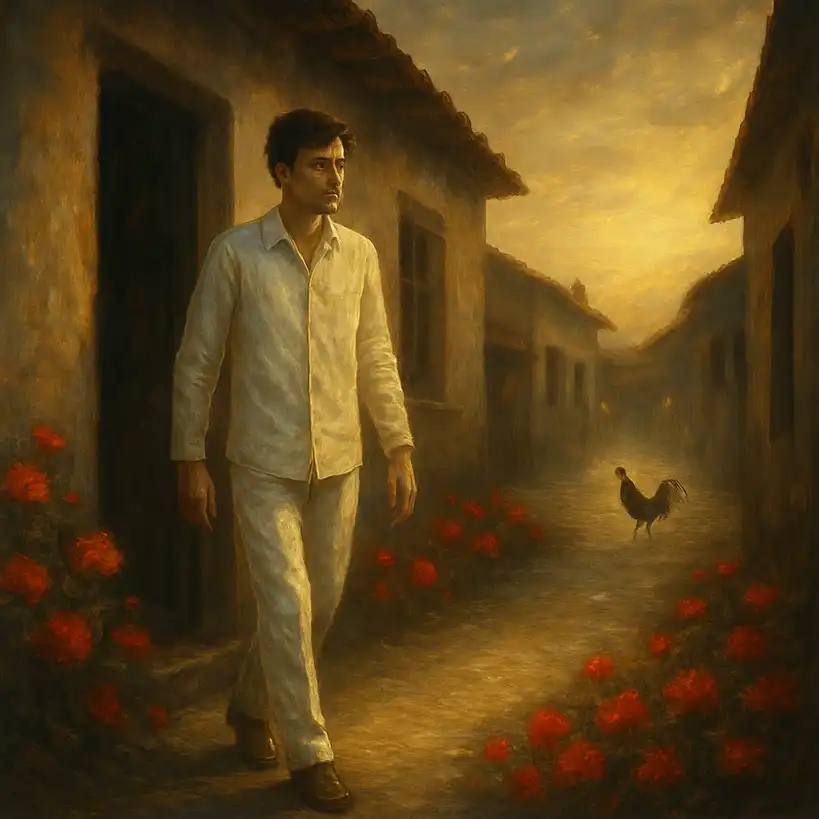
Honor’s weight in Chronicle of a Death Foretold
The murder is committed in the name of restoring a family’s honor, a concept so ingrained in the community that it overrides morality and law. Honor here is both sacred duty and lethal burden, dictating actions without room for doubt. It is this weight that turns the brothers into executioners, even against their own instincts.
The narrator’s investigation brings him to people whose inaction helped seal Santiago’s fate. Some claim disbelief; others insist it was not their place to interfere. In this silence, we hear echoes of 👉 A Happy Death by Albert Camus, where death is approached as a fact of life rather than an outrage to prevent.
Márquez uses small, seemingly mundane details to carry emotional heft, the smell of onions on the murderers’ hands, the sequence of Santiago’s last steps, the casual weather talk minutes before the killing. These fragments make the death intimate, almost unbearably close.
This chapter forces us to see honor not as an abstract ideal but as a social mechanism, one that can justify violence while erasing personal responsibility. It also makes clear that in this world, the boundaries between victim, culprit, and bystander are porous, and that the entire town carries the weight of the act.
Love tangled in duty
As the reconstruction deepens in Chronicle of a Death Foretold, the story widens to include the events leading to Santiago Nasar’s accusation. Angela Vicario, returned to her family on her wedding night, names Santiago as the man who took her virginity. Whether this is truth or a shield against greater shame remains uncertain, Gabriel García Márquez never resolves it, and the ambiguity is deliberate.
The cultural weight of a woman’s chastity in this small Colombian town is overwhelming. Marriage here is not only a personal union but a public contract, and its breach demands a reckoning. Angela’s brothers step into their role as avengers with reluctance, yet with absolute acceptance of their obligation.
This tension between love and duty adds another layer to the tragedy. Bayardo San Román, Angela’s wealthy suitor, returns her to her family without confrontation, a gesture as cold as it is dignified. Angela, for her part, grows more complex as the years pass, later admitting to a love for Bayardo that seems to have blossomed after the scandal.
In Chronicle of a Death Foretold, emotions are not static; they can be rewritten over time, memory reshaping not only facts but feelings. Love here is not an antidote to duty, it is another force capable of bending truth to fit the shape of survival.
A town’s complicity
By the time the brothers’ knives are sharpened in Chronicle of a Death Foretold, almost everyone knows what will happen. Shopkeepers, priests, neighbors, all hear the warnings. Some try to alert Santiago, others assume he’s been told already. This communal passivity becomes one of the novel’s most unsettling aspects.
Gabriel García Márquez paints the town as a living chorus, its voices blending into a single rhythm of inevitability. No single person delivers the fatal blow before the knives do; instead, it is the accumulation of small silences, polite hesitations, and misplaced assumptions that ensures the murder occurs.
This portrayal of communal guilt resonates with the social observations in 👉 Gabriela, Clove and Cinnamon by Jorge Amado, where the collective mood of a community shapes the fate of individuals as much as personal choice does. Both novels capture how gossip, norms, and quiet consent can harden into destiny.
The narrator notes inconsistencies in accounts: who saw Santiago last, what was said at the docks, whether he even understood he was in danger. In the novel, this uncertainty gives the crime an almost mythical quality, an event everyone remembers, yet no one can fully explain. The killing becomes less an act of two men and more the will of a town that, knowingly or not, allowed it to happen.

Fragments of a doomed morning
The day of the killing in Chronicle of a Death Foretold unfolds in overlapping fragments. Neighbors remember hearing Santiago’s mother call out to him, unaware she was locking the door against his escape. Friends recall seeing him laugh in the plaza, oblivious to the danger closing in. These shards of memory, told from different voices, build a chilling sense of inevitability.
What strikes me most is how ordinary life continues alongside the impending violence. Weddings are discussed, market stalls are opened, small disputes are settled, all while the knowledge of the murder hangs in the air. The author refuses to separate the tragedy from the mundane, showing how daily life absorbs even the gravest events.
In these recollections, the narrator pieces together Santiago’s final hours like a puzzle missing crucial edges. We know the image will be incomplete, yet the act of assembling it becomes its own form of witness. This echoes the slow, meticulous reconstructions found in 👉 In Cold Blood by Truman Capote, where a crime is both a factual event and an enduring social scar.
By the chapter’s end, it is impossible to see the murder as an isolated act. The book makes clear that the killing is stitched into the fabric of the town’s collective memory, and that fabric will never be whole again.
The role of the narrator
In Chronicle of a Death Foretold, the narrator is not a neutral observer. He returns to his hometown years later, carrying memories that bend the lens. His inquiry is personal, so every testimony he gathers is filtered through layered truth and partial recall. Because he knew many of the people involved, his questions sound like confessions, and his notes read like private history rather than a police file.
Contradictions pile up. One witness swears that warnings were loud; another insists that no one believed them. The narrator does not smooth these edges. He lets uncertainty stand, and in doing so he shows how community memory edits events to survive them. The truth becomes a mosaic that only looks whole from a distance.
In one telling moment, he considers whether his own actions might have prevented the killing. The doubt lingers, unspoken but palpable, reminding us that the line between witness and participant is thin. This perspective aligns with the moral tension in 👉 The House of the Spirits by Isabel Allende, where personal history is inseparable from public events.
By revealing the narrator’s connection to the tragedy, Chronicle of a Death Foretold transforms from a cold reconstruction into a deeply human confession. We are not just hearing about a death; we are hearing about a man’s lifelong reckoning with it.

Memorable Quotes from Chronicle of a Death Foretold by Gabriel García Márquez
- “On the day they were going to kill him, Santiago Nasar got up at five-thirty in the morning.” This iconic opening sets the tone for the novel, laying bare the inevitability of the tragedy and inviting the reader into a story where the ending is already known.
- “The truth is that they all knew he was going to be killed.” A stark acknowledgment of communal complicity, this line captures the moral heart of Chronicle of a Death Foretold, where silence becomes as lethal as the act itself.
- “Honor doesn’t wait.” This phrase crystallizes the cultural codes that drive the killing, showing how duty can override compassion, reason, and even justice.
- “Fatality makes us invisible.” Here, Gabriel García Márquez distills the paralyzing force of inevitability, how knowing the outcome can render action unthinkable.
- “The smell of closed-in flowers had penetrated everything.” A sensory detail that turns the reader’s focus to the intimate texture of grief and death, making the loss tangible.
- “There had never been a death more foretold.” This meta-commentary reinforces the structure of the novel: a story whose power lies not in surprise but in the slow unveiling of inevitable events.
- “We all remembered him as he was that morning: dressed in white linen and carrying his own fate.” This image turns Santiago into a symbol, his innocence or guilt less important than the role he plays in the town’s shared memory.
Trivia Facts from Chronicle of a Death Foretold
- Rooted in real events: Chronicle of a Death Foretold is inspired by the 1951 killing of Cayetano Gentile Chimento in Sucre, Colombia. Márquez knew people involved in the case, which gave the novel its distinctive authenticity. The real story has been documented extensively by 🌐El Espectador in retrospective features.
- A deceptively small cast: Although the novel features dozens of named characters, the story revolves around a tight circle whose choices, or lack thereof, directly lead to the killing.
- Communal complicity: The novel examines how silence and hesitation make a town collectively responsible for a murder. This theme closely parallels 👉 The Lost Honor of Katharina Blum by Heinrich Böll, where public perception and gossip shape reputations and fates.
- Critical acclaim and controversy: Upon its release in 1981, the book received international praise but also criticism in Colombia, where some felt the writer exposed too much of local culture’s darker side.
- Compressed but layered: At fewer than 130 pages, the book delivers a narrative as rich as a full-length novel. Critics have noted in 🌐The New York Times that its brevity heightens its moral intensity, forcing every scene to bear weight.
- Honor as a social script: The brothers’ actions follow an unwritten law that honor must be restored at any cost. A similar examination of rigid codes appears in 👉 The Time of the Hero by Mario Vargas Llosa, set in a Peruvian military academy.
- Enduring classroom presence: Decades after publication, Chronicle of a Death Foretold remains a staple in world literature curricula for its unique mix of cultural anthropology, moral inquiry, and narrative experimentation.
Aftermath in the shadows
The killing in Chronicle of a Death Foretold leaves a residue of violence that clings to streets, doorways, and family tables. The Vicario brothers, though acquitted, walk under a cloud of notoriety. Angela Vicario, once shamed, writes letters for years, and that persistent tenderness becomes unexpected resilience. Her life bends, then steadies.
Márquez shows how the murder shapes not just the living but the town’s very identity. Conversations still circle back to that day, each retelling sharpening some details while blurring others. It’s as though the event has become a local myth, one in which truth matters less than the shared act of remembering.
Through this, this work underlines the persistence of unhealed wounds. The crime’s legacy is not justice or closure, but a lingering unease that colors every interaction. The killing may have ended in minutes, yet its echo has no end.
Justice without resolution
In Chronicle of a Death Foretold, the legal process resembles a ritual of law. Witnesses speak, documents stack up, verdicts arrive. Yet what the town wants most, verdict without truth, is impossible. The ceremony acknowledges harm, but it cannot repair collective failure.
Testimony contradicts testimony. Motives dissolve under scrutiny. The court records feel orderly, but the moral record remains scattered. This uneasy gap mirrors the absurd drift in 👉 The Trial by Franz Kafka, where procedures without clarity produce movement without meaning. Here, too, justice explains little and resolves less.
By the closing pages, the reader understands that the book is not about solving a mystery but about witnessing how a community absorbs, and sometimes enables, its own tragedies. The murder is retold so many times that it becomes both more vivid and more uncertain, a paradox only Gabriel García Márquez could render so naturally.
The story ends not with moral clarity but with the weight of inevitability. Like the townspeople, we are left to carry the knowledge of what happened, and the quieter, more troubling knowledge of how easily it could have been prevented.