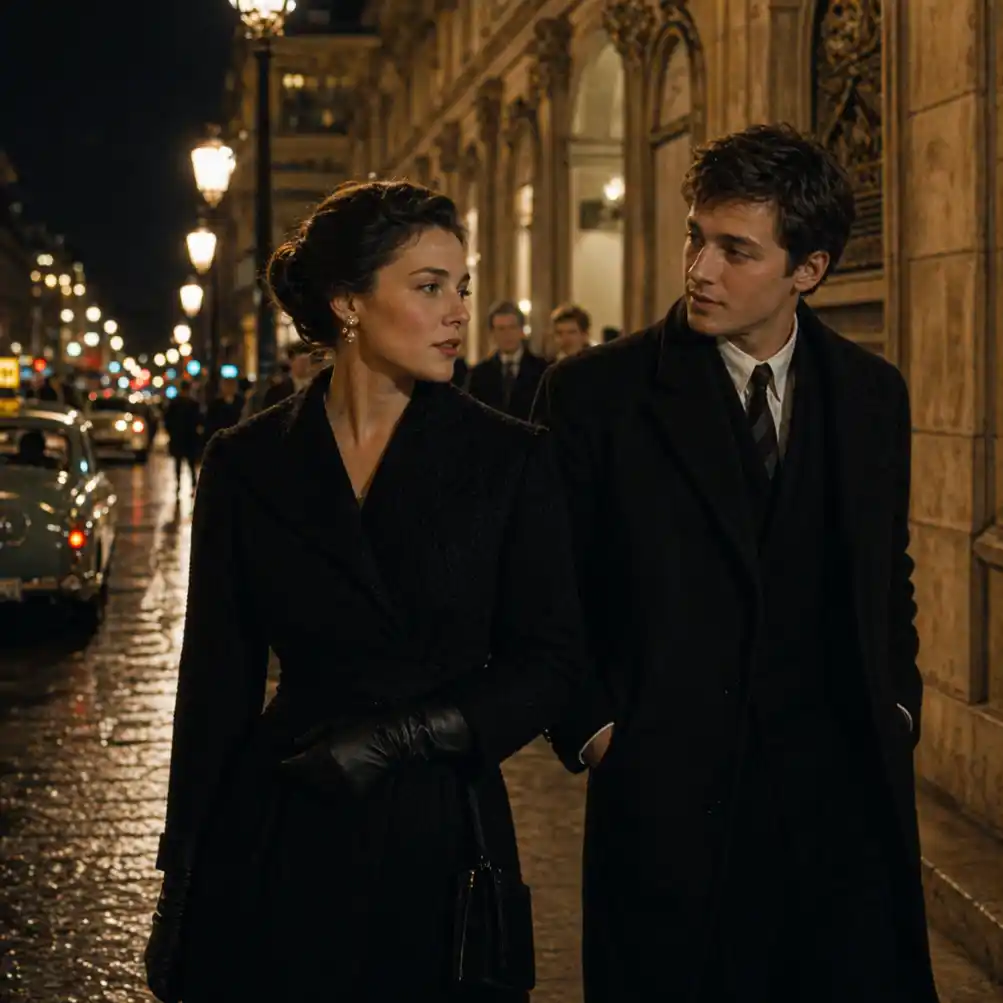
That Mad Ache by Françoise Sagan: Love and Surrender
At the beginning of That Mad Ache (La Chamade), Lucile lives with Charles, a wealthy man nearly twenty years older than she is. She has no profession, timetable, or financial anxiety. Charles gives her money, clothes, travel, and considerable personal freedom. He understands that possession would destroy much of what attracts him to her. Françoise Sagan avoids presenting Lucile as an innocent prisoner in a gilded cage. She enjoys luxury and has consciously organized her life around pleasure. Dependence feels liberating when it removes obligation. Charles rarely demands explanations, and Lucile experiences his generosity as the absence of pressure.
Yet her freedom remains conditional. She can move through Paris, attend parties, drink, drive, and pursue brief affairs because somebody else pays for the structure supporting those choices. The arrangement protects her from work while making independence difficult to test.
A darker culture of money and emotional vacancy shapes 👉 Less Than Zero by Bret Easton Ellis. Ellis portrays privilege as a system that deadens young people. She gives pleasure more genuine value, but she also asks whether comfort can preserve a personality by preventing it from developing.
Lucile is sincere even when she deceives herself. She does not claim to possess ambitions that she lacks. She loves being alive, yet she prefers existence without a defined purpose. That Mad Ache therefore begins with an arrangement that works. Its instability appears only when passionate love demands that Lucile turn freedom into responsibility.

Antoine Makes Desire Demand a Decision
Lucile meets Antoine through the social circle surrounding Charles. Antoine is close to her age, works in publishing, and maintains a relationship with Diane, an older, affluent woman. Their positions appear almost symmetrical. Each younger lover receives access to a world of money and cultivated leisure.
Their attraction disrupts that symmetry. Lucile and Antoine recognize a shared energy that feels spontaneous beside their established relationships. They laugh together, seek private meetings, and quickly become lovers. Passion gives Lucile a sense of necessity.
Desire and unequal wealth also structure 👉 The Lover by Marguerite Duras. Duras binds erotic intimacy to race, colonial power, memory, and money. The writer works within a narrower Parisian environment, but she similarly refuses to isolate love from the material conditions that permit it.
Antoine soon rejects the divided arrangement. He ends his relationship with Diane and expects Lucile to leave Charles. His demand appears morally direct. If their love is genuine, it should become their principal reality. Lucile hesitates. Charles’s delayed return from a journey suddenly makes her imagine his death. Her relief when he arrives exposes an attachment that cannot be dismissed as financial calculation. She may not love him with Antoine’s intensity, but Charles belongs to the continuity of her life.
Antoine wants love to reorganize everything. Lucile wants passion without the destruction of every earlier bond. That difference will shape their relationship long after she finally chooses him. In That Mad Ache, falling in love occurs rapidly. Building a life from that feeling proves far more difficult.
Charles Complicates the Morality of Possession – That Mad Ache
A simpler novel could make Charles selfish, controlling, or ridiculous. His wealth would then become the obvious obstacle to authentic love. The novelist instead makes him perceptive, patient, and painfully aware that Lucile cannot be secured through authority. When she leaves, Charles suffers without turning suffering into punishment. He warns her that Antoine may eventually resent the qualities he currently adores. Charles understands that Lucile’s idleness is not a temporary defect waiting for reform. His acceptance contains love and resignation.
The emotional and intellectual conflicts of postwar Paris acquire a broader political scale in 👉 The Mandarins by Simone de Beauvoir. Beauvoir’s characters debate responsibility and commitment openly. Her characters live those questions through domestic arrangements, money, and evasive conversations.
Charles’s generosity is not ethically neutral. It allows him to keep Lucile close while removing the ordinary conflicts that might force her to define herself. He does not command her, but his resources create a world to which Antoine cannot offer an equivalent.
Still, Charles sees Lucile more clearly than Antoine does. Antoine imagines that love will awaken her appetite for work, shared sacrifice, and conventional domestic progress. Charles recognizes that her deepest loyalty may be to unstructured time.
Understanding another person can preserve dependence. Charles’s kindness makes departure harder because Lucile cannot convert him into an enemy. When she asks him for help later, he responds without using her vulnerability to demand immediate repayment. That Mad Ache refuses to decide that the poorer lover represents truth while the richer lover represents corruption. Each man offers a different form of love, and each form carries a different pressure.
Shared Poverty Changes the Meaning of Time
Lucile eventually leaves Charles and moves into Antoine’s modest apartment. Their first period together appears to vindicate the decision. Desire fills their restricted space, and freedom from the old relationships creates a thrilling sense of beginning again.
The difficulties arrive when Antoine returns to work. Lucile now spends long hours waiting. Under Charles’s protection, idleness felt expansive because money provided cars, restaurants, travel, and constant variation. Without those resources, the same idleness becomes confinement.
Memory transforms passing time in 👉 In Search of Lost Time by Marcel Proust. Proust’s narrator discovers that inner experience can enlarge apparently ordinary moments. Lucile possesses no comparable vocation for memory or art. She seeks sensation in the present and suffers when the present offers only waiting.
Poverty does not destroy love by itself. The deeper problem is that Antoine expects their life together to generate new habits. He assumes Lucile will adapt because passion has already proved strong enough to make her leave Charles. She experiences that expectation as a gradual removal of the person he claimed to love. The woman who attracted Antoine was idle, impulsive, and attached to pleasure. Once they share a household, those qualities become practical burdens.
That Mad Ache (La Chamade) makes daily time the true test of passion. Extraordinary afternoons cannot organize every morning, expense, and absence. Love changes when it becomes a schedule. Antoine continues to feel deeply, but feeling no longer protects either lover from irritation. Their economic life exposes assumptions that desire allowed them to postpone.
Work Becomes a Test Lucile Never Chose
Antoine helps Lucile obtain a minor position at a publication. He sees employment as a practical necessity and perhaps as a route toward greater independence. Lucile initially tries to accept the new routine, but the work offers her neither meaning nor pride. She dislikes the fixed hours, repetitive duties, and expectation that she should be grateful for usefulness. Eventually she stops going while allowing Antoine to believe that she remains employed. Her lie protects idleness and postpones conflict.
It would be easy to treat this failure as proof of simple selfishness. Yet she complicates the judgment. Lucile has never claimed that professional achievement would fulfill her. Employment gives her an income, but it also subjects her time to an institution whose values she does not share.
Rachel’s movement toward adult experience in 👉 The Voyage Out by Virginia Woolf illuminates a revealing contrast. Woolf’s heroine searches for a self beyond inherited domestic expectations. Lucile resists both conventional domesticity and the modern demand that paid work must provide identity.
Antoine’s frustration is nevertheless justified. Their shared life cannot rest permanently on his income while she rejects every compromise. He asks her to participate in sustaining what they chose together.
Freedom becomes unequal when somebody finances it. That was already true with Charles, but his wealth made the imbalance comfortable. Antoine’s limited means make the same structure visible. In That Mad Ache, work does not automatically liberate Lucile. It reveals that she wants autonomy without the discipline normally required to maintain it. The author neither celebrates nor excuses that contradiction. She lets it become the central fact of Lucile’s character.
Pregnancy Turns Lifestyle Into Consequence
Lucile’s pregnancy brings the relationship into a crisis that passion cannot soften. Antoine sees the child as part of their possible future. A larger apartment and a more conventional family life begin to appear imaginable to him. Lucile reacts differently. She does not want motherhood, and she refuses to allow the pregnancy to define the rest of her life. The child means continuity to Antoine and enclosure to Lucile.
Her decision to have an abortion asserts bodily autonomy, but it also exposes her material vulnerability. She needs money and turns to Charles for assistance. The former lover becomes the person capable of financing her escape from a future with Antoine.
Charles helps without forcing Lucile to return immediately. His intervention demonstrates kindness, yet it also proves that she has never fully left the system of protection he created. Antoine may possess her passionate love, but Charles retains the power to solve the crisis.
That Mad Ache appeared in 1965, when abortion remained illegal in France except under limited circumstances. The journey to a Swiss clinic therefore carries social and legal pressure beyond the lovers’ private disagreement. Lucile’s decision is not an abstract declaration of independence. It requires money, secrecy, travel, and another person’s cooperation. The body ends the fantasy of consequence-free love. Antoine must confront a future that Lucile does not share, while Lucile recognizes how quickly intimacy can create obligations she never wanted.
Their relationship survives the procedure physically but loses part of its imaginative momentum. The life Antoine envisioned has been refused. Lucile has defended her freedom, although doing so has drawn her back toward Charles. The writer offers no sentimental punishment for the abortion. The emotional rupture arises from incompatible futures, not from a moral verdict imposed upon Lucile.
She Follows Thought Before It Becomes Honesty
The narrative remains close to Lucile while refusing to make her a reliable interpreter of herself. Her thoughts move through excitement, fear, tenderness, irritation, and self-justification. A decision may feel absolute until a new sensation changes its emotional value.
Lucile’s inconsistency is the novel’s method. She does not expose one hidden motive that explains every choice. Money matters, but so do affection, boredom, sexual desire, fear of death, and resistance to being remade. Her sentences frequently extend through qualifications and reversals. A character recognizes one truth, weakens it, invents an excuse, and then reaches an insight that may itself disappear. This psychological movement gives That Mad Ache more depth than its compact romantic plot suggests.
Its place within french literature depends partly on this cool examination of apparently frivolous lives. The novelist writes about fashionable parties, expensive cars, alcohol, coastal holidays, and private apartments without treating elegance as either moral achievement or sufficient evidence of emptiness.
Irony does not cancel tenderness. Lucile can behave badly while remaining emotionally vivid. Antoine can demand too much while loving her sincerely. Charles can be generous while benefiting from dependence. Her restraint also protects the novel from melodrama. Major changes occur through conversations, departures, payments, and alterations in routine. The lovers do not need grand declarations because their material choices reveal what their language tries to conceal.
That Mad Ache understands self-knowledge as temporary. Lucile occasionally sees the full cost of her life, but recognition does not guarantee transformation. An insight can be accurate and still fail to become a lasting principle.
Freedom, Jealousy, and Solitude: Quotes from That Mad Ache
- “Nothing brings on jealousy like laughter.” Laughter creates an intimacy that excludes the observer. Jealousy begins with the suspicion that someone else possesses a private route to happiness. 🌐 Quote
- “He knew this euphoria of hers: it was the euphoria of being alone.” Lucile’s solitude is not automatically loneliness. It becomes one of the freedoms that neither lover fully understands. 🌐 Quote source
- “Her utter lack of self-importance made her passionate. In a word, she was happy.” Happiness comes when Lucile avoids defining herself. The same absence of commitment later makes lasting intimacy nearly impossible.
- “The number of times she’d said ‘wait and see’ to herself in her thirty years of existence was way beyond counting.” Delay is Lucile’s preferred defense against consequence. By refusing decisions, she allows circumstances and other people to decide for her.
- “She wasn’t a courtesan, nor an intellectual, nor the mother of a family—she was nothing at all.” The sentence can sound liberating or devastating. Lucile escapes prescribed roles but has constructed no positive identity beyond escape.
- “Thirty-year-old children who refused to act like grown-ups.” She compresses the novel’s criticism into one unforgiving phrase. Privilege permits prolonged adolescence, but it cannot prevent emotional damage.
A Heartbeat of Surrender: Facts About That Mad Ache (La Chamade)
- Published the novel in 1965: Julliard released That Mad Ache eleven years after Bonjour Tristesse made her internationally famous. Lucile’s elegant inertia revisits the author’s fascination with pleasure, freedom, and emotional irresponsibility. 🌐 Bibliographic record
- Its title contains two opposing sensations: A chamade was a drum or trumpet signal requesting negotiations or surrender. In the French expression avoir le cœur qui bat la chamade, however, it describes a heart racing through love, fear, or excitement. 🌐 Expression and history
- The first translation retained the French title: Robert Westhoff translated the novel as La Chamade in 1966. Westhoff, her former husband, therefore became one of the earliest interpreters of her distinctive English voice.
- A later translator renamed it That Mad Ache: Douglas Hofstadter’s 2009 translation accompanies the novel with Translator, Trader, an essay examining translation as creative negotiation rather than mechanical substitution. 🌐 Basic Books
- The love triangle is also an economic experiment: Lucile abandons the wealthy, tolerant Charles for the younger Antoine, but employment and material restriction make passion feel like another form of captivity.
- The seasons chart Lucile’s failed transformation: Spring, summer, and autumn carry the affair from awakening through intensity to exhaustion. By the February epilogue, surrender has replaced emotional growth. 🌐 Contemporary review
- Lucile refuses every stable social identity: She is neither professional, mother, intellectual, nor conventional courtesan. Her resistance to definition creates an illuminating counterpart to the self-liberation pursued in 👉 The Immoralist by André Gide.
- The film became entangled with May 1968: Alain Cavalier’s adaptation starred Catherine Deneuve, Michel Piccoli, and Roger Van Hool. Production was interrupted by the French strikes, while Yves Saint Laurent’s costumes transformed Lucile’s luxury into visual characterization. 🌐 Yves Saint Laurent Museum
The Title Joins Heartbeat and Surrender
The word chamade holds two related meanings. It describes the rapid beating of an excited heart, but it also recalls the drum or trumpet signal by which a besieged force announced its wish to negotiate or surrender.
Both meanings govern the novel. Lucile’s heart responds to Antoine with an intensity absent from her relationship with Charles. Passion sounds like an alarm, interrupting the protected life she had treated as complete. Yet the heartbeat also announces defeat. Desire begins the surrender it cannot control. Lucile gives up security for Antoine, Antoine gives up his image of effortless love, and Charles accepts humiliation while waiting for the possibility of return.
The English translation history makes the ambiguity especially visible. An earlier version retained La Chamade, while Douglas Hofstadter later chose That Mad Ache. The translated title emphasizes longing and pain, but the French word preserves the military association with capitulation.
No character wins cleanly. Antoine receives Lucile and then discovers that shared love cannot make her desire his form of adulthood. Charles loses her but remains indispensable. Lucile escapes one arrangement only to learn that the alternative requires changes she cannot sustain. Every liberation contains another dependence. Money, desire, work, and bodily consequence keep reorganizing the apparent balance of power.
The title therefore describes more than romantic excitement. It identifies the instant when emotional intensity becomes an admission that resistance is failing. In That Mad Ache, the heart does not merely beat faster because it has found love. It signals that the self is about to yield something whose value it understands only afterward.
Lucile Returns Without Recovering Innocence in That Mad Ache
After the abortion, Lucile resumes contact with Charles. A concert and a night together restore the ease of their former intimacy. The return is not presented as a sudden revelation that Antoine never mattered. Lucile still loves him, but she no longer believes that love can support the life he wants.
She ends the relationship and goes back to Charles. Comfort wins because it asks less transformation. Charles offers the freedom to remain recognizably herself, even when that freedom depends upon his wealth.
Lucile’s choice recalls the existential loneliness surrounding Macabéa in 👉 The Hour of the Star by Clarice Lispector. Lispector portrays a woman almost entirely excluded from comfort and self-definition. She examines a privileged opposite whose many choices do not produce a stable identity. Both novels distrust the assumption that society can easily explain what a woman’s life should become.
The later marriage between Lucile and Charles supplies social form, but it does not erase the cost of her return. Antoine represented the possibility of a life based on shared passion, work, and consequence. Lucile rejects that possibility because accepting it would require her to become someone she does not want to be.
Self-acceptance can resemble defeat. She has defended her nature, yet she also recognizes that the defense may have excluded her from a more substantial existence. That Mad Ache closes without turning Lucile into either a triumphant nonconformist or a punished materialist. Her return is a choice, a retreat, and an honest admission of limitation. The heart has sounded its surrender. What remains is the quieter life that passion interrupted but could not replace.
More reviews of works by the famous french author