Mordshunger by Frank Schätzing
Mordshunger begins with the death of Inka von Barneck, a wealthy woman found with her throat cut in her Cologne apartment. Her money, sexual relationships, cocaine use, and hostile behavior have created an unusually generous field of suspects.
Frank Schätzing does not ask the police to discover who could have wanted Inka dead. Almost everyone surrounding her possesses some combination of resentment, fear, greed, or humiliation. The abundance of motives becomes the first mystery. Her husband Fritz von Barneck attracts immediate suspicion. Yet Inka’s daughter, lover, employees, and business associates also have reasons to conceal information. The investigation keeps producing testimony that looks decisive until another detail changes its meaning.
A similarly unpopular victim organizes 👉 The Murder of Roger Ackroyd by Agatha Christie. Christie builds an economical village puzzle whose narration controls access to truth. The writer creates a louder and more expansive social comedy, but both books understand that many plausible motives can make the obvious suspect less useful.
Inka remains powerful after death. The surviving characters continue reacting to the desires and conflicts she created. Their attempts to manage her memory reveal as much as the physical evidence. From its opening crime, Mordshunger treats murder as the final course in a culture of excessive appetite. Inka wanted pleasure without restraint. Others wanted her money, freedom, body, or disappearance. The police must discover which hunger became action.
Romanus Cüpper Investigates Through Appetite
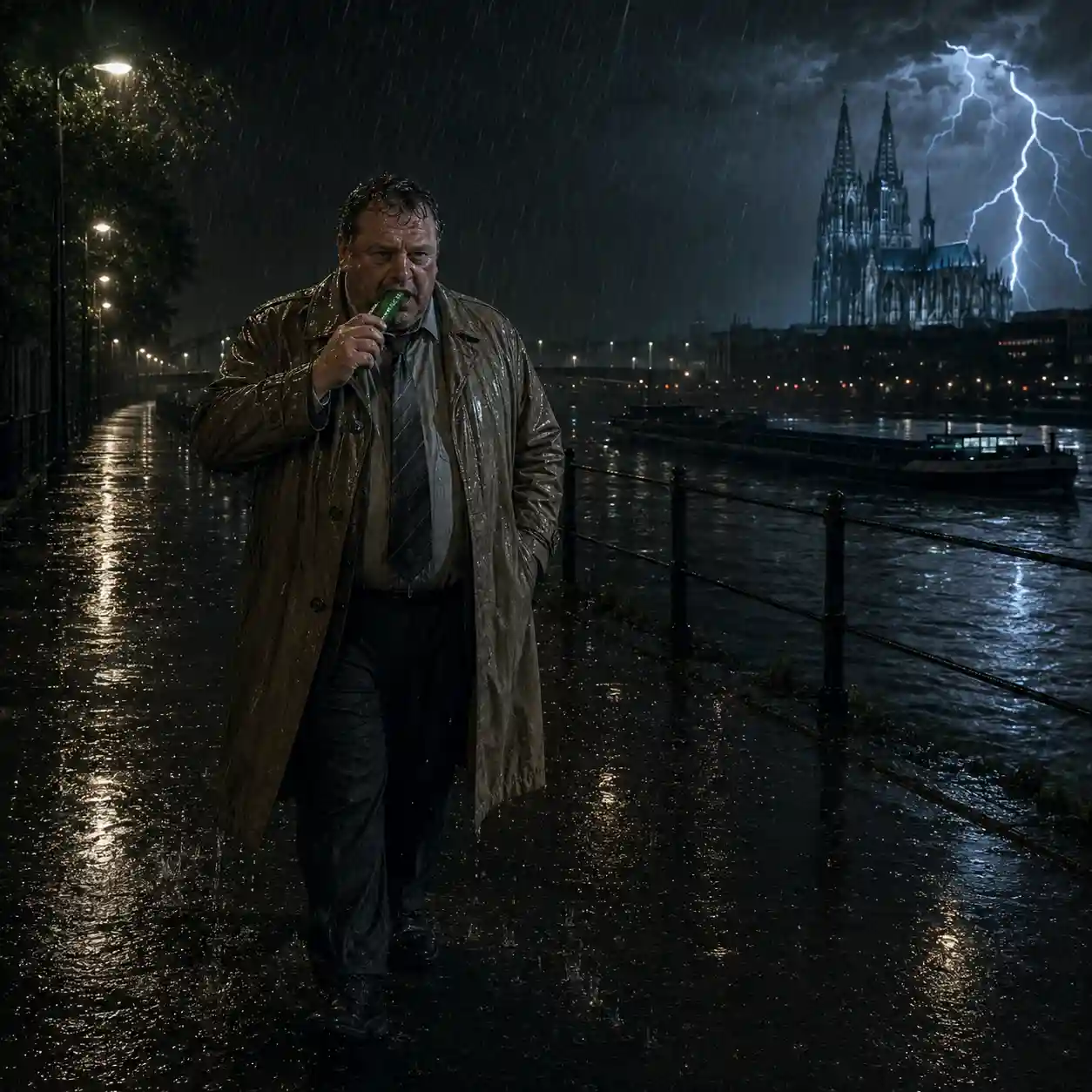
Commissioner Romanus Cüpper approaches police work with experience, curiosity, and an almost inexhaustible interest in food. He does not merely eat between investigative scenes. Restaurants, ingredients, cooking, and taste shape how he observes the world. Cüpper’s appetite makes him comic, but it also gives him a practical method. Cooking trains attention toward proportions and small components. An ingredient that seems minor can alter an entire dish, just as an overlooked contradiction can reorganize a case.
Atmosphere becomes evidence in 👉 The Hound of the Baskervilles by Arthur Conan Doyle. Holmes separates material clues from a legend designed to inspire fear. Cüpper works in a more playful register, but he similarly distrusts the story a crime scene appears to tell.
Pleasure sharpens rather than weakens his attention. Cüpper’s meals provide pauses in which competing explanations can settle into patterns. His gourmand identity also distinguishes him from detectives whose personal damage is treated as proof of seriousness. The comedy does not make him incompetent. He recognizes when testimony contains too much precision, when an alibi seems unnecessarily elaborate, and when appearances have been consciously arranged.
In Mordshunger, investigation resembles a recipe whose ingredients arrive in the wrong order. Motives are abundant, identities overlap, and witnesses contribute facts without understanding the finished structure. Cüpper tastes before he accepts. That principle applies equally to sauces and explanations. He knows that something impressive can still conceal an imbalance.
Rabenhorst Gives the Detective a Counterweight
Jan Rabenhorst works beside Cüpper and gives the investigation an essential second rhythm. Where Cüpper brings appetite, culture, and expansive speculation, Rabenhorst often supplies a more practical response. Their partnership allows him to externalize reasoning. Cüpper can test a theory through conversation instead of delivering long private explanations. Rabenhorst questions assumptions, reacts to eccentric suspects, and keeps the case connected to ordinary police procedure.
A past crime reopens through unexpected communication in 👉 Tell No One by Harlan Coben. Coben accelerates uncertainty through personal urgency. The author relies more heavily on comic dialogue and social observation, yet both stories repeatedly transform apparently settled evidence.
The detectives rarely control the pace completely. New statements, deaths, and revelations force them to revise the map of relationships around Inka. Their most useful skill is not immediate brilliance but the willingness to abandon an attractive explanation.
Rabenhorst also prevents Cüpper’s culinary interests from becoming a decorative joke detached from the case. The contrast between them keeps returning the commissioner’s preferences to the pressures of shared work. Mordshunger values the detective pair because truth requires more than one temperament. Cüpper notices patterns through association and taste. Rabenhorst tests whether those patterns can survive direct questioning.
Partnership turns intuition into evidence. Neither man needs to become the other. Their different habits create productive friction while the suspects attempt to exploit every gap in the investigation. The result is a procedural structure flexible enough to support comedy without abandoning the murder mystery.
The Twin Problem Makes Identity Unreliable in Mordshunger
The case becomes more complicated when Max Hartmann enters it. He is Fritz von Barneck’s identical twin and physical double. His existence disrupts witness testimony, chronology, and the apparent security of an alibi. A person seen near the crime may be Fritz or Max. A statement about one brother can redirect suspicion toward the other. Two bodies create one unstable identity.
The problem is not merely visual. Max is connected with acting and hungers for the role that might transform his life. Performance therefore becomes part of the mystery’s language. Resemblance provides the material, but ambition supplies reasons to use it.
Corporate identity becomes another instrument of control in 👉 The Firm by John Grisham. Grisham’s institution hides criminal purpose beneath professional respectability. He concentrates deception around two matching faces, showing how social confidence depends on the assumption that appearance establishes identity.
The twin device openly embraces the artificiality of classical mystery construction. Rather than hiding the improbability, Mordshunger turns it into comedy. Witnesses become certain about what they saw precisely when certainty is least reliable. An alibi can multiply suspicion. Conflicting accounts do not simply cancel one another. They suggest that somebody has designed the confusion.
The brothers also sharpen the novel’s interest in hunger. Fritz wants money and control. Max wants recognition and a defining performance. Their shared appearance conceals different appetites. Cüpper must determine not only where each man was, but which identity every observer believed they encountered. The murder becomes a theatrical production whose casting remains dangerously uncertain.
Cologne Is More Than a Decorative Location
Cologne gives Mordshunger its social scale, humor, and movement. Luxury apartments, police offices, restaurants, streets, the Rhine, and the zoo form a city that feels inhabited rather than added as regional scenery. The novelist knows the city’s habits and contradictions. Wealth exists beside casual disorder. Sophisticated dining coexists with earthy humor. Characters move between business, nightlife, domestic conflict, and public spaces without leaving the distinct atmosphere of Cologne.
Documentary detail gives violence a different geographic force in 👉 In Cold Blood by Truman Capote. Capote reconstructs a Kansas community transformed by real murder. His crime is fictional and deliberately playful, but both books use place to connect private violence with a wider network of routines.
The city supplies the novel’s appetite. Cologne eats, drinks, performs, bargains, gossips, and converts scandal into entertainment. Cüpper belongs to this environment because his curiosity about food is also curiosity about people.
The local setting supports satire without reducing the book to affectionate tourism. Restaurants reveal status and taste. Business relationships expose greed. The zoo introduces an animal hunger that eventually becomes more than a running joke.
Mordshunger helped establish the modern Cologne crime novel as a recognizable regional form. Its city is specific enough to guide the plot while remaining legible to readers who have never visited it. Local detail organizes the deception. Routes, meeting places, and social familiarity affect who can be seen, believed, or mistaken for somebody else. Cologne does not merely host the mystery. It helps make the mystery possible.
Food Changes the Tone of Violence
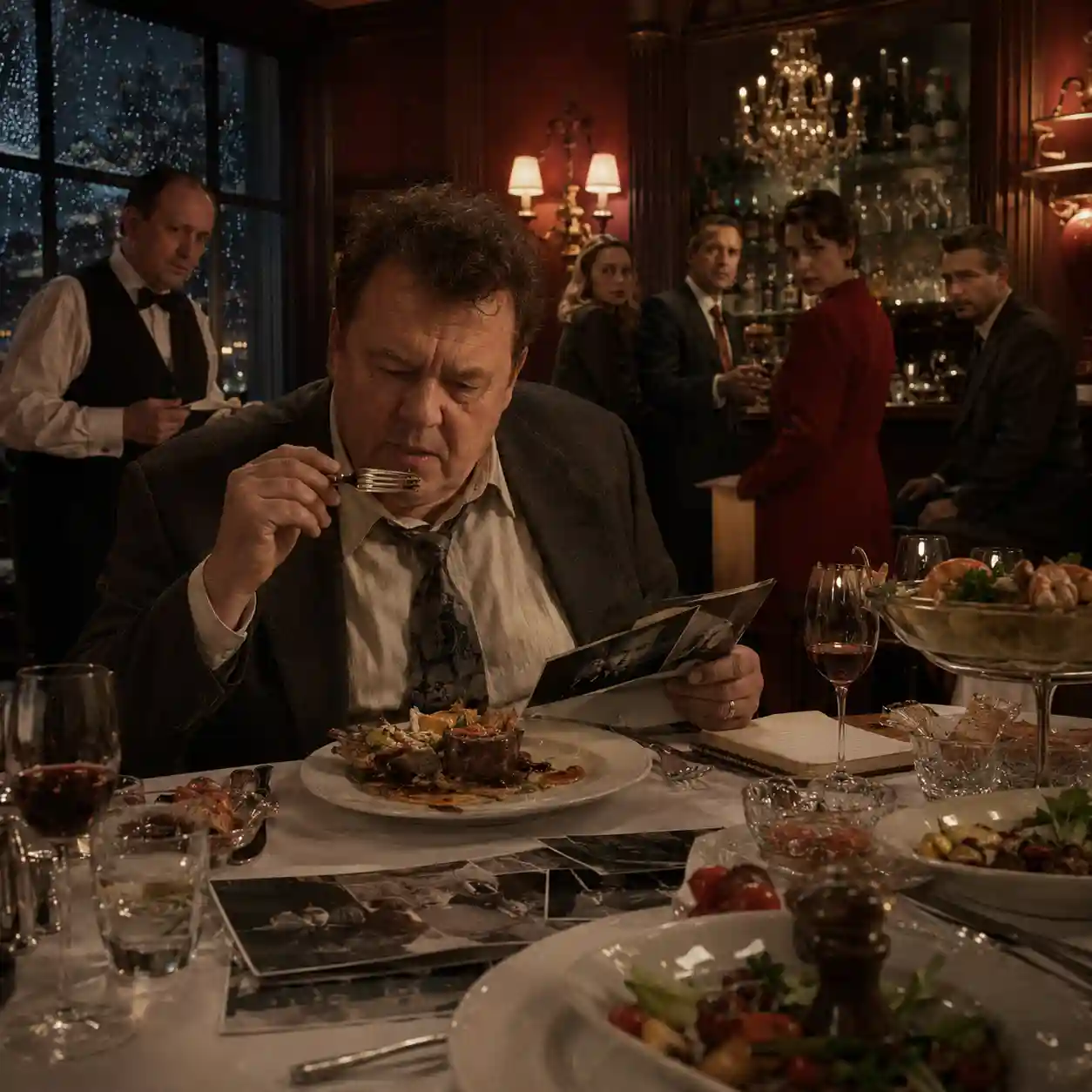
The culinary material in Mordshunger could have become a novelty attached to an otherwise conventional crime story. Instead, it shapes the novel’s balance between death and pleasure.
Cüpper eats because food offers knowledge, comfort, craft, and temporary order. A meal has structure even when the investigation does not. Ingredients can be combined deliberately, while human motives resist comparable control. Cooking becomes the detective’s rival art. Both activities require timing, patience, judgment, and sensitivity to what does not belong.
The editions containing recipes extend this principle beyond the narrative. Cologne chefs contributed dishes, and he added a favorite recipe of his own. The book can therefore move from fictional restaurants into the reader’s kitchen. That playfulness does not remove the darker implications of appetite. Inka’s desires involve sex, cocaine, attention, and power. Fritz wants wealth. Max wants professional transformation. The zoo’s lions want a break from routine. Each hunger seeks an object.
Mordshunger distinguishes Cüpper because his desire is creative rather than purely acquisitive. He prepares, tastes, shares, and appreciates. Food connects him with the world instead of reducing other people to instruments. Appetite reveals character through its limits. Wanting is not inherently destructive. The danger begins when desire treats every obstacle as something to consume.
The repeated movement between murder and meals may unsettle readers who expect a darker procedural tone. Yet the contrast belongs to the novel’s moral design. Death occurs within a world that continues cooking, eating, and enjoying itself. Cüpper solves crimes without pretending that seriousness requires hostility toward pleasure.
Red Herrings Become a Comic Performance
The writer constructs the investigation through repeated reversals. A convincing witness statement collides with reconstructed evidence. One principal suspect becomes another victim. Another possesses an alibi that appears too strong to challenge.
The accumulation can feel deliberately artificial. Mordshunger is less interested in naturalistic restraint than in the pleasure of watching a complicated mechanism operate. Each solution creates a new impossibility. Short sentences and energetic dialogue keep the machinery moving. He completed the original manuscript in 1991, although it appeared after his historical novel Tod und Teufel. He later revised the crime novel carefully, updating several gastronomic locations while retaining its early 1990s world.
This position within deutsche literatur is especially interesting beside the immense scientific and geopolitical thrillers that later made him internationally famous. The early work already shows his appetite for research, systems, rapid shifts, and spectacular endings, but it applies them to a lighter regional mystery.
The young novelist enjoys visible construction. Twins, theatrical ambition, contradictory alibis, organized greed, and hungry animals all enter the same plot without apologizing for their improbability. The red herrings work best when they emerge from character. People lie because they want money, protection, sex, professional advancement, or distance from Inka. Even misleading evidence belongs to a social appetite.
Readers seeking austere realism may find the design excessive. Those who accept its comic contract can enjoy how confidently the author keeps changing the apparent answer. Mordshunger treats mystery as performance. The author shows enough of the machinery to make its audacity part of the entertainment.
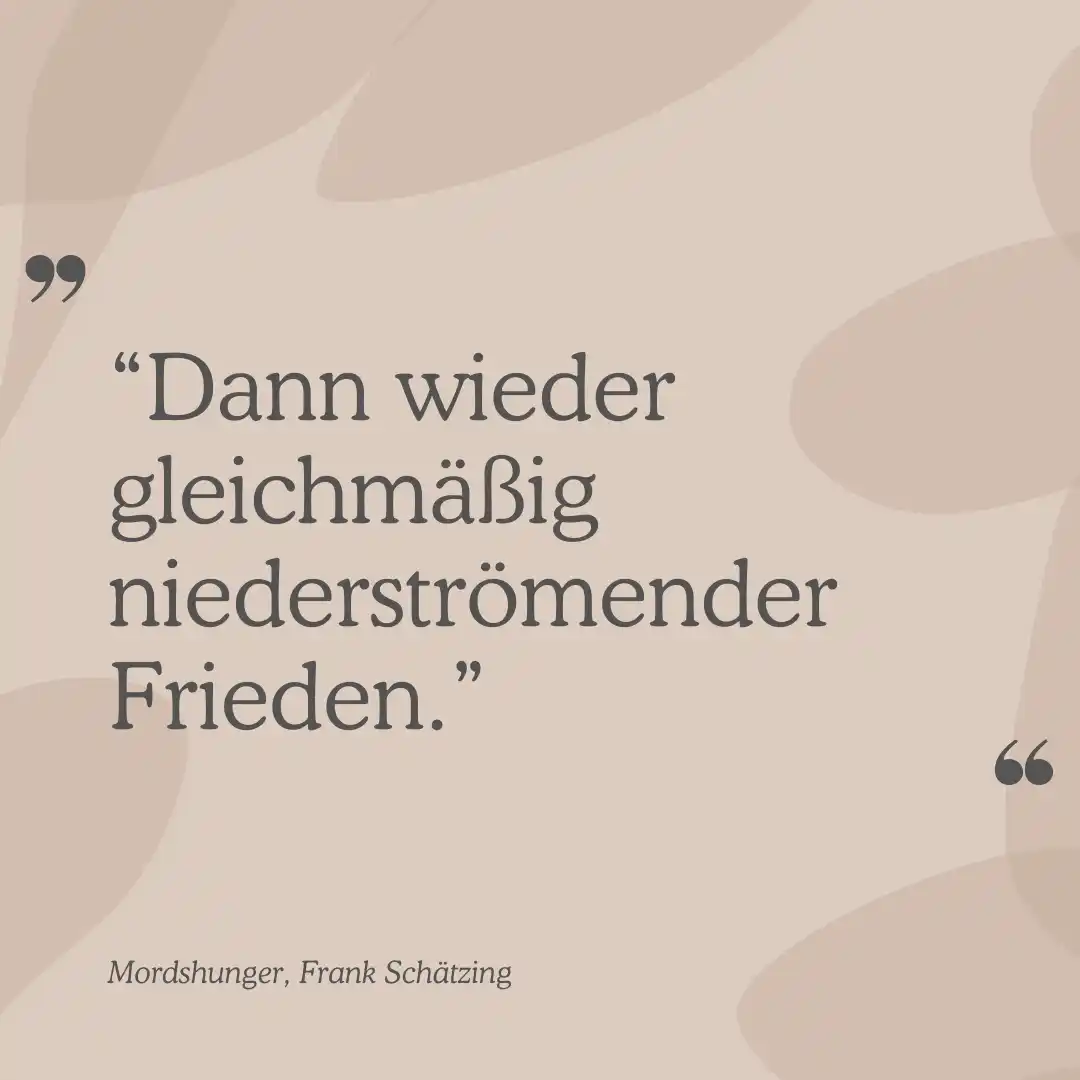
Loss, Appetite, and Dark Comedy: Lines from Mordshunger
The quotations remain in German because I could not verify an official English translation.
- “Ein guter Kriminalist wird verlassen.” Cüpper converts romantic failure into a theory of professional excellence. His reasoning protects his pride while revealing how badly the separation hurts.
- “Es hatte keine Zeit.” This abrupt reply destroys Cüpper’s elaborate fantasy that everything can wait. Schätzing turns timing itself into a compact punchline.
- “Nichts gehörte ihm.” The emptied apartment makes emotional loss physically visible. Cüpper suddenly measures his relationship through everything that has disappeared.
- “Bis auf die Küche.” Food remains his refuge, identity, and method of thinking. The kitchen becomes the one territory his departing partner cannot remove.
- “Wie immer der perfekte Mord.” Digestion is described as though Cüpper’s body were eliminating evidence. The joke fuses cuisine and criminal investigation at the level of physiology.
- “Eine Ente, ja!” Heartbreak immediately becomes a menu. Cüpper survives emotional disorder by transforming it into appetite, planning, and sensory pleasure.
Crime Served À La Carte: Facts About Mordshunger
- It was his first completed novel: According to his foreword, the writer finished Mordshunger on March 22, 1991. Although Tod und Teufel was written three years later, it reached readers first, while Cüpper’s investigation remained in a drawer until 1996. 🌐 Author’s foreword
- He “remixed” it in 2006: He revised several formulations and replaced restaurants that had closed or declined. The plot, characterization, and early-1990s atmosphere otherwise remained intact.
- He deliberately kept the world without mobile phones: During the revision, the author noticed that his characters never called anyone outside their homes or offices.
- Cüpper’s appetite originally made the book a restaurant guide: The gourmand detective visits real Cologne establishments and evaluates food almost as carefully as evidence. His sensory method offers a comic alternative to the systematic pattern hunting of 👉 The ABC Murders by Agatha Christie.
- The appendix extends the story into the kitchen: The current Emons edition contains dishes supplied by thirteen Cologne chefs, plus one of his own favorite recipes. Readers can therefore recreate part of Cüpper’s culinary investigation. 🌐 Emons Verlag
- Every major character experiences a different hunger: Inka wants sex and cocaine, Fritz wants money, Max wants the role of his life, Cüpper wants food, and the Cologne Zoo lions want variety. The wealthy suspects and elaborate alibis create a playful kinship with the concealed corruption of 👉 The Firm.by John Grisham.
- He turned the audiobook into a personal production: He served as narrator, composer, and performer. The unabridged recording runs approximately five and a half hours and emphasizes the novel’s humor as much as its mystery. 🌐 Audiobook details
- The television adaptation gave Henry Hübchen two roles: Robert-Adrian Pejo’s 2008 film cast Hans-Werner Meyer as Cüpper and Hübchen as Fritz von Barneck and Max Hartmann. He composed the music and appeared briefly as an undertaker. 🌐 Film details
Every Hunger Receives the Wrong Satisfaction
The title compresses the entire novel into one compound word. Mordshunger suggests murderous hunger, an appetite for murder, and a hunger so extreme that it transforms ordinary desire into predation. Inka’s death initially appears to promise satisfaction for many people. Her money can change hands. And her humiliations can end. Her lovers and relatives can escape her influence. Yet the murder reorganizes every appetite instead of fulfilling it cleanly.
Desire reaches its object and loses control. Suspects who hoped for freedom become trapped by testimony. Deceptions invented for one purpose produce consequences that their creators cannot contain.
The lions at Cologne Zoo give the metaphor a physical edge. Their appetite belongs to nature, but the human plot places animal hunger inside a system of performance, concealment, and revenge. The movement toward the zoo turns a running joke into genuine danger.
Cüpper’s relationship with food provides the counterpoint. His hunger encourages attention and pleasure. The criminal appetites surrounding Inka depend upon ownership, replacement, and removal. Mordshunger ends by bringing its exaggerated elements into one rapid resolution. Identity, money, acting, family resentment, and animal instinct converge. The construction may be improbable, but it remains faithful to the comic world established from the beginning.
Nobody receives exactly what was desired. That reversal completes the title’s irony. Hunger promises clarity because it names an object. Satisfaction proves chaotic because every object belongs to other people and motives. Frank Schätzing’s early mystery succeeds through abundance. It offers murder, restaurants, twins, Cologne humor, social satire, and recipes without choosing between them. The excess is not an accident. It is the taste of the book.