Brida by Paulo Coelho: Magic, Love, and Choice
Brida O’Fern is a twenty-one-year-old Irish woman who senses that ordinary explanations leave part of life untouched. Her interest in magic is not a passing attraction to spectacle. She wants knowledge that can change how she understands herself, love, destiny, and the invisible order of the world.
Published in Portuguese in 1990, Brida follows this desire as an initiation rather than a conventional adventure. The heroine seeks teachers, accepts tests, studies ritual, confronts fear, and gradually discovers that spiritual ability cannot be separated from responsibility.
Paulo Coelho gives the quest a simple surface. Forests, candles, cards, moonlight, music, and encounters with teachers create a symbolic landscape that remains easy to follow. The external journey mirrors an inward awakening.
She begins with confidence in her goal but uncertainty about her path. She wants to become a witch before she understands what that identity demands. The distinction matters. A name can express genuine vocation, yet it can also become another attractive image of the self.
The spiritual education in 👉 Siddhartha by Hermann Hesse follows a different religious and philosophical route. Siddhartha repeatedly leaves established teachings to discover knowledge through experience. Brida also insists that truth must become lived understanding rather than borrowed doctrine.
Curiosity becomes meaningful only when it accepts discipline. Searching is already a form of commitment. The heroine’s willingness to enter uncertainty gives the novel its movement. Magic begins not with supernatural control, but with the admission that her present way of seeing is incomplete.
The Magus Teaches Through Fear
Brida’s first major teacher is the Magus, a solitary man associated with the Tradition of the Sun. He recognizes a spiritual gift in her, but he does not answer every question. His instruction often arrives through experience, silence, and tests designed to expose the limits of intellectual preparation.
The most memorable early trial leaves her alone in a dark forest. Familiar surroundings become threatening as imagination fills the night with danger. Fear changes the world before anything happens. The test requires her to distinguish immediate reality from the stories panic creates.
This scene establishes the novel’s idea of courage. Bravery does not mean feeling no fear. It means remaining present long enough to discover that fear can be observed, endured, and transformed.
The Magus is not a neutral mentor. He recognizes the young woman as his Soul Mate and must teach someone whose presence awakens his own longing. That knowledge makes restraint part of his apprenticeship as well as hers. He has spiritual authority, but love tests whether he can respect another person’s freedom.
Brida treats instruction as ethically dangerous whenever a teacher confuses guidance with possession. True teaching must leave the student free. The Magus can show her a path, but he cannot decide which tradition, love, or future she should choose.
The forest lesson therefore has two meanings. The heroine confronts the fear of being alone, while the Magus confronts the limits of intervention. Both must learn that another person’s destiny cannot be completed on their behalf. The lesson replaces mastery with patience and alertness.
Wicca Opens the Tradition of the Moon – Brida
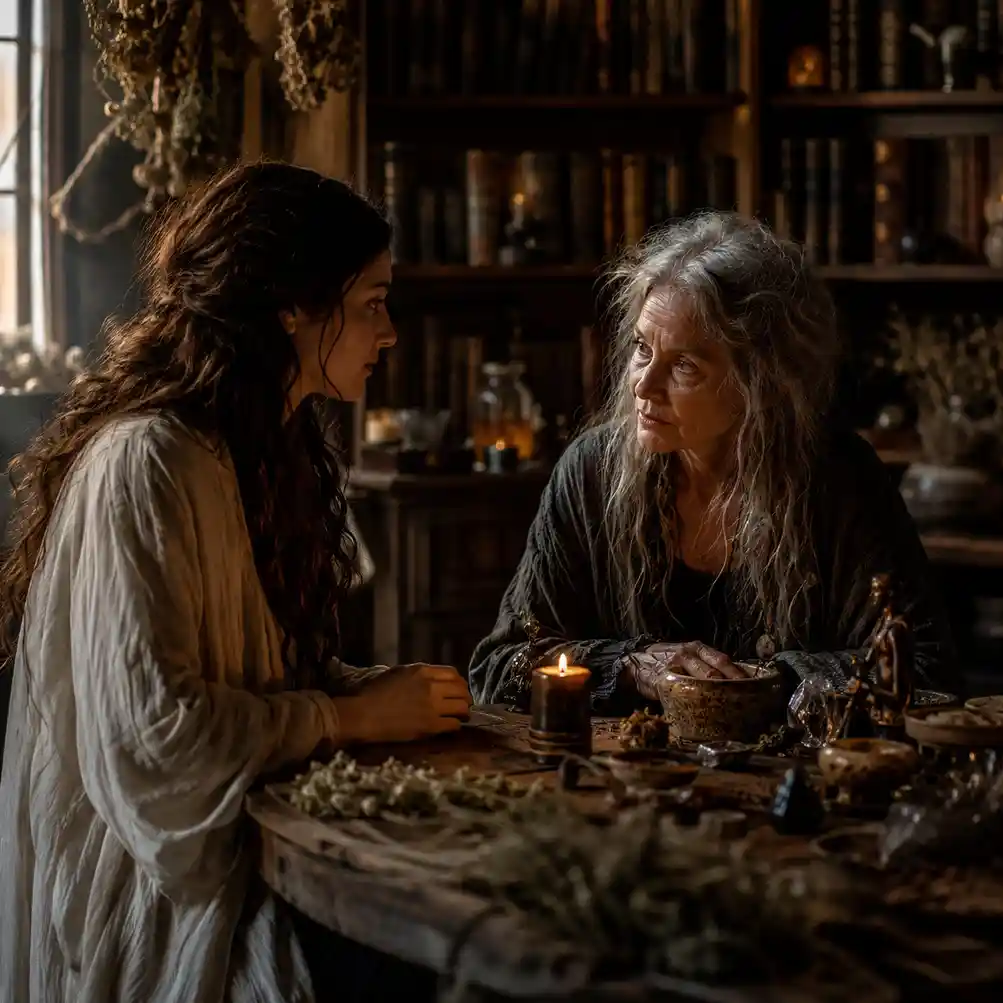
Brida also studies with Wicca, a woman who teaches the Tradition of the Moon. Her path emphasizes ritual, intuition, bodily awareness, cards, dance, music, and attention to cycles. Spiritual knowledge enters through practice rather than explanation alone.
The female community surrounding Wicca changes the shape of the apprenticeship. Magic becomes embodied and shared. The novice does not merely receive private secrets from a male master. She enters a lineage of women whose knowledge has survived suspicion and persecution. Community turns private longing into accountable spiritual practice.
Witchcraft appears in a more satirical and socially disruptive form in 👉 The Witches of Eastwick by John Updike. Updike’s novel examines desire and power within an American town. Coelho’s treatment is earnest and initiatory, but both works connect female magical identity with questions about freedom, community, and cultural fear.
The Tradition of the Moon may appeal through its affirmation of intuition and the body. It can also feel schematically gendered. Associating one path with feminine receptivity and another with masculine knowledge risks turning symbolic difference into fixed identity.
Brida partly resists that limit by making both traditions available as forms of wisdom rather than enemies. The heroine’s task is not to prove one false. She must discover which discipline allows her gift to develop honestly.
Ritual gives attention a physical form. Candles, movement, cards, and moonlight matter because they concentrate awareness. Whether readers accept the novel’s spiritual system literally or symbolically, Wicca’s lessons present transformation as something practiced with the whole person.
Sun and Moon Offer Different Knowledge
The Traditions of the Sun and Moon organize the spiritual world of Brida. The Sun emphasizes mastery, space, signs, and knowledge transmitted through disciplined understanding. The Moon emphasizes time, ritual, intuition, and entry into hidden rhythms. Their contrast gives Brida a clear symbolic architecture.
Neither path contains the whole mystery. The Magus and Wicca possess genuine insight, yet each sees through a particular tradition. The heroine’s development requires learning from difference without reducing wisdom to one formula.
Altered perception receives a more philosophical and autobiographical treatment in 👉 The Doors of Perception by Aldous Huxley. Huxley investigates how changes in consciousness reshape ordinary objects. The writer uses ritual and fiction, but both books question the assumption that everyday perception exhausts reality.
The novel blends Christian imagery, reincarnation, witchcraft, Tarot, prayer, and ideas drawn from several esoteric traditions. This openness makes Brida accessible to readers who approach spirituality eclectically. Others may find that the combination smooths important differences between belief systems.
His primary interest is experiential rather than historical. Symbols matter through the choices they awaken in the heroine. Knowledge proves itself by changing conduct. A vision has little value if it creates pride, dependence, or escape from responsibility.
Sun and Moon finally describe complementary human capacities. Reason needs intuition, discipline needs receptivity, and spiritual aspiration needs embodied life. Her initiation advances when she stops asking which side can eliminate uncertainty and begins accepting the work of holding both. Difference becomes a resource instead of an obstacle.
The Soul Mate Is Not a Possession
One of the novel’s central ideas is the Soul Mate, sometimes described as the Other Part. Souls recognize one another across time, and an encounter may carry the force of a relationship begun before the present life. The Magus sees this bond in Brida before she can see it herself.
The concept gives Brida its romantic intensity, but it also creates an ethical test. If destiny identifies two people, does that knowledge give either person a claim over the other? Recognition does not cancel freedom. The Magus must learn that love cannot justify control.
Her relationship with Lorens anchors the question in ordinary life. He belongs to a more rational world and does not share every stage of her magical education. Yet affection, trust, and choice may carry a truth as important as supernatural recognition.
Immortality complicates love differently in 👉 All Men are Mortal by Simone de Beauvoir. Beauvoir’s novel examines how endless life damages human relationship and historical meaning. Coelho approaches time through reincarnation and spiritual continuity, but both books ask whether love remains human when placed against eternity.
The possibility of more than one profound bond prevents the Soul Mate idea from becoming a mechanical command. Destiny may create recognition, while choice determines how a person responds. Love becomes valid through freedom, not inevitability.
This distinction is one of the book’s strongest insights. The Magus’s growth depends on accepting that her path belongs to her. Spiritual vision grants knowledge of connection, not ownership of its outcome. The beloved remains human, never merely a spiritual prize.
Past Lives Enter the Present
Brida’s initiation opens memories that appear to come from other lives. The past is not presented as an archive of verifiable dates. It arrives through image, emotion, fear, and recognition. Experiences that once seemed inexplicable acquire a spiritual history.
Reincarnation allows Brida to imagine identity as larger than one biography. The self carries unfinished patterns across time. Love, persecution, gifts, and mistakes may return until a person learns to respond differently.
This framework gives present choices unusual weight. Destiny does not mean that every action has been fixed in advance. It means that freedom operates inside patterns already in motion. She can repeat fear and dependence or transform them through awareness.
The past-life scenes also connect witchcraft with historical persecution. Knowledge transmitted through women has often survived under danger. Remembering becomes a way of reclaiming continuity after violence attempted to erase it.
Readers who do not accept reincarnation literally can approach these episodes psychologically. A past life may function like inherited memory, buried fear, or a symbolic account of traits that exceed conscious explanation. The novel leaves room for experiential belief.
At times, the metaphysical system explains emotion very quickly. Mystery becomes a lesson before its ambiguity has fully developed. Yet the speed belongs to the parable-like form Coelho chooses.
The essential question is not whether the heroine can prove where an image originated. It is whether the encounter helps her act with greater courage, freedom, and responsibility in the present. Memory matters only through the choices it changes.
Simple Prose Carries Large Claims
The prose of Brida is direct, symbolic, and highly accessible. Dialogue often carries instruction, while scenes are organized around tests, recognitions, and spiritual principles. Readers rarely have to search for the central question of a chapter.
That clarity gives the novel broad appeal. Abstract ideas become memorable situations. Fear becomes a night in the forest. Intuition becomes dance. Destiny becomes a difficult choice between recognizable forms of love.
The same method creates limitations. Characters sometimes speak as teachers even when they are lovers or friends. Aphoristic statements can resolve tensions that another novel might leave open. Secondary figures often serve the heroine’s development more than lives of their own.
Choice receives a secular philosophical defense in 👉 Existentialism is a Humanism by Jean-Paul Sartre. Sartre rejects a predetermined essence, while the novelist imagines destiny, reincarnation, and spiritual gifts. Despite that difference, both works place responsibility on what a person does with the conditions encountered.
Brida is strongest when destiny and freedom remain in tension. If every event merely confirms a cosmic plan, risk becomes decorative. When the heroine must interpret signs without certainty, spiritual growth requires genuine judgment.
Its simplicity is therefore both strength and constraint. Readers who prefer psychological realism may find the symbolic characters too light. Those open to spiritual fiction will value the warmth and clarity. The book aims less to construct a fully documented occult tradition than to create a reflective space where love, fear, vocation, and choice can be reconsidered.
Quotes from Brida
- “When you find your path, you must not be afraid. You need to have sufficient courage to make mistakes.” The Magus separates commitment from certainty. In fact, discovering a path does not remove danger; it creates the responsibility to continue despite imperfect judgment. The second sentence also protects error from becoming mere failure. Within Brida, mistakes function as instruments of initiation because experience teaches what abstract instruction cannot.
- “Nothing in the world is ever completely wrong. Even a stopped clock is right twice a day.” Brida remembers her father’s answer when discouragement makes every failed attempt look worthless. However, the clock image does not claim that all choices carry equal wisdom. Instead, it asks her to search error for the fragment of truth it may still contain. The lesson supports the novel’s patient, non-linear model of spiritual development.
- “None of us knows what might happen even the next minute, and yet still we go forward. Because we trust. Because we have Faith.” These three sentences define faith as movement under uncertainty rather than factual assurance. Moreover, the capitalized final word gives trust a spiritual dimension without eliminating fear. Brida advances because knowledge remains incomplete, so vulnerability becomes part of courage rather than its opposite.
Trivia for Brida
- The novel arrived at a decisive career moment: Paulo Coelho released Brida in Portuguese in 1990, two years after The Alchemist.
- A real encounter supplied the imaginative spark: According to the 🌐 Brazilian publisher, the writer drew inspiration from stories told by Brida O’Fern, an Irish woman he met while making the Road to Rome pilgrimage.
- Two teachers embody contrasting traditions: The Magus introduces the Tradition of the Sun, while Wicca guides Brida through the Tradition of the Moon. Consequently, initiation requires reason, intuition, discipline, desire, and experience rather than one exclusive doctrine.
- Romance complicates the mystical quest: The Magus recognizes Brida as his Soul Mate, yet she already loves Lorens, a physics student. Therefore, Brida refuses to make spiritual recognition identical with possession or an automatic romantic ending.
- Inner transformation drives the action: Visions, tarot, memory, and ritual matter because they alter Brida’s choices. Moreover, that inward intensity creates a useful dialogue with 👉 The Passion according to G.H. by Clarice Lispector.
- English readers encountered it much later: Margaret Jull Costa translated the novel for its first American English publication in 2008. 🌐 Publishers Weekly records the translator, edition, and the book’s earlier 1990 Brazilian debut.
- Brazilian television gave the story a troubled afterlife: Rede Manchete adapted it as a 1998 telenovela. However, a financial crisis halted filming, and 🌐 Folha de S.Paulo reported that episode 54 ended the production with narrated conclusions and frozen images.
Becoming a Witch Means Becoming Herself
The initiation toward which Brida moves is not simply the acquisition of unusual abilities. It marks the heroine’s acceptance of a vocation and the responsibilities attached to it. She enters a tradition, but the ceremony matters because an inward choice has already occurred.
A spiritual identity must be lived, not displayed. She begins by wanting the knowledge associated with witches. She ends with a clearer understanding that every gift demands discipline, humility, and respect for freedom.
Love remains central to this transformation. The Magus, Wicca, and Lorens each reveal a different form of relation: instruction, lineage, recognition, companionship, desire, and release. None can complete the heroine’s path for her.
The novel’s optimism rests on the belief that the world offers signs and teachers when a seeker commits sincerely. That faith can feel reassuring or idealized. Misread signs, unequal authority, and spiritual self-deception receive less sustained attention than they would in a darker novel.
Still, Brida does not make awakening passive. The heroine studies, risks embarrassment, confronts fear, submits to discipline, and chooses among competing meanings. Destiny requires participation. The ending values connection without making possession its reward. Becoming herself allows the heroine to recognize others more freely, not to bind them more tightly.
For readers drawn to parables of spiritual discovery, the book offers an inviting mixture of romance, ritual, and reflection. Its deepest message is not that magic removes uncertainty. Magic teaches the seeker to move through uncertainty with attention, love, and the courage to choose. Initiation confirms a path rather than ending one.
More reviews of works by the famous brazilian author