By the River Piedra I Sat Down and Wept by Paulo Coelho
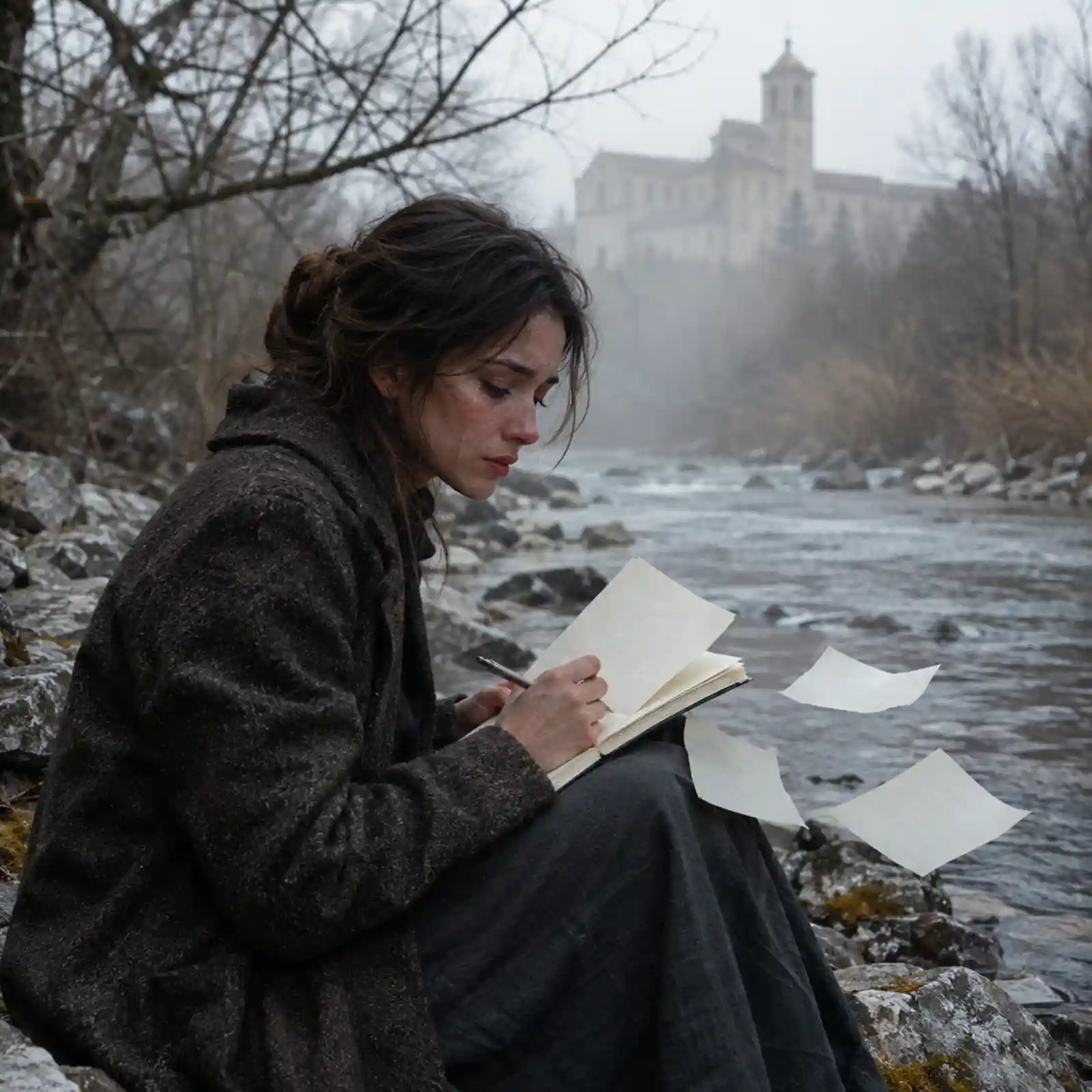
By the River Piedra I Sat Down and Wept opens at the end of Pilar’s journey. She sits beside the Piedra and writes about the week that overturned her cautious life. Legend says whatever falls into the river becomes part of its stone. Pilar wants memory to lose its power to wound. Writing produces the opposite result, preserving the experience even as she imagines surrendering it.
Paulo Coelho uses this framed opening to replace suspense about whether pain will come with a more intimate question: what kind of transformation could make grief necessary? The narrative then returns to Pilar’s reunion with a childhood companion after eleven years apart. He has become a charismatic spiritual teacher with a reported gift for healing. She has become practical, skeptical, and committed to the security of an ordinary future. The intervening story spans only a week, giving each conversation and change of location unusual weight. The author treats seven days as enough time for a life to reveal the decisions that years of routine kept postponing.
The title By the River Piedra I Sat Down and Wept carries biblical resonance without making Pilar a passive mourner. Her tears accompany an act of narration. She selects events, interprets signs, and tests what she has learned by giving it sequence. Grief becomes a form of authorship. The river does not erase the week for the reader because Pilar’s pages rescue it from disappearance. From its first scene, the novel treats spiritual change less as escape from experience than as a new way of carrying what cannot be undone.
Reunion Disturbs the Life Pilar Planned
Pilar travels from Zaragoza to Madrid to hear her old friend speak. Recognition arrives without familiarity. His years away have brought travel and religious experience, while university has strengthened her preference for exams, employment, and predictability. By the River Piedra I Sat Down and Wept brings them together as adults who remember an intimacy neither can resume. Shared childhood does not remove present difference.
He declares that he still loves her and invites her to continue traveling with him. Pilar hesitates because the offer threatens more than routine. Accepting it would require her to treat desire as information rather than danger. Her defensive inner voice, which she calls the Other, repeatedly urges caution, social obedience, and emotional retreat. The device gives fear a recognizable vocabulary, although it sometimes simplifies the competing motives inside her.
Letters once allowed Pilar to follow his travels safely through stamps and stories. His return removes that distance. She must respond to the person whose movement she admired without moving herself.
Spiritual education also depends on leaving received answers in Siddhartha by Hermann Hesse. Hesse’s seeker moves through a long sequence of teachers and experiences, whereas Pilar’s awakening is compressed into a single week and inseparable from romantic love. In By the River Piedra I Sat Down and Wept, travel matters because it suspends the structures that normally decide for her. Movement creates a temporary freedom to choose. The reunion does not recover the past; it gives Pilar a setting in which a different future can become imaginable.

The Pyrenees Turn Choice Into a Physical Journey
Together, they travel through Spain and into the French Pyrenees, moving among villages, churches, snow, and Marian sites. By the River Piedra I Sat Down and Wept makes geography participate in Pilar’s changing attention. Familiar urban schedules give way to weather and uncertain destinations. The landscape weakens her illusion of control. Each place asks her to decide before protective habits return.
Water recurs as river, mist, snow, and sacred association. It suggests movement, gestation, cleansing, and a power that cannot be held in a rigid shape. He uses the motif directly, sometimes explaining its meaning through dialogue rather than leaving symbolism implicit. Readers who prefer ambiguity may find that method insistent. Others may value the clarity with which the novel connects material landscape to spiritual argument. Saint-Savin and Lourdes place their decision beside histories of pilgrimage and apparition. Sacred space proves nothing, but surrounds Pilar with people whose lives spiritual experience has altered.
The family ghosts and intuitive women of The House of the Spirits by Isabel Allende place the marvelous inside generations of political and domestic history. The novelist works on a smaller, more allegorical scale. Miracles and signs in By the River Piedra I Sat Down and Wept concern two people trying to recognize a vocation that includes love. Wonder enters ordinary decisions rather than replacing them. The mountains do not solve Pilar’s conflict. They make it harder for her to dismiss the conflict as a temporary disturbance.
Travel also changes the balance between the couple. Her companion knows the religious map, but Pilar’s consent determines whether his proposed future has ethical substance. Guidance cannot substitute for her freely given answer.
The Feminine Face of God Reframes Pilar’s Faith
Pilar’s companion teaches that the divine also has a feminine face, understood within his Catholic practice through the Virgin Mary. Women encountered during the journey help Pilar recognize this teaching as a living tradition rather than one man’s private theory. By the River Piedra I Sat Down and Wept connects the feminine divine with water, creation, intuition, and the capacity to receive. Faith acquires a body Pilar can recognize.
This vision challenges religious structures dominated by masculine language and authority, but it does not reject Catholicism altogether. Coelho combines churches, prayer, Marian apparitions, charismatic gifts, and a broad spiritual universalism. The result will not satisfy every theological position. Its purpose is imaginative and experiential: Pilar must be able to encounter holiness without treating womanhood as secondary to it. The symbolism can link femininity too neatly with receptivity, water, and motherhood. Pilar complicates that pattern because receiving possibility requires judgment, courage, and responsibility.
A far more destabilizing encounter with matter and God shapes The Passion According to G.H. by Clarice Lispector. Lispector strips identity through an experience that resists consoling doctrine, while he gives Pilar symbols that gather confusion into meaning. Both books nevertheless make spiritual knowledge bodily and difficult to contain in inherited formulas.
In By the River Piedra I Sat Down and Wept, the feminine divine also changes the love plot. Pilar’s receptiveness becomes a source of agency. She is not merely asked to follow a gifted man; she must decide what sacred partnership would require from both of them. That emphasis moves the novel beyond reunion fantasy. The relationship becomes credible only when revelation enlarges Pilar’s freedom instead of absorbing her into another person’s mission.

Love and Vocation Appear to Demand Opposite Sacrifices
Pilar’s unnamed companion’s healing gift has given his life public purpose. His love for Pilar creates a conflict because he imagines religious vocation and shared earthly life as paths that may not remain open together. By the River Piedra I Sat Down and Wept refuses the easy claim that sincere love automatically resolves every practical difference. Devotion can become another language of fear. Both characters are tempted to sacrifice before understanding what sacrifice would serve.
Pilar initially worries that accepting him will diminish his mission. He, in turn, considers relinquishing the extraordinary gift that separates him from ordinary domestic possibility. Their choices expose a subtle struggle over responsibility. A person can renounce happiness and call the act holy, yet the renunciation may burden the beloved with permanent guilt. Love becomes ethical only when neither person uses self-denial to control the other’s answer.
The healing gift remains difficult to evaluate. Pilar encounters testimony, charisma, and conviction more often than detached proof. Readers must inhabit her decision without turning belief into a laboratory result.
Religious aspiration destroys intimacy through a harsher logic in Strait is the Gate by André Gide. Gide’s Alissa increasingly treats earthly fulfillment as an obstacle to spiritual purity. The author moves toward the opposing possibility that human love can participate in sacred work.
Union need not be a retreat from vocation. The tension gives By the River Piedra I Sat Down and Wept its strongest emotional argument, even when the rapid declarations make psychological development feel more parabolic than realistic. Neither choice means much if made only to end uncertainty. Pilar and her companion must learn that surrender differs from panic, although both feel like releasing control.
Simple Prose Carries a Deliberately Parabolic Design
The writing style of By the River Piedra I Sat Down and Wept favors short declarations, recurring images, spiritual anecdotes, and dialogue that states ideas openly. He rarely hides the lesson beneath dense description. Pilar’s first-person voice moves quickly between event, memory, fear, and interpretation. Accessibility is part of the book’s spiritual method. The prose invites recognition before analysis and aims to make large ideas portable.
That clarity produces both the novel’s reach and its limitations. Images of water, surrender, the Other, miracles, and decisive moments create coherence across a brief narrative. At times, however, characters speak like bearers of principles rather than unpredictable individuals. The male companion remains unnamed, which strengthens his parabolic role but restricts the social and personal detail through which readers might understand him beyond Pilar’s transformation. This novel began his On the Seventh Day trilogy, followed by Veronika Decides to Die and The Devil and Miss Prym. Each compresses change into one week.
Meditation and temporal recurrence work with greater formal density in Four Quartets by T. S. Eliot. Eliot circles spiritual insight through layered allusion and self-correcting thought. The writer instead makes revelation conversational and immediate. By the River Piedra I Sat Down and Wept is most persuasive when its simplicity sharpens a genuine dilemma, especially the possibility that fear can disguise itself as prudence or sacrifice. The weakest moments explain what the symbols already show.
Readers receptive to fable, devotional romance, and direct philosophical dialogue are more likely to value the method than those seeking social realism or sustained ambiguity. Its directness is a deliberate bargain. The book surrenders psychological density to make its spiritual propositions clear enough to accompany readers beyond the final scene.

Risk and Love: Quotes from By the River Piedra I Sat Down and Wept
- “Waiting is painful. Forgetting is painful. But not knowing which to do is the worst kind of suffering.” Uncertainty prevents both mourning and renewal. Pilar suffers because neither hope nor abandonment can become complete.
- “Love is a trap. When it appears, we see only its light, not its shadows.” Attraction initially conceals its costs. The novel gradually forces Pilar to examine what surrender might demand.
- “We can never judge the lives of others, because each person knows only their own pain and renunciation.” Private sacrifice cannot be measured from outside. Compassion begins by admitting the limits of observation.
- “God always offers us a second chance in life.” The reunion becomes more than recovered romance. It tests whether opportunity has any value without the courage to choose.
- “To love is to lose control.” The writer condenses Pilar’s central fear into six words. Love threatens the cautious identity she has built through predictability.
- “The moment we begin to seek love, love begins to seek us. And to save us.” Love changes from passive emotion into reciprocal movement. Salvation becomes possible only when Pilar stops treating vulnerability as defeat. All six quotations: Goodreads quote collection
Between Fear and Faith: Facts About By the River Piedra I Sat Down and Wept
- The novel first appeared in Portuguese in 1994: Its original title is Na margem do rio Piedra eu sentei e chorei. The English edition was marketed as both a spiritual love story and “a novel of forgiveness.” HarperCollins
- The title echoes a biblical lament: Psalm 137 begins with exiles sitting and weeping beside the rivers of Babylon while remembering Zion. He transfers that imagery of water, memory, separation, and displaced belonging to Pilar’s personal crisis. Psalm 137
- It opens the On the Seventh Day trilogy: Veronika Decides to Die and The Devil and Miss Prym complete the sequence. Each novel compresses a life-changing confrontation into approximately one week.
- The central story covers seven dated days: Pilar recounts events from December 4 through December 10, 1993. Within that narrow span, the defensive inner voice she calls “the Other” begins losing control, creating a spiritual counterpart to the divided self in Demian by Hermann Hesse.
- Pilar’s beloved is never given a personal name: He remains her childhood friend, spiritual teacher, healer, and possible lover. The omission turns him partly into a choice between competing lives rather than a conventionally individualized romantic hero.
- Travel replaces static introspection: The pair move through Spain and the French Pyrenees toward Catholic sacred sites associated with miracles and pilgrimage. Rivers, mountains, snow, and chapels make spiritual change physically visible.
- The feminine face of God is the theological center: The novel connects the Virgin Mary, compassion, intuition, healing, and suppressed female divinity. Its mixture of religious authority and emotionally compromised love invites comparison with The Pastoral Symphony by André Gide.
- Alan R. Clarke created the English translation: HarperCollins published it in 1996, two years after the Portuguese original. Clarke later translated several other Coelho novels. WorldCat
The Ending Converts Weeping Into a Readiness to Act
Pilar learns that her companion may have surrendered his gift, and she interprets that loss as the destruction of the future she had finally accepted. She flees to the Piedra under the weight of guilt. By the River Piedra I Sat Down and Wept returns to its opening scene with fuller meaning: the tears arise not only from romantic uncertainty, but from the fear that love has displaced another person’s calling. Her grief proves that passivity is no longer possible.
The act of writing prepares Pilar for reunion. When her companion finds her, the pages and the river have changed the function of memory. She no longer wants merely to return to the safe life that preceded the week. The conclusion protects hope without mapping every practical consequence of their decision. That openness fits a novel concerned with choosing a path before possessing guarantees. Questions about work, community, and the future remain unanswered. That incompleteness preserves commitment as courage, since certainty would remove what Pilar struggled to acquire.
Published in Portuguese in 1994, the book belongs to Brazilian Literature while placing most of its action in Spain and France. Its transnational setting reflects his preference for pilgrimage, symbolic geography, and spiritual traditions that cross borders. By the River Piedra I Sat Down and Wept succeeds most clearly through emotional clarity, recurring natural imagery, and a serious attempt to imagine love as part of vocation. Its compressed character development and explicit teachings can feel schematic.
The novel asks for receptiveness rather than detachment. It is best suited to readers who welcome mystical romance, Catholic imagery interpreted expansively, and stories in which inner change matters more than realistic social detail.