Four Quartets by T. S. Eliot
Four Quartets is not a poem sequence to rush through. T. S. Eliot builds it around time, but not in a simple philosophical way. Time appears as memory, regret, history, aging, spiritual pressure and the strange feeling that life is always slipping away while remaining somehow present. The poems ask what it means to live inside time when every moment carries what has been and what might have been.
That question gives the work its unusual gravity. The author does not treat time as background. He turns it into the central condition of human existence. We remember, but memory changes. So we hope, but hope can become illusion. We act, but action is always limited by what we cannot recover. Time is both wound and doorway.
The sequence moves through four named places, yet each place opens into something larger. A garden, a village, rocks by the sea and a religious community become points of meditation. The outer world is never merely descriptive. It starts the mind moving toward stillness, failure, surrender and renewal.
This makes Four Quartets demanding, but also deeply rewarding. Its difficulty does not come from obscurity alone. It comes from the seriousness of its listening. The poems do not explain life from above. They circle it, return to it and test each thought against silence.
For readers willing to slow down, the sequence offers one of modern poetry’s most searching reflections on how a human life can touch meaning while remaining trapped in change.
Burnt Norton and the missed path
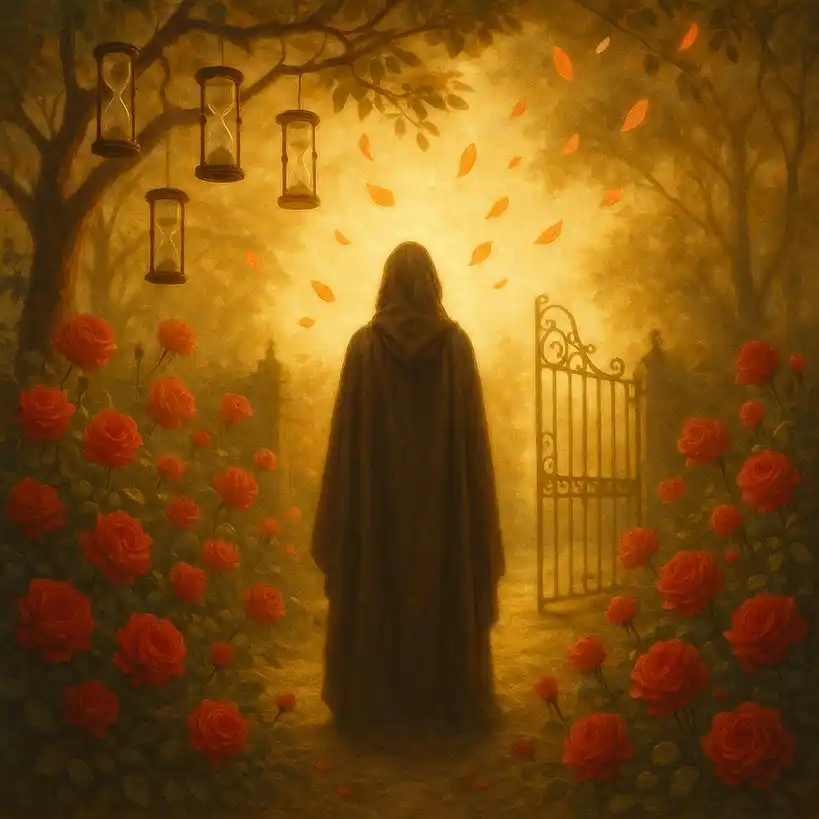
“Burnt Norton” gives Four Quartets its first great movement of thought. The poem begins with time, memory and unrealized possibility. It is haunted by the path not taken, the door not opened and the life that might have existed but never became actual. The poet does not turn this into sentimental regret. He makes it stranger. The missed path remains present as mental pressure, a shadow inside the life actually lived.
The garden imagery is central. It suggests beauty, order and the possibility of revelation. Yet the garden is not a simple paradise. It is filled with echoes, birds, movement and vanishing hints. The poem offers flashes of insight, then withdraws them. This rhythm teaches the reader how to read the whole sequence. Meaning arrives briefly, often indirectly, and cannot be possessed by force.
The connection with 👉 In Search of Lost Time by Marcel Proust is strong here. Proust also turns memory into a vast field where the past can return with unexpected force. He is more compressed and spiritual, but both writers understand that time is not merely chronological. It lives inside perception.
“Burnt Norton” also introduces the central tension between movement and stillness. Human beings move through time, but the poem keeps searching for a point beyond restless succession. Stillness is not escape, but deeper attention.
This first quartet is therefore not only an opening. It is a map of the whole work’s method. The poem begins with speculation, then turns toward discipline. It asks whether one can pass through regret without becoming trapped by it.
East Coker and the dark road down
“East Coker” changes the emotional temperature of Four Quartets. It is earthier, darker and more historical than “Burnt Norton.” The writer turns toward ancestry, rural memory, decay and the famous rhythm of beginning and ending. The poem does not comfort the reader with progress. It insists that growth may require descent, loss and humiliation.
The village of East Coker matters because it links him to ancestral origin. Yet the poem does not treat origin as sentimental refuge. Return does not mean safety. The past contains continuity, but it also contains darkness. Houses rise and fall. People dance, age and disappear. Language itself wears out. The poet must confront the failure of old words and the limits of accumulated knowledge.
This is one of the strongest parts of the sequence because it refuses spiritual glamour. The way forward is downward. To find wisdom, the self must pass through uncertainty, poverty of spirit and the collapse of easy confidence. Humility becomes a form of vision.
The theme has a useful echo in 👉 The Glass Bead Game by Hermann Hesse. Hesse also imagines a disciplined world of intellect, pattern and spiritual aspiration. His path is more austere and Christian, but both works ask whether cultivated intelligence can become wisdom only after it learns its own insufficiency.
“East Coker” gives Four Quartets much of its moral depth. It argues that modern cleverness is not enough. The mind must be stripped of pride. The poem’s darkness is not nihilistic. It is purgative. It clears space for a more difficult kind of faith.
The Dry Salvages and the sea of history
“The Dry Salvages” gives Four Quartets its most powerful water imagery. Rivers, sea, rocks, bells, prayer and danger combine into a meditation on human vulnerability. The poem moves between personal memory and collective history. Water becomes both origin and threat. It carries childhood, trade, travel, death and the long rhythms that exceed individual control.
This quartet is especially moving because it treats time as something larger than the mind. In “Burnt Norton,” time feels philosophical and inward. In “The Dry Salvages,” it becomes elemental. The river and sea remind us that human plans are small. Ships move, bells warn, bodies age and prayer rises from people who know they cannot master the world.
His tone here is less abstract than some readers expect. The poem thinks through images of movement and peril. It knows that human beings seek patterns, but it also knows that history can feel like water: repetitive, violent, carrying us before we understand where we are. The sea makes human control look fragile.
This concern with human life inside vast historical movement can be linked to 👉 War and Peace by Leo Tolstoy. Tolstoy writes through narrative and character, while Eliot works through meditative poetry, but both resist the illusion that individuals fully command history.
“The Dry Salvages” also deepens the religious dimension of the sequence. Prayer matters because mastery fails. The poem does not offer faith as easy answer. It presents faith as a practice shaped by danger, waiting and surrender. That makes the quartet less serene than its surface music may suggest.
Little Gidding and the fire of renewal
“Little Gidding” brings Four Quartets to its most concentrated spiritual point. Written in the shadow of war, it gathers the earlier themes of time, memory, place, suffering and purification. Fire becomes its central image. Fire destroys, but it can also refine. The poem asks whether pain, history and spiritual discipline can become part of renewal rather than mere ruin.
The setting matters. Little Gidding carries the memory of a religious community, and the poem turns that place into a field of encounter. The personal and the historical meet. War is present, but not as newspaper detail. It enters as pressure on the soul, as evidence of human disorder and as a test of language. The poem asks how one can speak meaningfully when history itself burns.
This final quartet has some of his most intense thinking about reconciliation. The past cannot be undone. The dead cannot be made living by memory alone. Yet the poem imagines a form of acceptance that does not erase suffering. Renewal passes through fire, not around it.
The spiritual and dramatic tension can be compared with 👉 Faust by Johann Wolfgang von Goethe. Goethe’s work is grander in narrative range and more expansive in its metaphysical wager, but both works explore human striving, error, purification and the hunger for final meaning.
“Little Gidding” does not make Four Quartets simple. It does not solve every question. Instead, it brings the sequence to a hard-won stillness. The end feels earned because it has passed through regret, darkness, history and flame.
Music, repetition and poetic form
The title Four Quartets matters. the poet does not call the sequence four arguments, four sermons or four meditations. He uses a musical term, and the poems behave musically. Themes appear, vanish, return and change. Phrases echo across the sequence. Images of time, stillness, movement, darkness, water, fire and speech recur like motifs in a composition.
This structure helps explain why the work should be read slowly. A single line may feel obscure at first, then become clearer when another quartet returns to the same idea in a different key. The author builds meaning through recurrence rather than straightforward explanation. The poems ask the reader to listen for pattern.
The musical design also keeps the work from becoming dry philosophy. Eliot thinks intensely, but he thinks through rhythm, sound and symbolic variation. His abstractions gain force because they are carried by cadence. The work’s difficulty is therefore partly musical. The poem teaches by returning differently.
This formal quality makes a comparison with 👉 The Waves by Virginia Woolf useful. Woolf also uses rhythm, recurrence and shifting voices to create a structure closer to music than conventional plot. His sequence is more theological and compressed, but both works show modernism seeking forms beyond ordinary narration.
The repeated five-part movement of each quartet gives the sequence balance without making it rigid. He allows lyric intensity, reflective argument and prayer-like attention to coexist. That formal discipline matters. It holds together a poem that might otherwise dissolve into fragments. The music gives shape to spiritual searching.
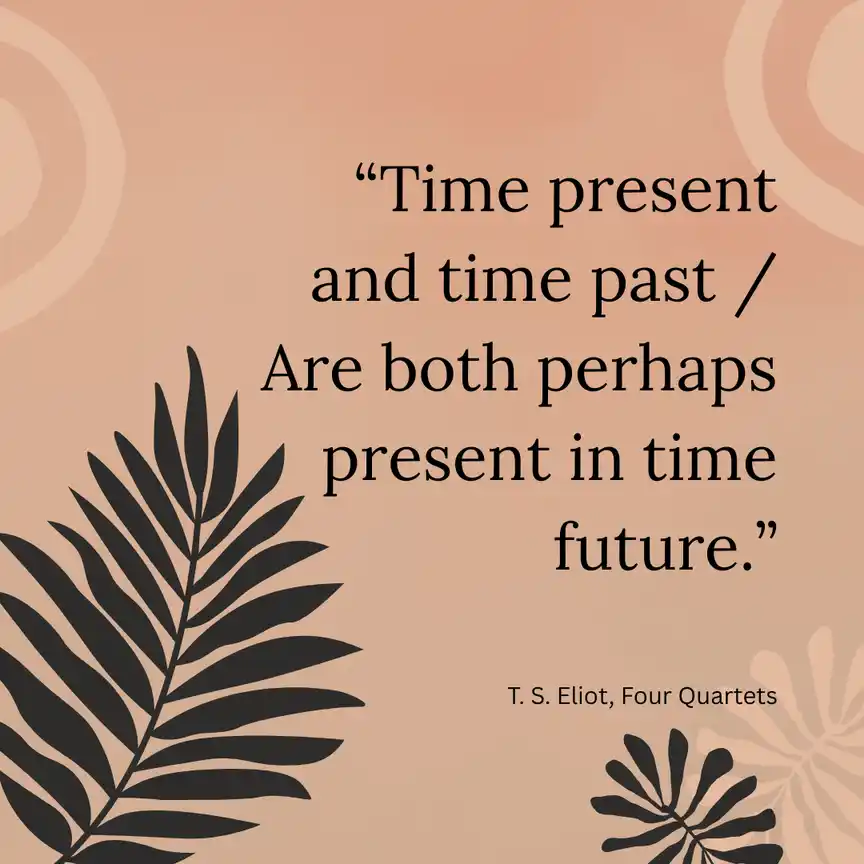
Quote List for Four Quartets
- “Only through time time is conquered.” This compact line captures the paradox at the heart of Four Quartets. Time wounds, limits, and separates, yet the poem also suggests that spiritual understanding can only happen inside time, not outside it.
- “In my beginning is my end.” The phrase gives “East Coker” its circular force. It links ancestry, death, return, and renewal, while it also prepares the reader for a poem where endings rarely feel final.
- “For us, there is only the trying.” This is one of the sequence’s clearest ethical statements. The poet removes triumph from the center and replaces it with discipline, humility, and the difficult dignity of effort.
- “The river is within us.” The line turns landscape into inner life. In Four Quartets, water does not merely decorate the poem, because it carries memory, movement, danger, and the pressure of origins.
- “We shall not cease from exploration.” This famous phrase makes discovery feel circular rather than linear. The poem suggests that true arrival may mean returning to the first place with deeper perception.
- “And all shall be well.” The closing echo of Julian of Norwich gives the final movement a fragile but memorable hope. However, the comfort does not erase suffering. Instead, it arrives after fire, history, loss, and the hard labor of attention.
Context-Rich Trivia List for Four Quartets
- Four poems, one design: Four Quartets gathers “Burnt Norton,” “East Coker,” “The Dry Salvages,” and “Little Gidding.” 🌐 Britannica describes the work as four poems published separately from 1936 to 1942 and collected in book form in 1943, with each quartet built from five movements.
- East Coker closes a circle: The poet’s ancestors came from 🌐 East Coker, and his ashes were later interred at St. Michael’s Church there. Therefore the second quartet turns place into ancestry, return, and burial.
- Water and childhood: “The Dry Salvages” draws on Cape Ann and Gloucester memories, where the poet spent childhood summers. 🌐 The official site links that coastal world to the poem’s rocks, sea, and memory-work.
- Modernist time: Four Quartets explores time as repetition, loss, and revelation. That makes 👉 In Search of Lost Time by Marcel Proust a strong echo, because both works treat memory as a doorway rather than a simple archive.
- Musical architecture: The title “quartets” suggests composition, balance, recurrence, and variation. Meanwhile, 👉 The Waves by Virginia Woolf offers another modernist structure where rhythm, voice, and time shape the reading experience.
- Spiritual pressure: The sequence turns inward without becoming private only. Its Christian meditation on suffering, purgation, and renewal also pairs well with 👉 The Magic Mountain by Thomas Mann, where illness, time, and spiritual testing reshape ordinary life.
Faith without easy comfort
Four Quartets is a religious work, but not a comforting one in any simple sense. The author writes from within a Christian imagination, yet the poems do not behave like easy devotional verse. They are full of struggle, failure, dryness, waiting and the difficult discipline of surrender. Faith appears not as emotional warmth, but as a demanding reorientation of the self.
This is why the sequence can speak even to readers who do not share his belief. The poems understand spiritual hunger as a human problem before it becomes a doctrinal one. They ask how one lives with regret, fear, mortality, historical violence and the limits of knowledge. The religious answer is present, but it is reached through pressure, not declared from a safe distance.
The poems repeatedly warn against illusion. Desire can disguise itself as spirituality. Words can become empty. Experience can harden into pride. Even wisdom can become another possession if the self wants to own it. Faith begins where mastery fails.
This dimension connects the work to 👉 Siddhartha by Hermann Hesse, though the religious worlds differ greatly. Hesse follows a seeker through experience toward spiritual insight. Eliot moves through Christian meditation, liturgical resonance and poetic discipline. Both works, however, distrust secondhand wisdom.
In Four Quartets, belief is inseparable from patience. The soul must wait, listen and accept that not every truth can be seized directly. This is the opposite of quick consolation. His faith is severe because it asks the self to become still enough to receive what it cannot manufacture.
Why these quartets still endure
Four Quartets endures because it speaks to experiences that modern life has not outgrown. People still live with regret, distraction, historical fear, spiritual uncertainty and the ache of time passing. His language can be difficult, but the underlying concerns are immediate. How should we live when the past will not vanish? So how should we act when the future remains unknowable? How can stillness exist inside movement?
The sequence also remains powerful because it refuses speed. In a culture drawn toward instant reaction, Four Quartets asks for attention. It rewards rereading because its meanings do not arrive all at once. A reader may first notice the famous reflections on time, then later hear the grief, then later the discipline, then later the tenderness hidden beneath the severity.
Its greatness lies in balance. The poems are intellectual without being merely academic. They are religious without being shallowly pious. While they are personal without becoming confession. They are historical without turning into commentary. The work feels private and cosmic at once.
Eliot’s achievement is to make thought sing without making thought easy. The sequence gathers garden, village, sea and chapel into one long movement of return. Each place becomes a way of approaching what cannot be held directly.
For that reason, Four Quartets is not only a monument of modernist poetry. It is also a guide to reading one’s own life with more patience. It suggests that meaning may not be found by escaping time, but by entering it more truthfully, with memory, humility and stillness.