Eugene Onegin by Alexander Pushkin
Eugene Onegin introduces its hero through habits rather than ideals. Onegin knows how to dress, dine, flirt, attend the theater, and survive the codes of fashionable Saint Petersburg. None of these accomplishments gives him a purpose. Alexander Pushkin presents sophistication as a form of premature exhaustion, since Onegin has mastered the gestures of pleasure before discovering anything he genuinely values. Experience has hardened into repetition. His boredom is therefore psychological.
The narrator does not simply condemn this privileged young man. He recognizes Onegin’s intelligence, shares parts of his cultural world, and sometimes treats him with the indulgence reserved for a difficult friend. That intimacy prevents Eugene Onegin from becoming a moral fable about an obvious villain. Onegin sees through vanity and convention, but perception has not made him generous.
His critical intelligence removes illusions without creating commitments to replace them. This narrative affection matters because it keeps judgment flexible. Readers can enjoy Onegin’s wit, understand his fatigue, and still see that charm does not absolve the damage caused by emotional inertia.
The country estate inherited from his uncle seems to offer renewal. Onegin initially changes the treatment of the peasants and enjoys the altered rhythm, yet novelty soon loses its force. Boredom travels with the bored man. The polished self-fashioning of 👉 The Picture of Dorian Gray by Oscar Wilde develops into a darker cult of sensation and appearance. Pushkin’s hero is less monstrous, but both books expose the danger of treating life as material for a cultivated persona. In Eugene Onegin, detachment feels intelligent until another person must pay for it.
Lensky and the Larins Offer Three Ways of Feeling
Life in the countryside brings Onegin into contact with Vladimir Lensky, a young poet recently returned from Germany. Lensky believes in friendship, poetic vocation, and his love for Olga Larina with an openness that Onegin finds both naïve and attractive. Their friendship thrives on disagreement. Eugene Onegin allows irony and idealism to share the same road, although neither man understands how quickly conversation can become consequence. Each sees the other’s limits more clearly than his own.
Olga appears cheerful, conventional, and easily legible to the people around her. Her older sister Tatyana inhabits books, landscapes, dreams, and the rhythms of the family estate. He does not define the sisters through a simple contrast between shallowness and depth. Olga inhabits her social role without Tatyana’s inward conflict, while Tatyana lacks the ease that would let her feelings move safely through convention. Their differences reveal how narrow the available scripts for young women remain.
Onegin’s arrival gives Tatyana’s imagination a human object. She recognizes in him figures encountered in imported novels, then tries to determine whether his distance hides nobility, danger, or pain. Her solitude is not merely shyness. It has trained her to interpret experience through weather, folklore, dreams, and fiction rather than through the confident gossip of the drawing room. Eugene Onegin keeps its focus on a difficult problem: a person formed by books must still learn to read the living. Tatyana’s error contains the beginning of insight. Unlike Onegin, she remains capable of revising the story through which she first understood him.
Tatyana’s Letter Makes Vulnerability an Act
Tatyana refuses to wait for Onegin to follow the approved courtship sequence. She writes him a confession, entrusting desire to a letter that could expose her to ridicule and damage. In Eugene Onegin, this act is not naïve because she misunderstands the risk. It is courageous because she understands the shame and writes anyway. Language gives her desire a chosen form.
Her letter draws upon the emotional vocabulary of European fiction. That borrowed language does not make her feelings false. Readers learn to love partly through stories, just as they learn to interpret grief, heroism, and betrayal through available forms. The epistolary intensity of 👉 The Sorrows of Young Werther by Johann Wolfgang von Goethe offers an illuminating comparison. Werther’s letters intensify a passion that gradually excludes correction, whereas Tatyana’s letter begins a longer education in how imagination and reality diverge.
The narrator presents her confession as a translation from French, the language in which a young noblewoman of her milieu would most readily articulate literary feeling. Even apparent spontaneity therefore reaches readers through mediation.
The author grants her emotional seriousness without turning the confession into proof that Onegin must reciprocate. Love cannot create an obligation to love in return. The ethical question concerns how he receives the gift of confidence placed in his hands. Eugene Onegin separates rejection from humiliation and then examines how close the two can become. Onegin protects the letter’s secrecy and speaks privately, yet his composure makes the encounter entirely his lesson to deliver. He answers sincerity with superior knowledge. Tatyana leaves wounded, but her capacity for truth survives the verdict.
The Rejection Is Honest and Still Morally Incomplete
Onegin tells Tatyana that he is unsuited to marriage and would eventually make her unhappy. The judgment may be accurate. He neither promises feelings he lacks nor exploits her declaration for temporary pleasure. Eugene Onegin makes the scene difficult by allowing honesty and cruelty to occupy one speech. A correct prediction can still protect selfishness. Onegin treats his incapacity as a permanent fact rather than a condition he might question.
His lecture also distributes maturity unevenly. Tatyana has taken the emotional risk, while Onegin claims the authority to explain both her future and his character. He warns her to control such openness with other men, converting her singular trust into evidence that she needs instruction. The response sounds responsible because it avoids seduction. Yet it preserves his freedom from any demand for self-examination. Age, gender, and social experience strengthen his control of the scene. Tatyana must absorb the judgment in silence, while Onegin can define restraint according to standards that leave his own emotional habits untouched.
Courtship becomes a testing ground for judgment in 👉 Pride and Prejudice by Jane Austen. Austen’s protagonists revise their first interpretations through argument, embarrassment, and renewed observation. In Eugene Onegin, the tragedy begins because Onegin believes self-knowledge has already finished. Detachment disguises a refusal to change.
Tatyana initially mistakes distance for depth, but she will later test that assumption against evidence. Onegin instead mistakes his current boredom for identity. His rejection becomes morally incomplete not because he owes Tatyana marriage, but because he uses lucidity to close a future he has never tried to imagine.
A Name-Day Joke Turns Convention Into Fatal Force
Lensky brings Onegin to Tatyana’s name-day celebration after suggesting that the gathering will be small. Onegin finds a crowded party and resents being placed under curious observation. Rather than direct his annoyance at Lensky honestly, he chooses a more theatrical revenge. He dances with Olga and enjoys watching his friend’s jealousy grow. Eugene Onegin makes the provocation trivial in motive and devastating in effect. A social joke recruits the machinery of honor.
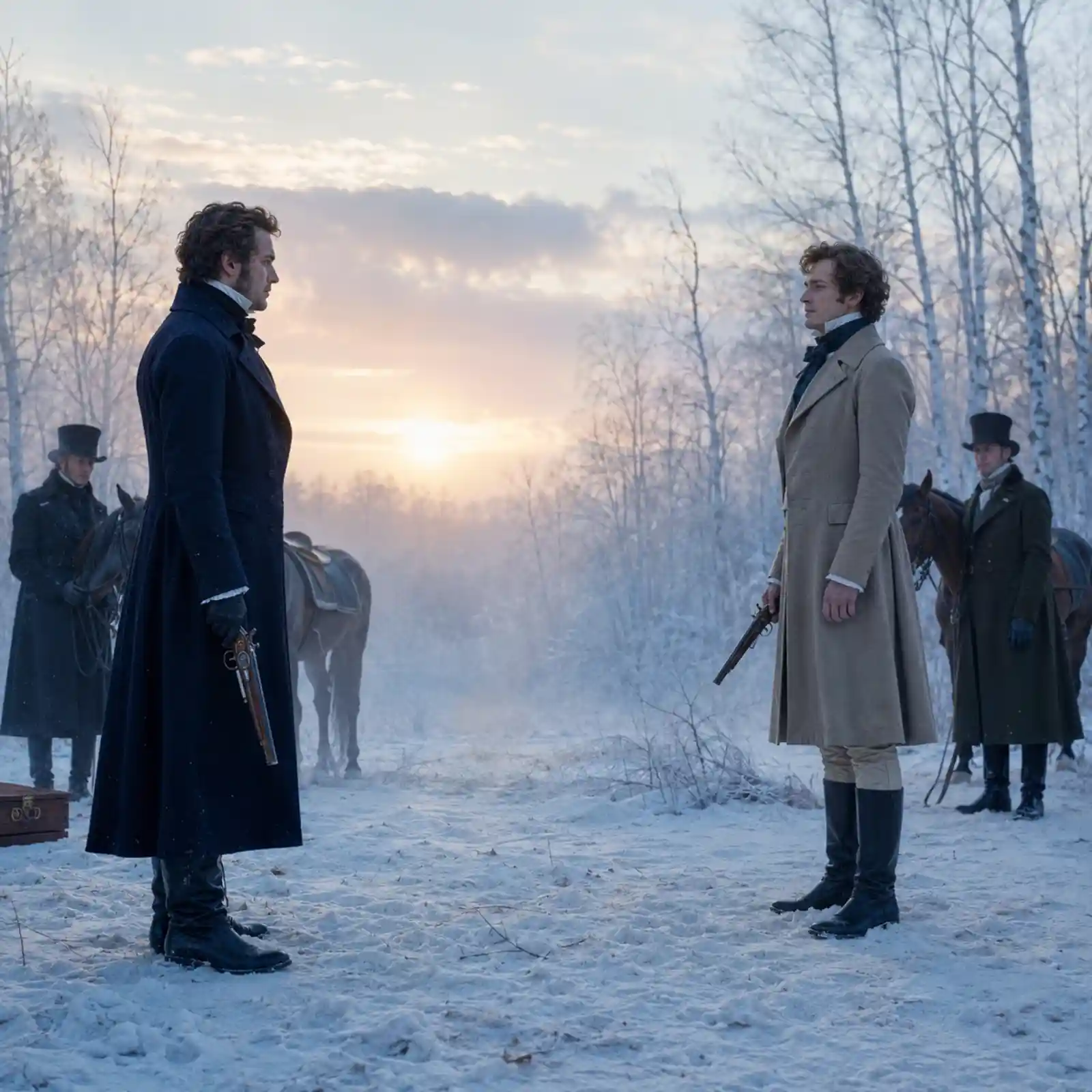
Lensky challenges Onegin to a duel. Both men have opportunities to interrupt the sequence, but each fears the interpretation that withdrawal might receive. Onegin recognizes the absurdity more clearly than Lensky, which increases rather than reduces his responsibility. He arrives late and uses his servant as second, gestures that approach mockery without becoming refusal. Public codes continue acting after private conviction has disappeared. Zaretsky, the second, could help reconcile them but instead keeps the ritual moving. Reputation depends upon witnesses who know the convention is destructive and enforce it because others are watching.
The duel ends with Lensky dead before his poetic promise can mature. The writer pauses over futures that will now remain hypothetical, including the possibility that Lensky might have become either a great poet or an ordinary husband. Eugene Onegin refuses to let romantic death certify romantic greatness. Potential dies without revealing its measure. Onegin’s remorse is real, yet remorse cannot convert passivity into innocence. The episode exposes a central pattern in the novel: people submit to conventions they privately distrust, then describe the result as fate. Society supplies the ritual, but Onegin still pulls the trigger.
Tatyana Reads the Library Onegin Left Behind
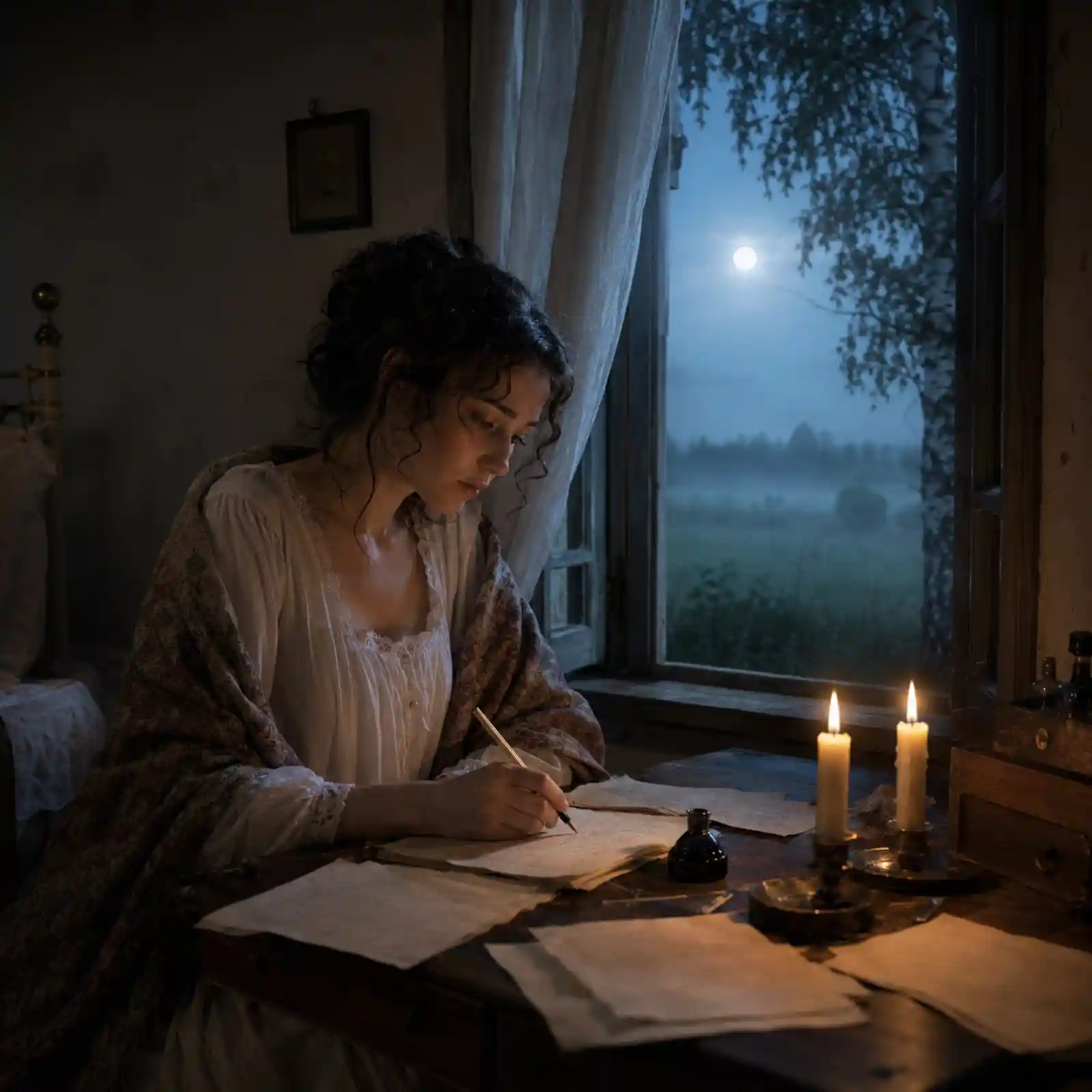
After Onegin departs, Tatyana visits his empty house and studies the books he read. Marginal marks, chosen passages, and literary preferences allow her to examine the identity she once filled with fantasy. Eugene Onegin turns the library into an indirect portrait. Reading another reader breaks the spell of projection. Tatyana begins to ask whether Onegin is an original mystery or a composition assembled from fashionable models.
This discovery does not prove that he has no authentic self. Every identity borrows language, gestures, and possibilities from culture. The sharper question is whether Onegin has transformed his influences into responsibility. Tatyana recognizes that his dramatic detachment may itself be imitative, a performance learned from types. Her earlier reading made him larger than life; her later reading restores proportion.
That intellectual labor distinguishes her later composure from mere social training. Tatyana does not simply replace rural innocence with aristocratic polish. She gains authority by revisiting her earlier interpretation and accepting evidence against desire.
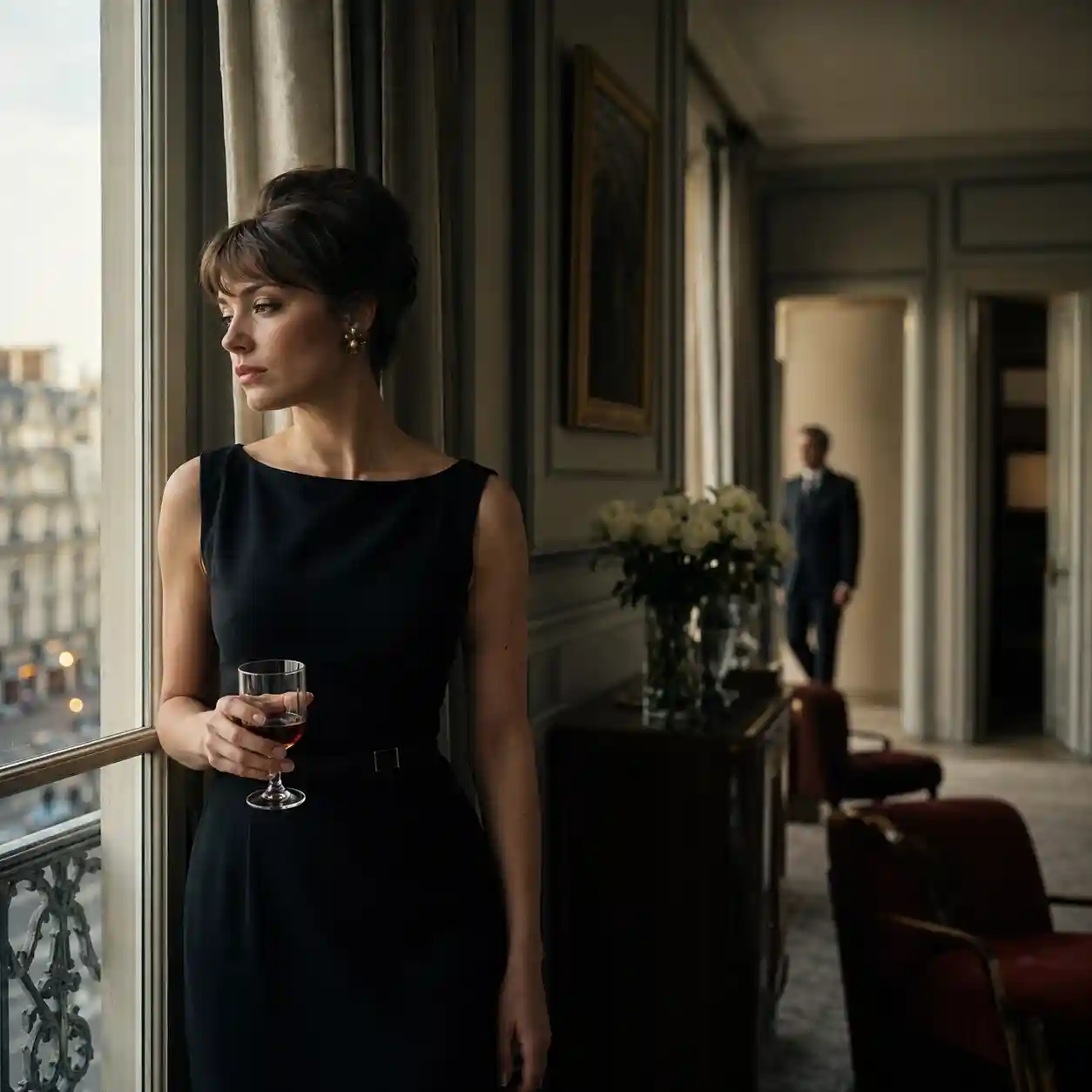
Tatyana leaves the countryside for Moscow and enters the marriage market under family pressure. When Onegin meets her again in Saint Petersburg, she has become a commanding figure in aristocratic society and the wife of a respected general. The social judgment surrounding female desire expands on a vast scale in 👉 Anna Karenina by Leo Tolstoy. Tolstoy’s heroine confronts the destructive asymmetry of public morality, while Tatyana acquires authority by mastering its forms.
Social fluency does not erase inward truth. Her transformation in Eugene Onegin is not a conversion from sincerity to coldness. It is the disciplined control of what she once exposed without protection.
The Onegin Stanza Keeps Freedom Inside Discipline
He composed Eugene Onegin as a novel in verse, largely through fourteen-line stanzas of iambic tetrameter with a fixed and intricate rhyme pattern. The form became known as the Onegin stanza. It can carry narration, dialogue, description, satire, confession, and sudden digression without losing its recognizable frame. Formal discipline creates tonal mobility.
The poem can move from a ballroom detail to mortality within a few lines. Its rhyme scheme combines alternating, paired, and enclosing patterns while moving between masculine and feminine endings. Closure keeps changing its sound, so each stanza can feel complete while quietly preparing another shift in argument or mood.
That mobility defines its writing style. The narrator interrupts the story, addresses readers, remembers acquaintances, discusses theater and food, withholds stanzas, and comments on the act of composition. These movements make the book feel conversational even when its architecture remains exact. The self-conscious play of 👉 Don Quixote by Miguel de Cervantes provides an important precedent. Cervantes exposes the unstable boundary between books and life, while the author makes the narrator’s selective presence part of that instability.
Translation therefore creates an unusual challenge. An English version can preserve literal sense, conversational speed, meter, rhyme, or some negotiated combination, but no choice remains neutral. Vladimir Nabokov famously favored close semantic accuracy over reproducing the original music, while other translators have attempted the stanza’s rhyme and rhythm.
Eugene Onegin changes texture across those decisions, yet its central tension survives. The form is sociable without being loose. The writer places emotional improvisation inside rules, mirroring characters who seek freedom while speaking through inherited conventions. Form and social insight remain inseparable because rules in verse and society both contain disruptive choices.
Letters, Habit, and Regret: Eugene Onegin Quotes
The wording comes from Henry Spalding’s public-domain translation. Other English translations differ substantially.
- “I write to you! Is more required?” Tatiana rejects rhetorical protection in the opening of her letter. The direct address makes emotional exposure feel immediate and irreversible.
- “Men become friends from idleness.” The narrator undercuts romantic ideas of friendship. Onegin and Lensky’s intimacy begins through proximity rather than deep compatibility.
- “Habit was given us in distress / By Heaven in lieu of happiness.” Adaptation can imitate contentment without producing it. He treats habit as both consolation and quiet defeat.
- “Happy he who in youth was young, / Happy who timely grew mature.” The apparent simplicity conceals a standard neither Onegin nor Lensky can meet. Both become trapped in performances unsuited to their emotional age.
- “I love you—to what end deceive?— / But I am now another’s bride— / For ever faithful will abide.” Tatiana separates enduring feeling from chosen conduct. Love remains real, but it no longer grants Onegin a claim upon her life.
- “Reader, whoever thou mayst be, / Foeman or friend, I do aspire / To part in amity with thee!” The author ends by releasing his reader as well as his characters. The farewell reminds us that narrator and audience have also shared a temporary relationship. 🌐 All six quotations: Project Gutenberg
Eight Years Inside Fourteen Lines: Eugene Onegin Facts
- He spent much of the 1820s constructing the novel: He wrote Eugene Onegin between 1823 and 1831, publishing chapters separately before the complete 1833 edition. The long composition period allowed contemporary life to enter the work almost as it happened. 🌐 Russian History Museum
- It established the Russian novel in verse: Narrative development, social observation, dialogue, characterization, and lyrical poetry occupy the same form. The writer could interrupt the plot without abandoning its fictional world.
- The “Onegin stanza” became its own poetic structure: Each stanza contains fourteen lines of iambic tetrameter with alternating masculine and feminine rhymes. The formal regularity allows the voice to move rapidly between wit, description, intimacy, and grief. 🌐 Poetry Foundation
- The narrator is almost another character: He claims personal acquaintance with Onegin, remembers his own travels, addresses readers, discusses literary fashion, and comments on the act of writing. The result constantly blurs autobiography and invention.
- The love story forms a mirror: Tatiana first writes to Onegin and is rejected; years later, Onegin writes to the married Tatiana and receives his own rejection. Letters also turn emotion into irreversible action in 👉 The Sorrows of Young Werther by Johann Wolfgang von Goethe.
- Onegin became the model “superfluous man”: He possesses education, social privilege, and intelligence but cannot convert them into meaningful action. Later Russian writers developed variations of this alienated, frequently destructive figure.
- Belinsky called it an “encyclopedia of Russian life”: The author moves between metropolitan fashion, provincial estates, books, theater, food, courtship, seasonal customs, and class behavior.
- Tchaikovsky transformed it into an opera: His Eugene Onegin premiered at Moscow’s Maly Theatre in 1879, performed by students from the Moscow Conservatory. The first professional production followed at the Bolshoi Theatre in 1881.
The Final Reversal in Eugene Onegin Does Not Restore the Lost Moment
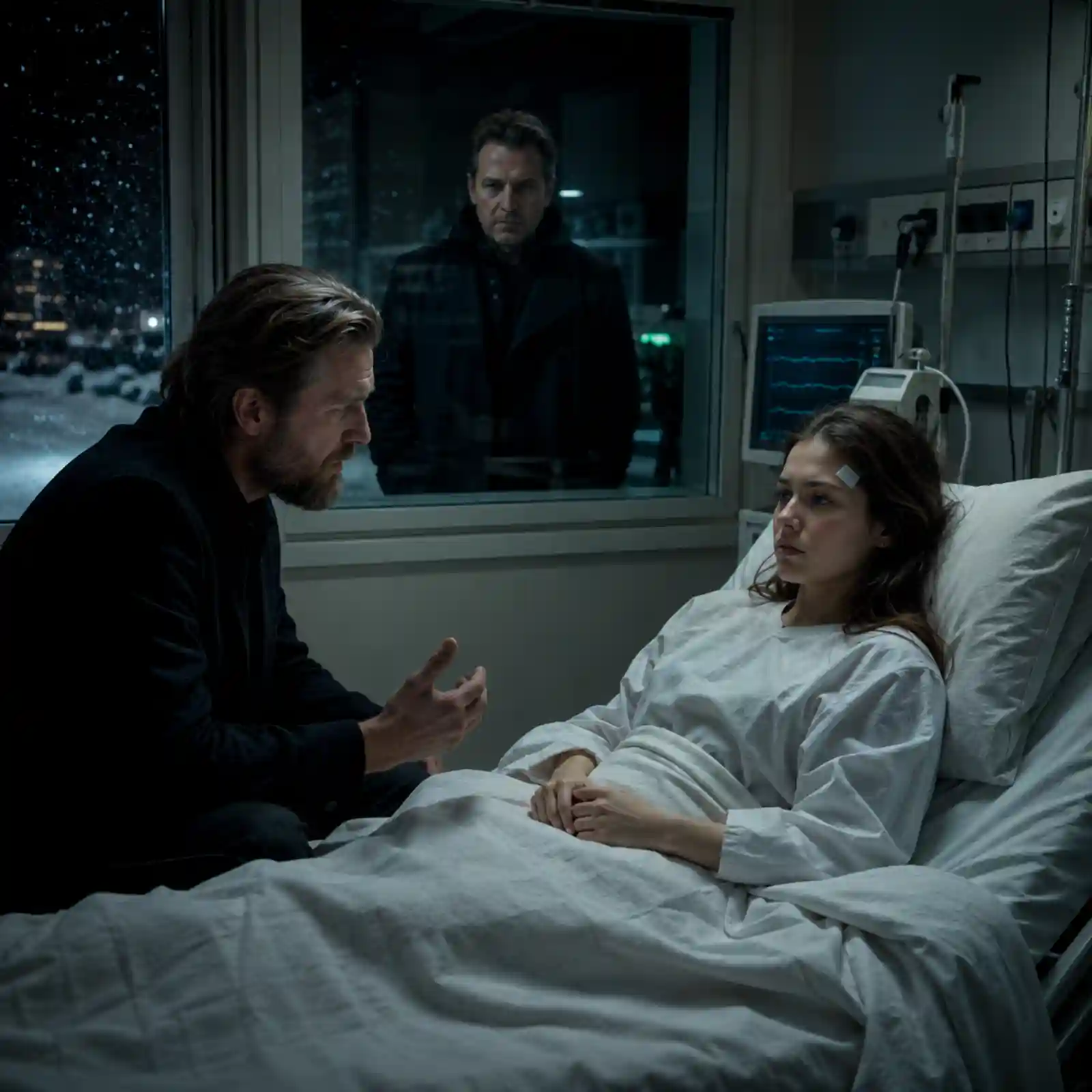
When Onegin encounters Tatyana again, her composure and social authority awaken the passion he could not feel in the countryside. He writes letters, waits for replies, and finally enters her private room in desperation. Eugene Onegin reverses the earlier confession, but it does not present symmetrical suffering as justice. Timing changes the moral meaning of desire. Tatyana is no longer free to answer only for herself.
She admits that her feelings have not vanished, then refuses to abandon her husband. Readers may interpret that decision as integrity, submission, grief, or a combination. Pushkin preserves its difficulty. Tatyana does not reward Onegin’s belated recognition, yet neither does she deny the emotional life that makes refusal costly. Her authority comes from holding love and obligation in the same sentence without pretending they agree.
Within russian literature, the novel helped establish a language flexible enough for psychological intimacy, social observation, comic interruption, and lyric precision. Its influence does not depend only on Onegin as an early “superfluous man.” Tatyana’s development, the intrusive narrator, and the fusion of poetic form with novelistic breadth matter just as much. Eugene Onegin can frustrate readers seeking uninterrupted plot, and its digressions demand attention to tone. Those are also its greatest strengths.
The novel makes belated understanding irreversible. It best suits readers who enjoy formal invention, morally unresolved love stories, and books in which irony deepens feeling instead of canceling it. That ending stops before Onegin can reorganize rejection into another performance. Such abruptness leaves him inside recognition, the one state his practiced detachment can neither master nor escape.