Old Possum’s Book of Practical Cats: Names and Performances
Try saying the cats’ names aloud before deciding what kind of book this is. In Old Possum’s Book of Practical Cats, Thomas Stearns Eliot (T. S. Eliot) makes syllables part of characterisation: a name can sound ceremonious, slippery, cumbersome, or already halfway towards a theatrical entrance. These light-verse poems turn familiar feline habits into performances of personality and social status.
The pleasure is immediate, but it is not merely a matter of recognising one’s own pet. Cats become entertainers, criminals, organisers, and public figures. Each poem finds a form of speech appropriate to its subject, so that a portrait also becomes a miniature demonstration of how people announce, praise, accuse, or explain one another.
Old Possum’s Book of Practical Cats is a collection rather than a continuous adventure. The recurring imaginative world does not supply a central quest or a single dramatic outcome. Its cohesion comes from the narrator’s delighted authority, the abundance of names, and the repeated suggestion that cats possess arrangements humans only partly understand.
That suggestion gives the jokes room to move. A missing household object may indicate a conjuring trick; a lazy appearance may conceal nocturnal management; an absent suspect may become more impressive with every attempted accusation. The poems elevate ordinary inconvenience into legend while retaining the small domestic detail that makes the exaggeration funny.
Readers arriving through the musical Cats should allow the book its own scale. Its performances occur in rhythm, syntax, and imagined voices before they occur on a stage. Reading aloud reveals much of the design. The best introduction is therefore an invitation to listen, with room for pleasure, occasional resistance, and a few historical qualifications.
Names and Privacy in Old Possum’s Book of Practical Cats
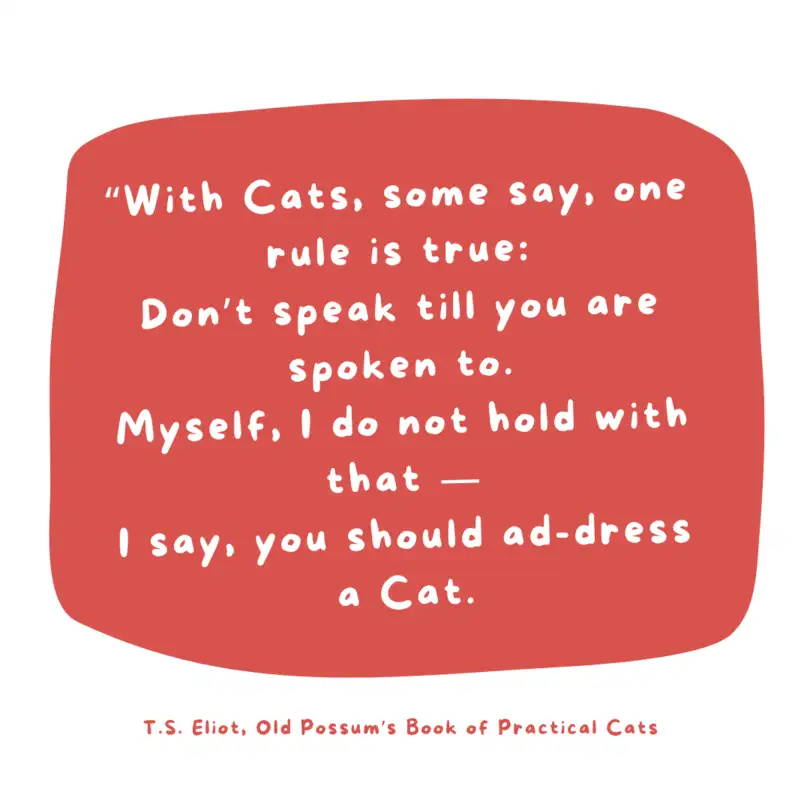
The opening poem proposes several kinds of name, moving from everyday household usage towards something a human cannot discover. That movement gives a comic naming ceremony an unexpected boundary. The cat remains partly unknowable, even after the reader has been supplied with an extravagant vocabulary for addressing it.
Ordinary names establish social familiarity. More elaborate names add distinction and dignity. The final private name belongs to the cat’s own inward attention. The joke works partly because a speaker who sounds so confident must finally concede that knowledge has limits, even in a world he seems able to catalogue.
This creates an illuminating connection with Ode to the Cat by Pablo Neruda. Both poems make the animal resistant to complete human possession. Their methods differ: the ode approaches feline independence through admiration, while the naming poem lets verbal exuberance run up against an inaccessible interior.
In Old Possum’s Book of Practical Cats, this privacy prevents the portraits from becoming wholly transparent human disguises. A cat may resemble a social type and still retain an unexplained reserve. The reader is encouraged to recognise patterns without claiming the authority to finish the creature’s identity.
Names also reward physical speech. Their unusual lengths and combinations ask the mouth to participate in the invention. That participation gives recognition a pleasurable form: before knowing everything about a character, we can already enjoy announcing it.
The opening thus supplies more than introductory whimsy. Old Possum’s Book of Practical Cats begins by balancing classification with mystery, public ceremony with private life. Naming is an approach, not a conquest. The later portraits become more interesting when that limit is remembered, especially whenever a narrator seems sure he has explained a cat completely.
Writing Style: The Ear Does Half the Work
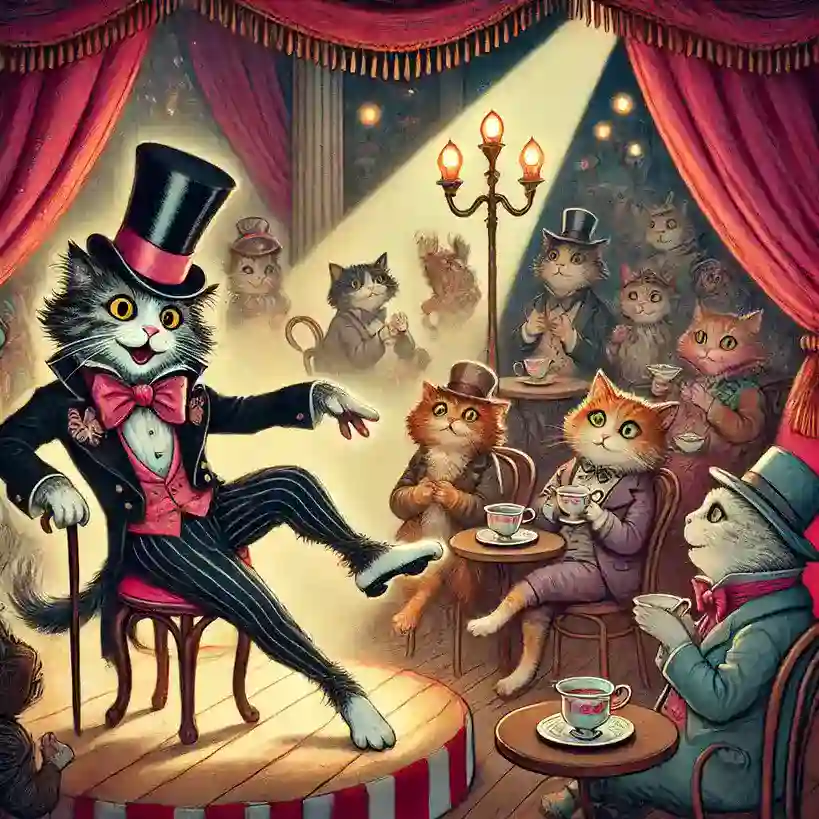
The Writing Style turns rhythm into a way of presenting temperament. A refrain can make a character’s habits feel inescapable, while a longer line can accumulate the bustle of a household or the elaboration of a public reputation. Sound carries the portrait, rather than merely decorating its information.
In Old Possum’s Book of Practical Cats, the narrator frequently addresses an audience as though already standing before one. Invitations, assurances, and renewed announcements make the reader a listener. The poems do not require musical accompaniment to establish an exchange between a performer and people expected to respond.
The Jellicles’ repeated collective identity gives their poem a communal pulse. Mistoffelees’s introduction works differently, building the excitement of a conjuring act. A reader can feel the shift from coordinated dance to an announcer’s delighted insistence without treating all the poems as variations on one tune.
The verbal play in The Book of Songs by Heinrich Heine offers a useful comparison for ease that conceals craft. The emotional and satirical purposes differ, but both collections show why an inviting lyric surface need not mean that sound and reversal are incidental.
Old Possum’s Book of Practical Cats is particularly enjoyable aloud because emphasis can reveal a boast’s absurdity or a refrain’s resignation. Quiet reading may preserve the joke while losing some of its momentum. Conversely, overperforming every line can flatten the distinction between gentle observation and extravagant publicity.
The strongest delivery leaves room for changes of pace. The language can hurry, pause, insist, or wander ceremoniously. Light verse still requires precision: the poems’ apparent friendliness depends on knowing when an unusual word should be relished and when a familiar phrase should land without extra explanation.
Criminals, Organisers, and Social Types
Macavity converts the disappearance of a household culprit into an expanding criminal legend. The accusations reach from domestic theft towards official secrets, but the authorities repeatedly fail to catch him. Old Possum’s Book of Practical Cats makes absence a form of celebrity: the suspect grows grander because he is unavailable.
The detective-story vocabulary creates a direct comparison with The Adventures of Sherlock Holmes by Arthur Conan Doyle. Investigation ordinarily promises that scattered signs can become an explanation. Here, the accumulating signs serve the comic legend without producing the satisfying apprehension of a culprit.
Rum Tum Tugger represents a more domestic difficulty. His preferences reverse whatever is offered, creating a character through an exhausting sequence of alternatives. The poem’s resigned return makes contrariness seem both recognisable and impossible to legislate away. It is funny because management repeatedly fails at the most ordinary level.
Jennyanydots turns the appearance of daytime inactivity upside down with her nighttime organising. Her portrait applies the language of discipline and improvement to a household’s smaller inhabitants. These cats become social types, but the absurd scale keeps the reader aware of the transformation.
The collection’s limits appear when caricature draws on historical prejudice. Growltiger’s Last Stand includes racist language and hostile racial stereotypes. Its defeat of a bullying cat does not make that language harmless. Comic exaggeration can carry inherited contempt, a qualification worth making when introducing the book to children.
Old Possum’s Book of Practical Cats remains inventive because its portraits use different public scripts: criminal notoriety, domestic efficiency, obstinate independence. Their variety also discourages a single moral interpretation. Some performances invite affection, others mock authority, and some require readers to recognise how the joke’s assumptions have aged.
Quotes: Five Glimpses of Verbal Character
These very short excerpts preserve the English wording while leaving room to examine what each phrase does. They come from five different poems in Old Possum’s Book of Practical Cats. Four texts appear in the Academy of American Poets’ permission-based presentation; the remaining phrase is from The Rum Tum Tugger.
- “DIFFERENT NAMES” In The Naming of Cats, the narrator’s capitals emphasise a distinction that ordinary naming habits might overlook. The surrounding progression eventually reaches a name unavailable to human inquiry. The initial certainty therefore leads towards a limit on the speaker’s knowledge.
- “Curious Cat” The opening of The Rum Tum Tugger presents its subject as a type worth announcing. The poem then demonstrates his refusal to settle for whichever option is supplied. The label acquires meaning through repetition, not through a lengthy explanation of his psychology.
- “Jellicle Moon” In The Song of the Jellicles, this recurring phrase supplies the gathering with a time and atmosphere of its own. It makes the cats’ apparently idle daytime behaviour look like preparation for a collective life humans do not ordinarily witness.
- “Hidden Paw” The opening of Macavity: The Mystery Cat gives its criminal an alias with feline specificity. The phrase makes him sound like an established legend before the catalogue of alleged offences expands. Public naming and physical absence strengthen one another.
- “Conjuring Turn” In Mr. Mistoffelees, the narrator frames the cat’s activities as a stage act. That frame promotes household disappearances into proof of extraordinary skill, with the audience invited to join the excitement rather than conduct a sober investigation.
The selection shows Old Possum’s Book of Practical Cats building character through naming and performance. See the Academy’s collection page for the book and its linked poems.
Trivia: Letters, Broadcasts, and Illustrations in Old Possum’s Book of Practical Cats
- Cats in private correspondence: The archive traces the developing feline world to a 1931 letter to the young Tom Faber. That origin helps explain the voice of personal address in Old Possum’s Book of Practical Cats: the imaginative world began with particular readers before reaching a wider public.
- A prepublication radio audience: Geoffrey Tandy read five of the cat poems in a BBC broadcast on Christmas Day 1937. Their life in spoken performance therefore preceded publication as a collection, a useful reminder that the later musical did not invent the poems’ capacity to entertain listeners.
- The first release: The Foundation records publication on 5 October 1939, with an initial printing of 3,005 copies. That release date should be distinguished from bibliographical transcriptions whose imprint states September; the archival account supplies the specific public publication date used here.
- The poet’s cover artwork: The first edition’s front cover and dust jacket used drawings by the author himself. It did not contain the later familiar internal illustrations, so assigning those pictures to the original 1939 edition conflates two stages of the book’s production.
- Bentley’s later contribution: Nicolas Bentley illustrated the new edition in 1940. His work became closely associated with Old Possum’s Book of Practical Cats, but that association does not change the sequence of editions. Foundation publication archive
- The musical’s London opening: Andrew Lloyd Webber’s Cats premiered at the New London Theatre on 11 May 1981. The substantial interval between book and musical makes their relationship one of later adaptation, not simultaneous publication across two formats. Official production history
Old Possum’s Book of Practical Cats Before Cats
Knowing the musical can make the poems feel like sketches of characters waiting for their full dramatic purpose. That approach reverses their history. Old Possum’s Book of Practical Cats already supplies complete small performances, but it does not organise them around the musical’s overarching emotional journey.
The difference is especially clear with Grizabella. The stage adaptation drew on material that had remained unpublished, giving the production an emotional centre absent from the original collection. The musical’s arrangement is a creative response to the poems, not simply a plot that every reader ought to discover hidden between them.
Performance changes the frame. A refrain on the page may express comic resignation; a production can turn its speaker into a prominent stage personality. Movement, casting, and musical emphasis direct attention in ways a book leaves to the voice of whoever is reading. Neither experience makes the other redundant.
The social performances in The Importance of Being Earnest by Oscar Wilde help clarify why names and public roles can themselves become entertainment. Its plot depends on consequences among people, whereas these poems often let an announced personality provide the whole miniature occasion.
Old Possum’s Book of Practical Cats can thus be approached in any order that allows a reader to hear individual differences. Returning to the opening naming poem restores the book’s sense of an animal world partly beyond human explanation. Familiarity with a production may enrich the voices one imagines, but it can also make its interpretations feel compulsory. The more rewarding return lets the poems recover their own pace and notices which effects survive without scenery, choreography, or a larger narrative resolution.
A Delightful Collection with Rough Edges
The book earns its affection through the specificity of its inventions. A celebrated absence, a contrary preference, or an inexplicably missing utensil becomes enough to launch a character. Old Possum’s Book of Practical Cats understands how a household turns repeated behaviour into stories, and how stories gradually acquire the authority of legend.
Readers interested in imagined creatures may enjoy placing it beside The Book of Imaginary Beings by Jorge Luis Borges. That book gathers a different kind of fabulous company. The connection lies in classification as imaginative pleasure, while the cats distinguish themselves through voices and repeated performances.
The collection is especially welcoming to readers who want poems they can speak, share, and remember without first mastering an interpretive apparatus. Children can enjoy the sounds; adults may recognise social habits behind the fur. Those kinds of pleasure coexist without requiring every cat to conceal a solemn allegory.
Its dated prejudices and caricatures still matter. A reader need not declare the entire collection harmless in order to value its invention. Nor does sophistication require pretending that the jokes are secret philosophical puzzles. Critical attention can remain proportionate, distinguishing technical delight from assumptions that deserve objection.
I would recommend Old Possum’s Book of Practical Cats as a collection to revisit in small portions, preferably aloud. Its uneven historical texture makes thoughtful introduction useful, especially for younger listeners. What keeps drawing me back is the balance between public display and private reserve: the poems announce their cats with extravagant confidence, then leave enough unexplained behaviour for the animals to remain themselves after the performance ends.