Hadji Murat: A Warrior Whose Family Becomes a Weapon
Hadji Murat by Leo Tolstoy begins with a narrator destroying a flower he admires. He struggles to uproot a thistle for his bouquet, damages it, and throws it away. That small act introduces a historical novella in which admiration repeatedly accompanies destruction. Commanders value a formidable fighter, officers enjoy his company, and enemies acknowledge his courage. Their appreciation gives him little protection.
First published after its author’s death in 1912, this work of Russian realist fiction follows an Avar commander caught between the Russian conquest of the Caucasus and his conflict with Imam Shamil. His family’s captivity makes every political calculation painfully personal. The achievement of Hadji Murat lies in showing how that predicament connects to other lives: a wounded conscript, a ruined household, an ambitious officer, and rulers insulated from the consequences of their decisions. Its hero is exceptional; the mechanisms closing around him are frighteningly ordinary.
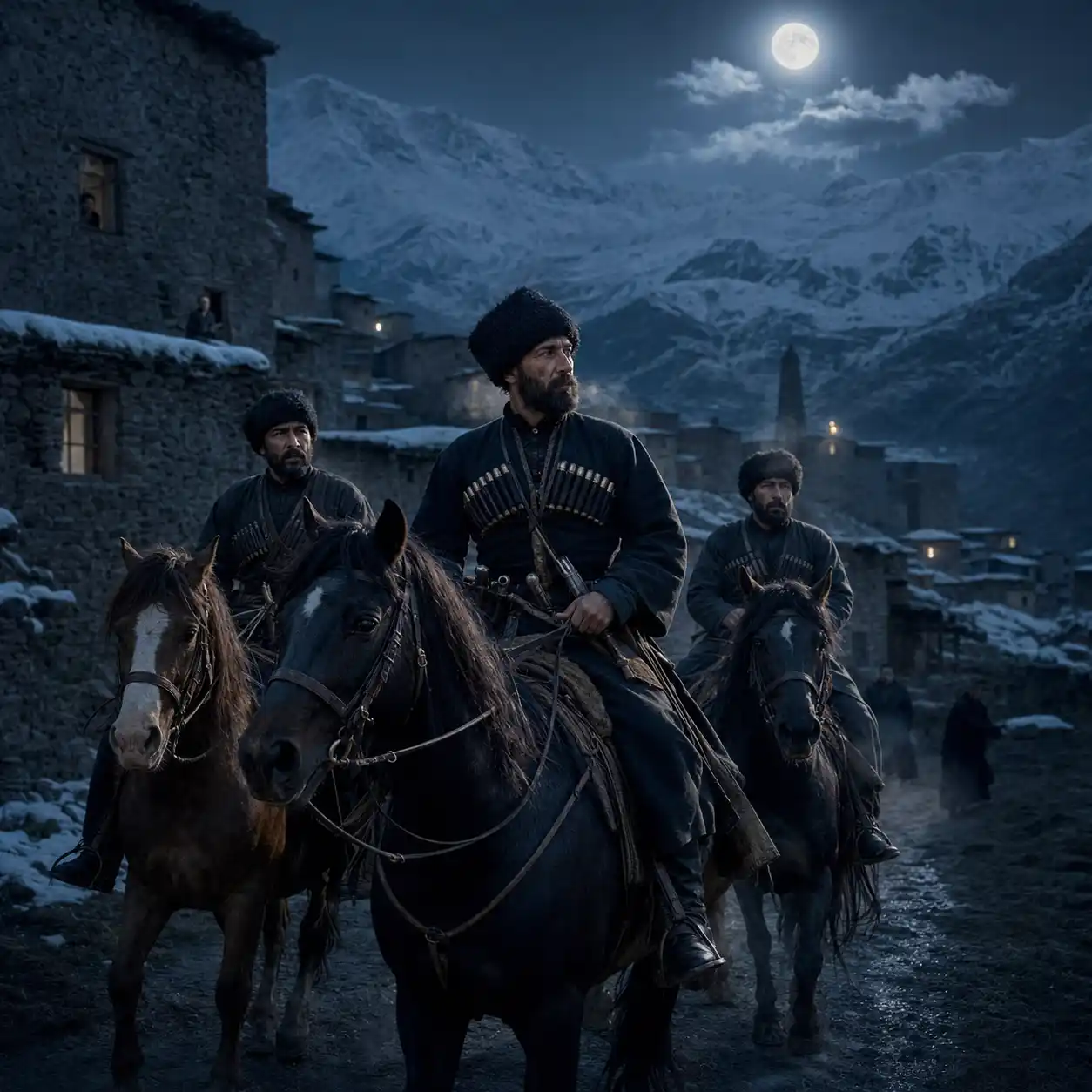
Hadji Murat and the Cost of Choosing a Side
The main action of Hadji Murat begins late in 1851, when Murat seeks Russian protection after falling out with Shamil, whose forces have been resisting imperial expansion. The change of allegiance looks like a decisive move. He brings military knowledge, a formidable reputation, and the possibility of weakening his former leader. For the Russian command, he is an opportunity.
For Murat, the immediate problem is a family he cannot protect. Shamil controls access to the people he loves. A Russian welcome cannot resolve that danger, while a return to his former side offers no dependable safety. Each supposed refuge carries conditions imposed by someone else.
Hadji Murat makes this constraint more interesting by allowing its protagonist ambition as well as affection. He can imagine defeating his enemy, earning distinction, and exercising renewed authority. His desire to save his family does not cancel pride or political calculation. Those mixed motives give his predicament substance: he is an experienced commander seeking room to act, with no reliable way to separate private rescue from military advantage.
Readers of Wallenstein by Friedrich Schiller will recognize a related danger in a general’s attempt to negotiate beyond the allegiance that defines him. Wallenstein’s dealings with the Swedes help turn political possibilities into fatal commitments. Murat’s bargaining is driven more urgently by hostages, but both works expose the fragility of a military leader’s apparent freedom.
This makes choosing sides an inadequate account of choice. Murat can change the people with whom he negotiates. He cannot determine the terms on which they will value him, or make his family’s lives cease to be useful leverage.
The Warmth of a Hospitable Prison
The early welcome is disarming because it includes real curiosity and affection. Murat attracts attention through his composure, reputation, and unexpectedly open smile. The domestic encounters make him approachable without erasing the discipline of a man accustomed to danger.
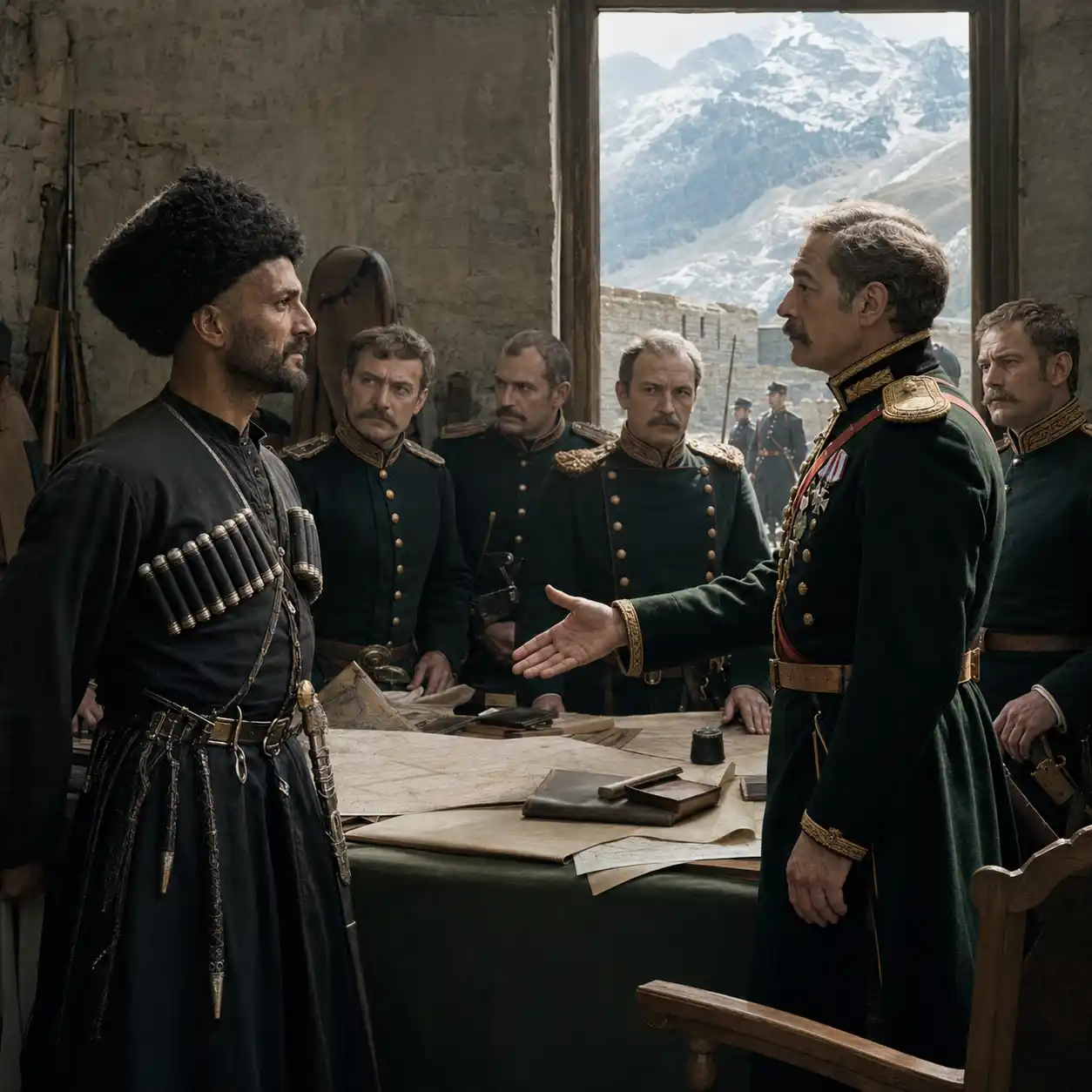
Yet friendliness and freedom remain separate. Officers can admire him while their superiors consider where to keep him, what information he possesses, and how to prevent his departure. The Cossacks accompanying his rides provide protection and surveillance at once. The arrangement’s ambiguity is its practical purpose.
Vorontsov’s letter makes the calculation explicit. Treating the newcomer openly as a prisoner would discourage others from abandoning Shamil. Courtesy has a strategic audience beyond the person receiving it. That does not make every kindly gesture fraudulent, but it shows why goodwill alone cannot secure his independence.
A different imperial society appears in Burmese Days by George Orwell. There, the prospect of admitting an Asian member to the European Club turns social acceptance into a prize controlled by the ruling community. U Po Kyin’s campaign against Dr Veraswami exposes how that prize encourages rivalry. Murat’s welcome is less a desired social promotion than an arrangement he needs to survive, but it too depends on decisions made within a hierarchy he cannot command.
The best scenes preserve the limits of personal sympathy. Sharing a room, accepting a gift, or enjoying someone’s conversation may establish a relationship. It does not necessarily change what one person is authorized to do to the other. The hospitality becomes unsettling precisely because some of its warmth is sincere.
A Dead Soldier Outlives the Dispatch
Avdeev, a Russian private wounded during an encounter, briefly draws the narrative away from its famous protagonist. In hospital, the doctor probes his wound while fellow patients and comrades gather around. His attention falters. Messages home mingle with a question about a missing pipe. The small object has more immediate presence than any grand explanation of the campaign.
The scene establishes a death too particular for a report. Avdeev’s body bears old marks of punishment, his speech breaks into practical concerns, and he asks for a candle as he recognizes that he is dying. None of this grants him an exemplary military identity. It gives him an individual existence that the official dispatch will barely record.
The report that follows describes an engagement through units, movements, and casualty totals. Its narrow account collides with what we have just witnessed. The subsequent move to the soldier’s family extends the discrepancy: he belonged to a household whose labor, resentments, and memories have continued while he served elsewhere. His absence has an economic and emotional shape.
In All Quiet on the Western Front by Erich Maria Remarque, Paul Bäumer’s encounter with the dying Gérard Duval also breaks an enemy category into an individual life. Duval becomes a man with a trade and family. Here, the narrative itself does that work for a soldier whom commanders can reduce to a loss in an engagement. The comparison sharpens our awareness of what military language leaves out.
The digression is essential to the book’s judgment. Murat’s extraordinary courage cannot be the only reason a death matters. Avdeev’s interrupted life enlarges the moral field beyond the commanding figure at its center.
The Village the Army Has Just Left
One of the novella’s most powerful transitions moves from the Russian officers’ experience of a raid to its consequences for the inhabitants. Butler enjoys the landscape, comradeship, and release from his former life of gambling. The campaign seems to offer purpose and renewal. The narration lets that pleasure become convincing before revealing what sustains it.
The ruined village is the place where Murat previously found shelter. This return gives destruction a recognizable address. Sado’s house has been wrecked; the boy who looked at the visitor with admiration has been killed. Trees and beehives are destroyed, the water source polluted, and the mosque defiled. These are the materials and practices through which a community continues living. Their destruction reaches beyond the immediate casualties.
The effect comes from the connection between scenes. The household that once offered food and security now has to bury a child and rebuild. Butler’s satisfaction can no longer stand as an adequate description of the expedition, although nothing requires him to stop feeling it. His capacity for ordinary happiness becomes part of the horror.
The villagers’ reaction is fierce and dehumanizing in turn. The text does not soften their revulsion into a dignified speech for an outside audience. Their possible choices are also constrained: rebuild under the threat of another raid, or submit to the force that has devastated them. Survival itself becomes a political pressure. The passage gives the conquest a concrete method while refusing to let the reader remain comfortably inside the army’s view of its achievement.
Two Rulers, Different Powers, Similar Certainties
The extended portrait of Nicholas I can initially seem to interrupt the story. It follows an imperial day through vanity, personal appetite, official business, and the expectation of deference. Murat’s fate enters a consciousness occupied by many other concerns.
That disproportion is the point. A ruler’s passing mood can govern another life. A minister hopes to influence the decision, while Nicholas’s response also reflects his reaction to the minister. A person in the Caucasus becomes an item passing through court rivalries.
The chapter’s cruelty is sharpened by self-approval. Nicholas can prescribe a punishment he knows will kill while congratulating himself on the absence of capital punishment. The official description permits him to preserve an image of humane authority without changing the suffering he orders.
Shamil’s council provides a related performance of certainty. A pause is understood as communion with sacred authority, while the decision being prepared concerns how to exploit Murat’s love for his son. Yusuf, who has admired the Imam, encounters the threat behind that prestige. The gap between veneration and vulnerability becomes painfully immediate.
The parallel exposes power’s talent for justifying itself, but it should not erase the different positions of an expanding empire and those resisting it. Russian forces destroy the village; that responsibility remains specific. Shamil’s treatment of hostages is another action to judge, not an explanation that excuses the invasion. Hadji Murat can recognize domination within resistance while making the violence of conquest unmistakable. Its breadth comes from examining particular acts, even when the actors claim very different causes.
Hadji Murat Makes His Last Ride Without a Safe Destination
As attempts to secure his family’s release fail, Murat must decide whether continued waiting is itself a surrender. The fable of a falcon rejected by its own kind after living among humans gives his situation a merciless shape. Returning home cannot simply restore the belonging that political circumstances have damaged.
His decision to escape restores the possibility of action, at a terrible cost. He and his followers kill members of the escort. The narrative has introduced those men as individuals with dependants and histories, preventing their deaths from becoming a convenient gateway to someone else’s freedom. Sympathy for Murat cannot make the violence disappear.
Then terrain frustrates intention. Flooded rice fields impede the horses, delay the fugitives, and help make pursuit effective. Knowledge, courage, and leadership remain real abilities; they do not make the ground cooperate. The final resistance is extraordinary, but its result cannot fulfil the purpose that drove him towards it. His family has not been rescued.
The wounded Robert Jordan in For Whom the Bell Tolls by Ernest Hemingway also tries to give his remaining strength a purpose while enemies approach. Jordan hopes to delay pursuit after his companions have escaped. Murat’s last stand offers no equivalent assurance that the people he loves have reached safety. The difference makes courage and success painfully separable.
This is the ending’s hardest achievement. It allows us to feel the force of resistance without turning death into the accomplishment of the rescue. The body’s persistence commands attention, while the unfulfilled intention remains beside it. Heroism cannot settle the account.

Quotes: Passages on Admiration and Control – Hadji Murat
The following passages use Aylmer Maude’s historical translation, available from Standard Ebooks. They bring together the observer, the administrator, and the dissenter, rather than treating the protagonist as the book’s only significant voice.
- “But what energy and tenacity! With what determination it defended itself, and how dearly it sold its life!” The narrator admires the thistle after struggling to tear it out. His admiration implicates the admirer: recognizing resistance does not prevent him from destroying its source.
- “If we treat Hadji Murád as a prisoner, all the good effect of the situation will be lost.” Vorontsov explains the political value of a courteous reception. The concern is what the treatment will communicate to others who might abandon Shamil.
- “I do this because I consider it necessary,” said Nicholas, “and I will not allow it to be discussed.” The sentence makes the ruler’s conviction sufficient justification. Its closure against discussion helps explain how individual judgment becomes an unanswerable public order.
- “War? War, indeed! … Cutthroats and nothing else. A dead body should be given back to the earth, and they’re grinning at it there!” Marya Dmitrievna refuses the officers’ treatment of the dead man as a spectacle. Her anger challenges the vocabulary through which they normalize what they are doing.
- “He felt nothing more, and his enemies kicked and hacked at what had no longer anything in common with him.” At the end, sensation and the body separate. The victors continue acting upon the remains, but the sentence denies that their possession amounts to possession of the person.
Trivia: The Caucasus, Publication, and Storytelling in Hadji Murat
- A posthumous book with censored passages: Hadji Murat first appeared in 1912. The publication history preserved at slovotolstogo.ru records cuts in the Moscow edition, notably to the Nicholas chapter and the devastated village. It also records an uncensored Berlin publication that same year, an important qualification to simplified accounts of the text’s release.
- Several peoples inhabit the story: The central figure is associated with Avaria, while Chechen villages and followers from different Caucasian communities also enter the narrative. These distinctions matter: the novella’s setting should not be reduced to one undifferentiated people confronting Russia.
- Military experience behind the setting: The author’s service began in the Caucasus in 1851, before his transfer to the Danube army in 1854. The Tolstoy Museum documents this sequence. His later literary treatment returns to a region he knew as a participant in the imperial military world.
- A letter occupies an entire chapter: Chapter XIV presents Vorontsov’s communication to the Minister of War. Its calculations about trust, supervision, and political advantage make administrative prose part of the novella’s storytelling. The letter shows how a desperate family situation is translated into the language of state usefulness.
- A song anticipates the last resistance: Before the escape, Murat hears a song about Hamzad fighting overwhelming Russian forces. The song supplies a heroic pattern against which the subsequent battle can be read. Its presence brings oral storytelling into a work otherwise crowded with reports, conversations, and private thoughts.
Writing Style: Moving Beyond the Hero’s View
The writing style in Hadji Murat depends on changes of scale and perspective. A conversation about an individual leads to imperial business; an army’s excursion leads to the people left behind; a warrior’s fate interrupts a provincial household. These shifts repeatedly reveal something the preceding viewpoint could not, or would not, contain.
The prose is especially effective when placing confident language beside vulnerable bodies. A dispatch counts losses after the reader has watched a man die. A ruler congratulates himself on a policy whose consequences the narrative makes visible elsewhere. The irony emerges through arrangement as well as direct comment.
Marya Dmitrievna’s response to the severed head gives that method a human voice. Where the officers can mix admiration with the display of a trophy, she insists on what has been done to a person. Cassandra by Christa Wolf offers a useful formal comparison: the fall of Troy is reconsidered through a woman’s memories rather than contained within the prestige of its celebrated warriors. Here, a woman’s objection similarly disturbs the authority of a heroic account. Witness challenges the language of glory.
There are limitations. The crowded succession of officers, relatives, titles, and places requires attention, especially when names vary between translations. The Nicholas portrait becomes openly prosecutorial; readers who value the subtler transitions may find its satirical emphasis heavy. Murat’s family also matters more often as the object of rescue than as a fully developed group of perspectives. Yusuf’s encounter with Shamil partly corrects that imbalance, but cannot remove it.
Those reservations do not diminish the novella’s most demanding insight. The opening narrator wants the thistle’s beauty for his own arrangement and destroys it in obtaining it. At the end, admiration for endurance must confront another destroyed life. Hadji Murat asks the reader to examine what admiration permits us to overlook. For anyone interested in the relationship between military courage, political power, and ordinary vulnerability, its shifting attention offers a remarkably concentrated reading experience.
More reviews of works by the russian writer

Was this article helpful?
…One vote per user. No account needed.