The Client by John Grisham – A Suicide Leaves Mark Sway With a Deadly Secret
The Client begins in a patch of woods near a Memphis trailer park, where eleven-year-old Mark Sway is teaching his younger brother Ricky to smoke. A large car arrives, and its driver runs a hose from the exhaust into the interior. Mark repeatedly removes the hose because he wants to stop the stranger from killing himself. John Grisham turns that impulsive act of courage into the mistake that reorganizes both boys’ lives. A rescue attempt becomes an involuntary confession.
The driver is Jerome Clifford, known as Romey, a lawyer for New Orleans mobster Barry “the Blade” Muldanno. Intoxicated and terrified, Clifford catches Mark, forces him into the car, and reveals why he expects to die. Muldanno murdered Senator Boyd Boyette, and Clifford knows where the missing body is buried. Mark escapes before Clifford shoots himself, but knowledge has already made the boy valuable to prosecutors and dangerous to organized crime.
Ricky witnesses the suicide and withdraws into traumatic shock. Mark remains able to speak, yet that difference does not mean he is unharmed. The Client builds its suspense around two contrasting responses to terror: one child becomes almost unreachable, while the other survives through argument, deception, and constant motion. Mark’s voice is both shield and evidence.
The opening succeeds because every later conflict is present in miniature. An adult tries to transfer an unbearable burden to a child, violence enters an ordinary place, and Mark must act before reliable help arrives. The legal thriller begins outside a courtroom because its central question is not simply whether the law can obtain the truth. It is whether powerful adults can seek that truth without destroying the child who carries it.

Mark’s Defiance Has Been Learned Through Poverty
Mark is unusually alert to adult weakness, but The Client never suggests that poverty has magically made him invulnerable. He lives with Ricky and their mother, Dianne, in a trailer park after an abusive father has left the family. Money is scarce, authority has often been unreliable, and Mark has learned to read danger before adults acknowledge it. Street knowledge has developed where security should be. His confidence therefore combines real competence with the exhausting vigilance of a child forced to grow quickly.
He lies to police officers, studies their questions, and notices when explanations do not fit. These skills make him an effective thriller protagonist because he can influence events rather than wait for rescue. Yet the author repeatedly restores his age through fear, anger, impulsive decisions, and his attachment to Ricky. Mark understands that officials want information, but he cannot calculate every legal consequence or mob strategy surrounding him.
Institutional cruelty toward vulnerable children also shapes 👉 Oliver Twist by Charles Dickens. Dickens uses satire and melodrama to expose a society that treats poverty as moral failure. Grisham writes a modern commercial thriller, but The Client shares the recognition that adults often praise a child’s resilience while benefiting from the conditions that made resilience necessary.
Mark is resourceful because dependence feels unsafe. That distinction keeps his cleverness from becoming a fantasy of complete self-sufficiency. Every successful deception buys time, not peace. The boy needs an advocate who can respect his intelligence without treating it as proof that he should bear adult risk alone.
Reggie Love Makes Representation Personal
Mark finds Reggie Love almost by chance and hires her with a one-dollar retainer. She has practiced law for only a few years, lacks the institutional resources of the federal government, and does not initially know the full secret. What she offers is more important than prestige. Reggie represents Mark before using him as evidence. That professional choice gives The Client its emotional and ethical center.
Reggie’s authority has been built after personal collapse. A painful divorce, separation from her children, alcoholism, and recovery preceded her legal career. The writer does not make suffering an automatic qualification, but it helps explain why she recognizes fear behind Mark’s defiance. She knows that a person can appear difficult while struggling to preserve the last available form of control. Her patience remains practical rather than sentimental because she challenges his lies while defending his right to counsel.
The relationship develops through negotiation. Mark withholds information because disclosure may bring the Mafia to his family, while Reggie insists that she cannot protect him from dangers she does not understand. The Client turns attorney-client trust into a suspense mechanism. Each partial confession increases intimacy and risk at the same time.
Public narratives close around an individual with similar speed in 👉 The Lost Honor of Katharina Blum by Heinrich Böll. Böll focuses on press violence, whereas Grisham examines prosecutorial and criminal pressure. Both works show why formal innocence offers little immediate protection once powerful institutions define a person as useful. Advocacy resists that imposed identity.

Roy Foltrigg Turns Prosecution Into Performance
United States Attorney Roy Foltrigg arrives from New Orleans with a reputation built on courtroom preaching and media attention. Called “Reverend Roy,” he approaches the Boyette case as both a criminal prosecution and a stage for his ambitions. He needs the senator’s body to secure the case against Muldanno. The Client does not deny the legitimacy of that goal, but it questions what prosecutors may sacrifice while pursuing it. A public duty becomes entangled with personal glory.
Foltrigg and the FBI see Mark as the shortest route to missing evidence. Their logic is institutionally coherent: a murdered senator deserves justice, a dangerous mobster remains free, and a witness may know the decisive fact. The problem lies in how easily this reasoning turns a frightened boy into an obstacle. Pressure, detention, subpoenas, and strategic leaks become tempting because officials describe urgency as permission.
Judge Harry Roosevelt introduces a more humane form of authority. His juvenile court must balance Mark’s welfare, the government’s demands, and legal procedures that were not designed for this extraordinary threat. Even protective detention feels punitive to a child who distrusts the adults controlling him. The incomprehensible accusation surrounding Josef K. in 👉 The Trial by Franz Kafka offers a darker comparison. Kafka’s system has no intelligible purpose, while his officials pursue an identifiable crime. Yet both narratives show procedure expanding until the person at its center struggles to remain visible.
Law can injure without becoming lawless. This is one of the novel’s sharper insights. The government’s case may be righteous, but righteousness does not guarantee proportionate methods.
The Mafia Makes Silence a Matter of Survival
Barry Muldanno knows that Senator Boyette’s body can connect him to murder. Jerome Clifford’s suicide creates uncertainty because the lawyer may have passed the location to Mark. Organized crime therefore mirrors the government’s interest in the boy while reversing its desired outcome. Prosecutors need him to speak, and Muldanno needs him permanently silent. Both sides reduce knowledge to leverage. The Client places Reggie between those pressures with few resources beyond law, nerve, and Mark’s incomplete trust.
Mob operatives watch the hospital, threaten Mark, and extend danger toward anyone protecting him. The burning of the Sway family’s trailer destroys the small amount of security Dianne has managed to maintain. That attack matters beyond its thriller function. In The Client, wealthier witnesses might relocate, hire specialists, and disappear temporarily. Mark’s family can lose nearly everything through a single act because poverty leaves no buffer between intimidation and homelessness.
The social aftermath of murder receives a documentary scale in 👉 In Cold Blood by Truman Capote. Capote reconstructs how violence alters a Kansas community, while Grisham uses faster and more openly dramatic machinery. Even so, The Client similarly understands that crime expands beyond its original victim. Ricky’s illness, Dianne’s lost work, the destroyed home, and Mark’s fear are consequences of a killing committed in another state against a man the family never met.
Violence travels through unequal lives. Muldanno possesses money, armed associates, and family connections. The Sways possess information they never wanted. Suspense grows from the brutal mismatch between those forms of power.
Confidentiality Becomes a Test of Legal Ethics
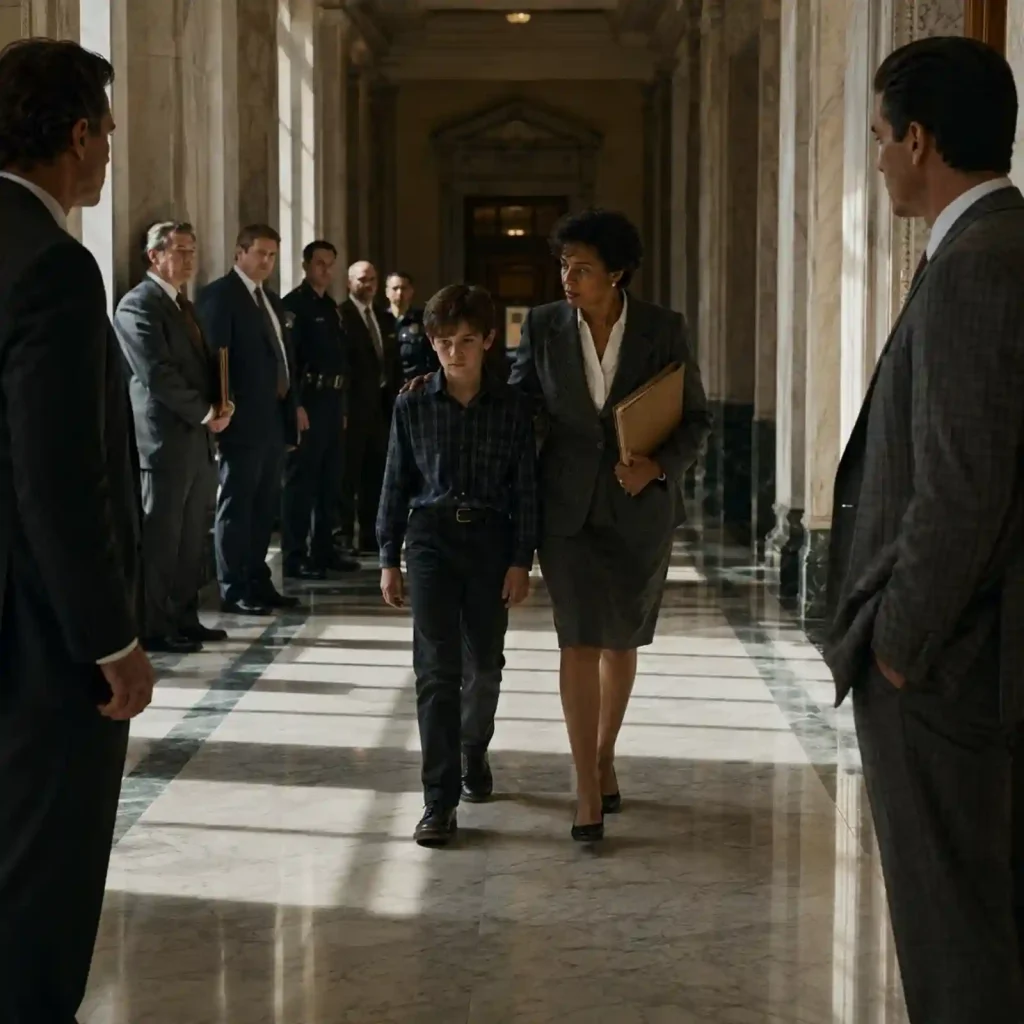
Mark fears that telling Reggie the location will merely move the threat from himself to both of them. Reggie must protect confidentiality while avoiding promises the law may not support under every circumstance. The Client translates legal concepts into personal choices rather than stopping for abstract lectures. A secret creates duties before it creates strategy. Readers understand privilege because they see what disclosure could do to a child, a lawyer, and a criminal case.
Mark invokes the Fifth Amendment and resists questions, but his position remains precarious. He is not accused of Boyette’s murder, yet officials can use courts and custody to compel cooperation. The novel dramatizes the gap between having rights and possessing the confidence, knowledge, and representation required to exercise them. Reggie’s presence changes the room because she can name pressure that Mark could only experience.
Their disagreements also prevent the attorney-client relationship from becoming idealized. Reggie sometimes pushes too hard, and Mark’s evasions make responsible counsel nearly impossible. Trust grows through conflict because neither character can solve the danger alone. Protection requires truthful dependence.
The novel takes liberties for pace and drama, but its legal machinery serves a consistent moral inquiry. Evidence does not exist outside human cost, and a prosecutor’s desire for conviction cannot erase the vulnerability of a witness. The Client works best when several valid obligations collide: prosecute murder, protect a child, preserve confidentiality, and prevent further violence. That collision becomes compelling because every available choice transfers risk to someone. No option is morally cost-free.
Mark and Reggie Search for the Body Themselves
Government pressure and mob surveillance eventually convince Mark that waiting will not make him safe. He and Reggie travel toward Clifford’s property, where the senator’s body has been concealed beneath concrete in a boathouse. Muldanno’s men arrive for the same reason. The hidden corpse becomes the meeting point. From there, The Client shifts from legal contest to physical investigation without abandoning its central concern with evidence and power.
In The Client, the decision is reckless, especially because Reggie brings a child close to armed criminals. The novelist does not fully disguise that implausibility. Instead, he uses it to show how institutions have narrowed their choices. Mark believes the FBI will use and expose him, while Reggie knows that the Mafia will not accept indefinite uncertainty. Finding the body may be the only fact valuable enough to purchase protection on their terms.
This episode reverses their earlier relationship. Mark has often possessed the information while Reggie supplied legal judgment. At the boathouse, they share physical danger and direct observation. Neither must rely entirely on Clifford’s words once they see where the body lies. Knowledge changes from burden into bargaining power.
The discovery also ends Muldanno’s advantage. A concealed body allowed him to occupy the space between suspicion and prosecution. Once its location can be delivered, officials no longer need Mark’s testimony in the same way. The boy cannot defeat organized crime through force, but he can change the value of the secret controlling him. Through evidence, The Client makes agency possible, even though the cost of acquiring it remains frighteningly high.
A Child Who Knows Too Much: Quotes from The Client
- “Mark was eleven and had been smoking off and on for two years, never trying to quit but being careful not to get hooked.” The opening combines childish confidence with adult rationalization. Mark already believes he can manage danger. 🌐 Official excerpt
- “He felt like an eleven-year-old father.” Mark’s protectiveness toward Ricky predates the central crisis. The thriller intensifies responsibilities he was already too young to carry.
- “They were supposed to gawk in fear and get out of his way.” Muldanno treats intimidation as a public performance. His appearance must advertise power before he exercises it. 🌐 Quote and chapter reference
- “One good thing about jail is that it allows you to think a lot.” Confinement creates time but removes control. The dry joke cannot disguise Mark’s vulnerability. 🌐 Quote
- “He lived forty-four years and no one cried at his funeral.” Professional knowledge and money have produced no human legacy. The sentence reduces Romey’s tragedy to absence.
- “Between staying drunk and chain-smoking, he’ll be dead in a few years.” Mark discusses his father with a child’s blunt survival logic. Dark humor reveals the violence behind his premature independence.
Eleven Years Old Against the System: Eight The Client Facts
- The novel appeared in 1993: It followed A Time to Kill, The Firm, and The Pelican Brief, making it his fourth novel. It became a number-one New York Times bestseller. 🌐 Penguin Random House
- A forbidden cigarette initiates the entire thriller: Eleven-year-old Mark Sway takes his eight-year-old brother Ricky into the woods to smoke. Their minor act of rebellion places them beside a suicidal lawyer carrying a lethal secret.
- He becomes the only witness: The dying lawyer reveals the location of a murdered senator’s body. Like the staged notice in 👉 A Murder Is Announced by Agatha Christie, one extraordinary disclosure reorganizes everyone’s behavior.
- Knowledge makes Mark valuable: Prosecutors need him to speak, while the Mafia needs him permanently silent. The moral pressure of carrying another man’s crime creates a youthful counterpart to 👉 Crime and Punishment by Fyodor Dostoevsky.
- Reggie Love is deliberately inexperienced: She has practiced law for only four years when Mark hires her. Her own history of addiction and family loss helps her see a frightened child where officials see evidence.
- The title changes meaning as the story develops: “Client” initially sounds like a professional legal category. Reggie’s responsibility expands into protection, emotional support, strategy, and decisions that no conventional attorney should have to make.
- Film earned recognition for Susan Sarandon: Joel Schumacher’s 1994 adaptation starred Sarandon, Tommy Lee Jones, and Brad Renfro. Sarandon received an Academy Award nomination and won the BAFTA for Leading Actress. 🌐 BAFTA
- The adaptation continued on television: CBS broadcast a one-season series in 1995–96 with JoBeth Williams as Reggie and John Heard as Roy Foltrigg. Ossie Davis returned as Judge Harry Roosevelt, the role he had played in the film.
Witness Protection Offers Safety Without Restoration
Reggie negotiates a deal that places Mark, Ricky, and Dianne in witness protection. She reveals the body’s location only after the family is moving beyond immediate reach. The arrangement resolves the thriller’s central danger, yet it requires the Sways to surrender names, home, routines, and community. Survival arrives through disappearance. The Client refuses to describe that outcome as a complete victory.
Ricky still needs treatment for trauma, Dianne must rebuild a life, and Mark carries memories that cleverness cannot neutralize. Reggie also loses the daily presence of a client who has become emotionally important to her. Their relationship succeeds professionally because it ends with the child protected, but that success contains separation. The law can organize relocation more easily than it can restore childhood.
Justice and mercy remain similarly uneasy partners in 👉 Les Misérables by Victor Hugo. Hugo builds an enormous moral epic around law’s failure to recognize transformation, while he works through commercial suspense and institutional bargaining. Both novels distinguish legal persistence from humane judgment. A correct prosecution is not the whole of justice.
Published in 1993, The Client became one of his defining early bestsellers because its structure combines an immediate hook, accessible legal conflict, a vulnerable hero, and a sustained chase. Some villains are broadly drawn, and several escapes strain realism. The emotional design remains strong because every reversal returns to one clear imbalance: adults with institutions, money, and weapons are competing over what a child knows. Reggie’s achievement is to make the child matter more than the secret.