Turbulence : A City Without Escape
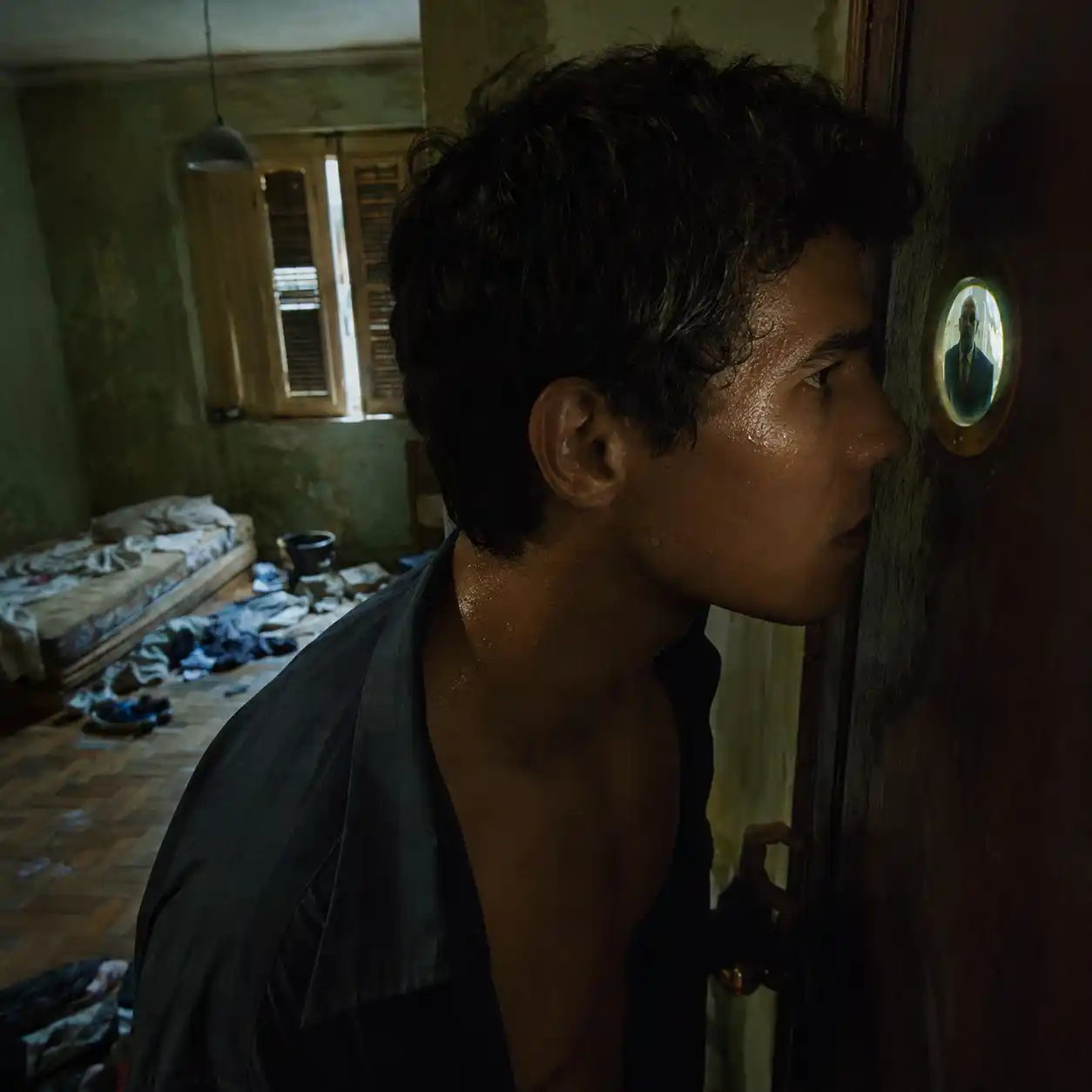
Turbulence begins with an unnamed man waking to the insistence of his doorbell. Through the peephole, he sees a well-dressed visitor whose face becomes distorted by the glass. He cannot identify the man, establish what he wants, or decide whether the danger is real. Chico Buarque makes that uncertainty more decisive than any confirmed threat. Fear becomes evidence before facts arrive. The narrator escapes through another part of the building and begins a journey that never acquires a secure destination. Flight becomes his first answer and soon hardens into his only recognizable method.
The opening defines the visual logic of Turbulence. A peephole should help an occupant distinguish safety from danger, but here it alters the object it reveals. The narrator’s consciousness works in the same way. He notices surfaces, gestures, clothing, money, and routes with unusual intensity, yet every observation passes through anxiety. Readers receive a crowded field of detail without gaining a stable overview. The result resembles the divided interior landscape of 👉 The Book of Disquiet by Fernando Pessoa. Pessoa’s Bernardo Soares converts Lisbon into an extension of solitude, while Buarque turns urban movement into paranoid exposure.
Nothing in this first encounter produces the clean contract of a conventional thriller. The visitor does not supply a visible crime, a clear pursuit, or a motive that can organize later events. Instead, the unknown man activates an existing collapse. Turbulence therefore asks a more disturbing question than who stands outside the door. It asks what kind of life can be overturned by a face that may not even have arrived to cause harm.
Movement Through the City Creates No Distance
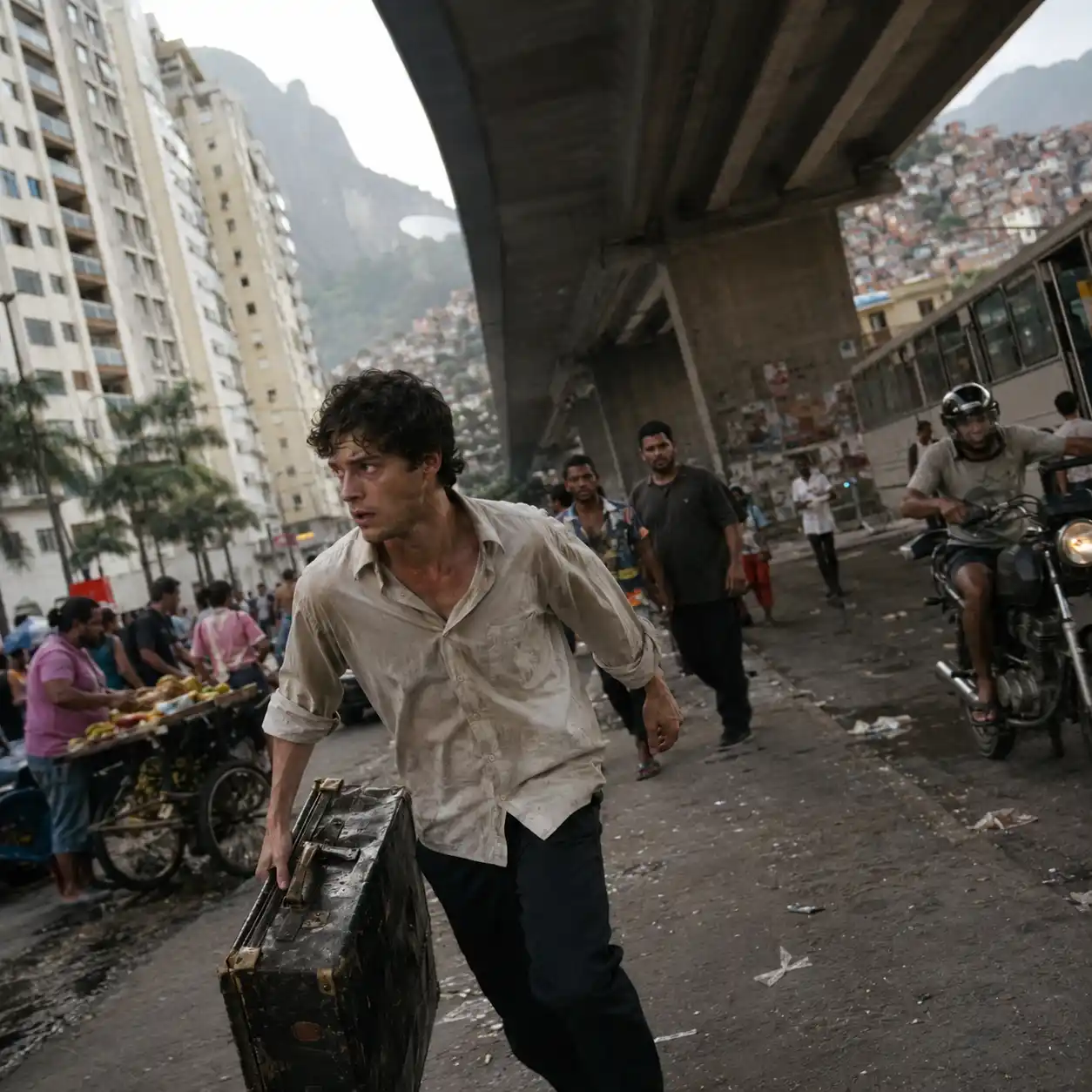
Once outside, the narrator crosses streets, rides public transport, enters affluent buildings, and returns to places associated with earlier versions of himself. Motion promises escape but repeatedly brings him back into the same network of dependence and humiliation. Turbulence uses the city less as a map than as a circulation system. Every route carries him toward another failed refuge. Crowds offer anonymity, yet they also increase the number of glances, collisions, and possible pursuers he must interpret.
Buarque keeps the city largely unnamed in the English text, although its inequalities and rhythms evoke Rio de Janeiro. That partial anonymity prevents local detail from becoming picturesque scenery. Luxury apartments, poorer streets, guarded entrances, taxis, buses, and rural edges belong to one fractured order. The narrator can pass among these zones because of his family background, but he belongs securely to none of them. His movement reveals social boundaries without giving him a stable position from which to judge them. Physical access only makes his emotional and social exclusion more visible.
The urban unease of 👉 Nausea by Jean-Paul Sartre offers a useful contrast. Antoine Roquentin’s encounters with ordinary objects lead toward philosophical confrontation, whereas the man in Turbulence rarely converts discomfort into sustained thought. He reacts, imagines, flees, and drifts. Consciousness produces momentum without direction. This difference matters because Buarque’s protagonist is not seeking a truth beneath appearances. He barely preserves continuity from one encounter to the next. The city becomes the physical form of that condition, always moving and never arriving.

Family Privilege Survives Without Family Intimacy
The narrator comes from wealth, but he inhabits privilege as a damaged inheritance rather than a dependable shelter. His sister lives comfortably and gives him money, even though their exchanges reveal distance, embarrassment, and unequal expectations. He visits her home as both relative and intruder. Turbulence shows that access can continue after belonging has disappeared. Family doors open without offering welcome.
His ex-wife represents another failed connection. He approaches her with needs he cannot state cleanly and memories he cannot organize into responsibility. Their marriage appears less like a lost paradise than one stage in his longer withdrawal from reciprocal life. His mother remains similarly remote, present in conversation and recollection but difficult to reach. The narrator circulates among women who once sustained him while contributing little that could support them in return.
That imbalance becomes unmistakable when he steals his sister’s jewelry. The theft converts emotional dependence into material violation, yet he does not narrate it with the moral clarity expected from confession. He moves quickly from desire to justification, then toward the next practical problem. The narrative gaze toward poverty and social invisibility differs sharply from 👉 The Hour of the Star by Clarice Lispector. Lispector makes the act of representing a vulnerable life an ethical crisis. Buarque instead traps readers inside the consciousness of a man who consumes other people’s care.
Need has replaced mutual obligation. In Turbulence, class privilege does not protect the narrator from decline, but decline does not make him innocent. His family’s resources cushion his movement even as he damages the relationships that provide them. The novel keeps material advantage present even when the protagonist feels personally abandoned.
The Childhood Farm Has Become Hostile Territory
The old family farm appears to offer an escape from urban confusion. It carries memories of childhood, land, and a more coherent social order. When the narrator returns, however, he finds the property occupied by men connected with drugs and violence. The place survives geographically while its meaning has changed. Nostalgia arrives after ownership has already failed. Turbulence refuses to preserve the countryside as a moral alternative to the city.
The farm exposes contradictions that the narrator’s movement through wealthy interiors could partly conceal. His family once possessed land and authority, but neither guarantees continuing control. The new occupants create another hierarchy based on force, secrecy, and illegal commerce. Meanwhile, the narrator enters this environment with the confused confidence of someone who remembers access but cannot enforce it. His childhood association with the property becomes useless against men who operate according to present power. Memory grants him familiarity, but no protection, status, or practical command.
A suitcase of marijuana draws him further into this criminal economy. He handles it less like a calculating trafficker than a person unable to understand the consequences attached to objects passing through his hands. Yet confusion does not prevent those consequences from becoming physical. The unreachable administration in 👉 The Castle by Franz Kafka similarly leaves its protagonist wandering through a territory whose rules remain inaccessible. Buarque replaces bureaucracy with unstable class relations and violence, but both novels deny the traveler a reliable claim to place.
The past cannot certify present belonging. In Turbulence, the farm becomes a compressed image of social transition. Former privilege, criminal occupation, rural memory, and police intervention overlap without producing a legitimate order.
The Narrator Cannot Separate Memory From Projection
The first-person voice constantly approaches explanation and then slips away from it. His mind imagines what another person may be thinking, rehearses possible scenes, and sometimes treats anticipated events with the vividness of recollection. Turbulence moves between waking experience, dream, memory, and projection without erecting firm borders. Possibility enters the narrative dressed as fact. Readers must therefore evaluate not only what happens, but also the mental process through which an event becomes reportable.
This instability does not reduce the novel to a puzzle with one hidden, correct chronology. Buarque is less interested in inviting a final reconstruction than in making perception itself feel unreliable. The narrator may accurately register a threatening gesture while misunderstanding its cause. He may also imagine danger and then act in ways that produce the violence he feared. His distorted viewpoint changes the world because other people respond to his evasions, thefts, intrusions, and sudden movements. Perception becomes action before it has survived the discipline of interpretation.
The method protects Turbulence from a simple diagnosis. Paranoia is present, but so are genuine crime, class conflict, exploitation, and physical danger. If readers dismiss everything as delusion, they reproduce the indifference surrounding the protagonist. Trusting him completely would instead mean accepting a consciousness that repeatedly avoids responsibility. Uncertainty becomes an ethical demand on the reader.
This balance gives the novel its unusual tension. The narrator is vulnerable without being reliably sympathetic, and guilty without possessing full command of his actions. His voice does not ask for forgiveness. It creates proximity so intense that judgment must occur from inside the confusion rather than at a safe distance from it.
Present-Tense Prose Turns Drift Into Pressure
Buarque tells much of the story in an urgent present tense that narrows the distance between impulse and action. Events seem to form while the narrator speaks, leaving little room for retrospective order. Sentences follow visual associations, guesses, corrections, and sudden changes of direction. The prose moves faster than understanding. In Turbulence, style does not decorate disorientation. It manufactures the reader’s experience of it.
His career as a songwriter makes rhythm an unavoidable context, but the novel should not be treated as an extended song. Its musical quality comes from recurrence, variation, timing, and the return of verbal patterns under altered circumstances. Images of eyes, glass, doors, wounds, vehicles, and luggage reappear like motifs. Each repetition changes what readers believe they recognize. Alfred Mac Adam’s English translation preserves the forward pressure while accepting that the Portuguese title Estorvo also suggests a hindrance, burden, or nuisance rather than motion alone. The translation gains energy while the original title retains sharper social accusation.
Published in 1991, the original novel emerged during Brazil’s difficult transition after military rule and amid sharp economic and social instability. Turbulence does not translate that history into a political allegory with fixed equivalents. It makes social fracture perceptible through private incoherence. Wealth and poverty occupy adjacent spaces, authority changes hands, and violence circulates without a stable institution capable of explaining it.
Sensational narratives also damage an individual’s control over reality in 👉 The Lost Honor of Katharina Blum by Heinrich Böll. Böll analyzes public distortion, while Buarque internalizes it. A damaged gaze becomes the novel’s camera.

Sleep Lost at the Door: Lines from Turbulence
- Five quotations remain in Portuguese; the final passage comes from Peter Bush’s published translation.
- “Para mim é muito cedo.” The apparently ordinary objection opens a world in which time already feels wrong. Morning becomes a threat rather than a beginning.
- “O sono está perdido.” Sleep is described like an object that cannot be recovered. Its disappearance begins the narrator’s flight from certainty.
- “Não posso dormir com a imagem daquele homem fixo na minha porta.” An image, not an action, creates the danger. The stranger’s stillness allows imagination to produce pursuit. 🌐 First three quotations: official sample
- “Quando me levanto, posso estar vendo as coisas mais nítidas do que são.” Greater clarity may produce greater distortion. Perception becomes unreliable precisely when it feels sharpest.
- “Prossigo a viagem olhando para baixo, como quem procura uma religião.” The narrator seeks belief on the ground rather than in transcendence. Movement substitutes for conviction. 🌐 Literary study
- “My bedroom window looks out on the verandah, and I feel I’ve been asleep at a race-track.” Rest has the noise and exhaustion of competition. Even waking offers no exit from motion. 🌐 Boston Review
Through the Distorting Peephole: Turbulence Facts
- It was Buarque’s first novel, but not his literary debut: Before Estorvo appeared in 1991, he had written plays, the satirical novella Fazenda Modelo, a children’s book, and an illustrated poem. 🌐 Mafuá literary study
- The debut won two Jabuti honors: In 1992, it received both Best Novel and Book of the Year. Its success established Buarque’s fiction as more than an extension of his songwriting career.
- The story begins with an optically distorted face: The narrator sees an unknown man through his door’s peephole and immediately senses danger. The lens supplies a model for the whole novel: everything is visible, yet nothing can be interpreted securely.
- Its protagonist has no name: Neither do his mother, sister, ex-wife, friend, or other central figures. Curiously, the few characters who receive names are generally marginal, reversing the usual connection between importance and identification. 🌐 Character analysis
- Present-tense narration traps readers inside uncertainty: Memory, prediction, dream, and immediate perception repeatedly flow into one another. Its unstable inwardness invites comparison with 👉 Near to the Wild Heart by Clarice Lispector.
- Repetition secretly organizes the apparent chaos: Sentences, gestures, journeys, and visual details return with small variations. Scholarly analysis describes this as a mirroring structure connected with consumer society’s production of the falsely new.
- Private disorientation becomes social criticism: The narrator moves between wealthy relatives, a decaying family estate, criminals, and urban poverty without understanding his complicity. The resulting moral vacancy provides a Brazilian counterpart to 👉 Empty Hearts by Juli Zeh.
- The novel crossed into English and film: Peter Bush’s translation was warmly received in Britain and the United States, where Pantheon published it in 1993. Ruy Guerra’s 96-minute adaptation competed at Cannes in 2000. 🌐 Festival de Cannes
The Final Wound Does Not Produce Clarity
Near the end, the narrator is physically wounded after trying to embrace a stranger he may have misrecognized. He boards a bus while bleeding, still imagining destinations, encounters, and possible forms of assistance. The injury should force the narrative into certainty because the body can no longer treat danger as speculation. Instead, Turbulence keeps perception unstable. Pain confirms violence but not its meaning.
The ending returns the novel to movement rather than resolution. He does not solve the identity of the original visitor, restore his family relationships, recover a legitimate place at the farm, or transform guilt into insight. Even mortality remains suspended because the text does not grant a secure account of what follows the final journey. Buarque denies the conventional reward promised by both crime fiction and psychological confession. Exposure accumulates, but knowledge does not.
That refusal explains why Turbulence can feel simultaneously brief and inexhaustible. Its incidents invite interpretation, yet every interpretation must pass through a narrator whose vision both reveals and deforms. Social collapse and individual breakdown cannot be separated cleanly. The protagonist is a product of privilege, a burden upon others, a possible victim, a thief, and a frightened consciousness searching for shelter. No single verdict contains him. Every category clarifies one action while obscuring another part of his condition.
The title finally describes more than speed or disorder. Turbulence is motion generated when forces moving at different pressures collide. The novel places wealth beside dispossession, memory beside projection, intimacy beside dependence, and real danger beside imagined pursuit. Its unnamed man remains caught among those currents, carried forward by a life he can neither direct nor leave behind.