The Ravishing of Lol Stein by Marguerite Duras
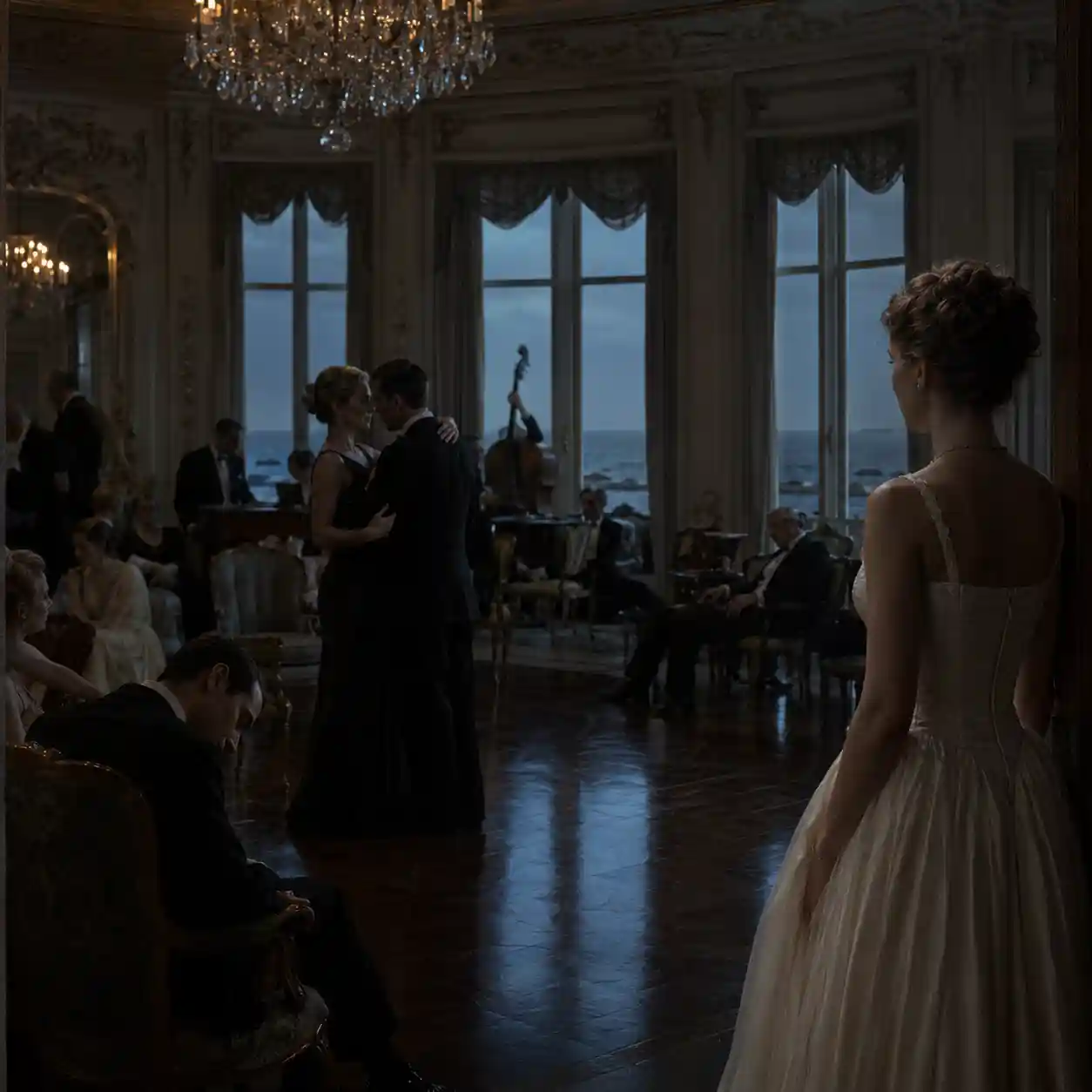
A dance at T Beach divides Lol V. Stein’s life into a before and an after. Nineteen-year-old Lol arrives with her fiancé, Michael Richardson. Then Anne-Marie Stretter enters the ballroom. Michael turns toward the older woman, dances with her, and abandons his engagement without needing a private conversation.
Marguerite Duras refuses to present this moment as an ordinary scene of romantic betrayal. Lol does not interrupt the couple or demand an explanation. She watches them through the night. Her childhood friend Tatiana Karl stays nearby, yet even Tatiana cannot determine what Lol feels.
The witness becomes more mysterious than the lovers. Michael and Anne-Marie move toward a recognizable passion. Lol remains outside it, fascinated by the image of her own exclusion. She seems less interested in recovering Michael than in seeing the dance continue.
At dawn, the ballroom must close. Anne-Marie and Michael leave, and Lol finally collapses. The conclusion is more devastating than the betrayal because it destroys the scene she has been watching. Her catastrophe begins when the spectacle ends.
This opening controls The Ravishing of Lol Stein. Every later relationship attempts to approach the lost arrangement without restoring it. The ball becomes an image without a complete explanation, and Lol’s life becomes a search for the position from which she can watch it again. She therefore starts with an event and removes its psychological certainty. Something happened at T Beach, but its meaning belongs to competing witnesses, memories, and desires.
Lol’s Breakdown Refuses a Stable Diagnosis
After the ball, Lol enters a period described by others as illness or madness. Yet The Ravishing of Lol Stein never gives readers a clinical account that would settle what happened inside her. Tatiana believes the disturbance may have begun before Michael’s departure. That possibility weakens the comforting idea that one identifiable trauma explains everything.
Lol’s silence encourages interpretation. Family, friends, and eventually Jacques Hold fill the absence with theories. Their concern may be sincere, but it also turns her into an object that exists through other people’s language. Not knowing Lol becomes a form of possession. Each observer believes that a more accurate story could recover the woman hidden beneath her behavior. The author keeps exposing the desire behind that confidence.
A related tension shapes 👉 The Hour of the Star by Clarice Lispector. Lispector gives Macabéa a male narrator who questions his right to describe her. The writer makes the problem even less stable because Jacques does not merely narrate Lol. He desires her and becomes part of the arrangement he claims to examine.
Lol’s apparent emptiness should not be mistaken for a lack of character. Her opacity directs the entire novel. Other people change their conduct because they cannot decide what she wants.
The Ravishing of Lol Stein thus avoids a simple portrait of a damaged woman. It portrays a social world disturbed by a woman who cannot be made fully legible. The uncertainty surrounding Lol is not waiting for a final diagnosis. It is the structure through which the novel sees her.
Domestic Order Becomes Another Kind of Disguise
Lol eventually meets the musician John Bedford during one of her walks. They marry, leave S Tahla, and have three children. For ten years she appears to build a stable bourgeois life. She maintains the household carefully, raises her family, and seems separated from the ballroom where her earlier identity collapsed.
When the Bedfords return to S Tahla, Lol moves into her childhood home. The return appears practical, but old geography begins reorganizing her attention. She resumes long walks through familiar streets and notices people who connect the present to T Beach.
Routine preserves the space beneath routine. Lol’s ordered house does not prove that the past has been resolved. Its precision may instead protect a life whose central scene remains unfinished. She does not turn John Bedford into a cruel or foolish husband. He belongs to the part of Lol’s existence that functions. The marriage offers duration, children, movement, and social coherence. Yet he cannot enter the imaginative system created by the ball.
In The Ravishing of Lol Stein, the opposition is therefore not between a false marriage and a true passion. Lol does not simply want Michael back. She is drawn toward a configuration in which she can be present and absent at once.
Her walks make that contradiction visible. Movement allows her to remain suspended. She crosses the town without arriving at a declared goal, letting streets, houses, and chance sightings guide an inquiry she never explains directly. The return to S Tahla does not awaken a forgotten self. It gives Lol the physical materials needed to construct a new version of an old scene.
Jacques Hold Cannot Observe Without Interfering
During one of her walks, Lol sees Tatiana Karl with a man. He is Jacques Hold, Tatiana’s lover and the hidden narrator of much of The Ravishing of Lol Stein. His identity emerges gradually, changing the apparent authority of everything already told.
Jacques reconstructs the ball from Tatiana’s memories, his own deductions, and what he imagines about Lol. He frequently admits uncertainty. Still, the admissions do not make him neutral. Doubt becomes part of his seduction. By acknowledging that he invents Lol, Jacques presents himself as the observer most aware of her mystery.
The unstable recollection of violence in 👉 The Flanders Road by Claude Simon offers a useful formal comparison. Simon lets memory reshape war through repetition and sensory fragments. Duras narrows a comparable instability around desire. A ballroom, a hotel room, a garden, and a field keep changing as different people imagine them.
Jacques also enters the triangle he describes. Lol seeks contact with Tatiana and arranges opportunities to meet him. His curiosity becomes erotic, while his affair with Tatiana acquires a second audience. The narrator is evidence inside his own case. Every claim about Lol also reveals his wish to understand, rescue, possess, or be transformed by her. Interpretation cannot remain outside the action.
This design makes The Ravishing of Lol Stein resistant to summary. The plot can be listed, but the narrative event lies elsewhere. It occurs in the uncertain distance between what Lol does and what Jacques needs her actions to mean.
The Rye Field Turns Desire Into a Spectacle
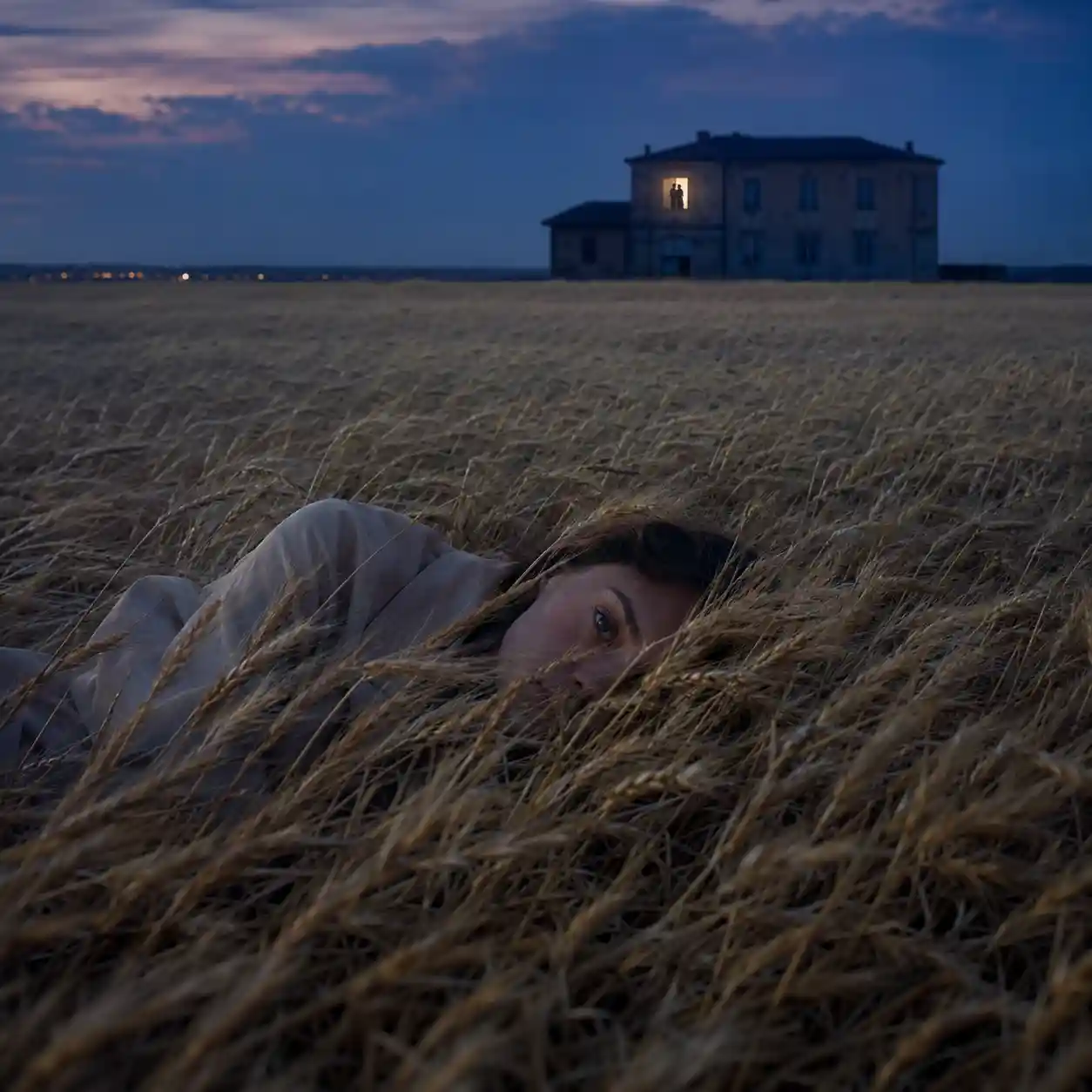
Jacques and Tatiana meet at the Hôtel des Bois. Lol lies in a rye field outside, watching the illuminated window. Jacques knows she is there. Tatiana may understand more than he assumes. The arrangement transforms secrecy into a performance shared by three unequally informed participants.
The field matters because it is open, exposed, and almost empty. Lol remains physically separated from the lovers, but their awareness of her gives the distance erotic force. Exclusion becomes a chosen position.
This is not a straightforward repetition of T Beach. At the ball, Lol watched Michael leave her for Anne-Marie. Outside the hotel, she has helped create the scene. Jacques is drawn toward Lol partly because she watches him with Tatiana. The observer now influences the spectacle.
The Ravishing of Lol Stein repeatedly unsettles the division between passivity and control. Lol seems motionless, yet she determines routes, meetings, and emotional tensions. Jacques appears active, but he follows a structure he does not fully understand. Tatiana seems used by both of them, although the limits of her knowledge remain uncertain.
Every watcher is also being watched. Jacques looks toward the field. Lol imagines the room. Tatiana becomes the body through which Jacques and Lol communicate, but she cannot be reduced to a transparent instrument. She removes the moral security usually provided by exposure. Revealing the arrangement would not uncover one hidden truth. Desire here depends on partial sight, guessed knowledge, and the preservation of distance. The rye field is therefore more than a setting. It is the novel’s clearest image of intimacy without possession.
A Second Triangle Repeats Without Copying
Lol asks Jacques to accompany her back to T Beach. The journey seems to promise confrontation with the original scene. Yet memory cannot reproduce the ball as it happened. The building, rooms, and surrounding town exist in the present, while Lol approaches them through an account shaped by silence and repetition.
Return changes the event it seeks. Jacques is not Michael Richardson, and Tatiana is not Anne-Marie Stretter. Lol is no longer nineteen. Still, the positions echo one another: a couple, an observer, a departure, and a desire that becomes most intense through exclusion.
Memory also reorganizes love in 👉 In Search of Lost Time by Marcel Proust. Proust’s narrator discovers that recollection creates new emotional realities rather than retrieving an untouched past. Duras compresses that process into a few charged locations where people attempt to inhabit earlier images.
Jacques and Lol spend the night together. Their intimacy does not resolve the triangle because Lol insists that his connection with Tatiana continue. She does not want a conventional transfer of affection from one woman to another. Desire must preserve the absent third person.
This demand makes Lol difficult to describe through familiar motives. Jealousy, revenge, curiosity, and erotic control all offer partial explanations. None contains the entire pattern. In The Ravishing of Lol Stein, repetition is neither cure nor simple compulsion. It is a creative act with destructive risks. Lol rebuilds the scene that once excluded her, but she cannot enter it without changing what made it powerful.
Places Carry What Chronology Cannot Explain
T Beach and S Tahla sound specific, yet their abbreviated names also make them strangely unreal. The author gives readers hotels, streets, gardens, houses, a ballroom, and the rye field without turning them into a complete social map. These locations operate as emotional structures.
Space remembers through arrangement. The ballroom holds Lol outside a couple. The Bedford home represents continuity. The hotel window divides watcher from watched. The field permits concealment without complete disappearance.
Time behaves similarly. Ten years pass, but the narrative refuses to treat them as a clean distance. Past and present touch whenever the same positions return. Lol can be a married mother walking through S Tahla and the abandoned young woman at T Beach within the same imaginative movement.
The meditations in 👉 Four Quartets by T. S. Eliot also treat time as recurrence rather than a straight line. Eliot searches for stillness within temporal change. She gives stillness a more disturbing erotic form: Lol remains attached to a moment because it never became complete enough to become the past. An unfinished image has no natural ending. It can be revisited, rearranged, and inhabited by new bodies.
This spatial method explains the novel’s dreamlike clarity. Individual scenes are sharply visible, but the path connecting them remains uncertain. Readers know where Lol lies and where Jacques looks. They cannot convert that knowledge into a final psychological map. The Ravishing of Lol Stein makes place the nearest available form of memory. The characters return because language alone cannot hold what happened.
Bone-White Time: Quotes from The Ravishing of Lol Stein
- “She had lived her early years as though she were waiting for something she might, but never did, become.” Lol’s identity is introduced as an unrealized possibility. Waiting precedes the ballroom trauma rather than beginning with it.🌐 Source
- “In a certain state of mind, all trace of feeling is banished.” Emotional absence may be protection, performance, or something language cannot accurately classify. Duras refuses to decide for the reader.
- “All that remains of that minute is time in all its purity, bone-white time.” Memory loses ordinary detail until duration itself becomes the surviving substance—empty, stark, and almost visible.
- “One should never be cured of one’s passion.” Recovery is presented not simply as health but as a troubling loss. Sanity may erase the intensity that once made existence meaningful.
- “A prolonged silence ensues.” Silence in the novel is active rather than empty. It holds attraction, suspicion, and knowledge that the characters cannot yet acknowledge.
- “I have never waited for anything the way I’ve waited for today, when nothing will happen.” Desire attaches itself to an anticipated absence. Nothing happening becomes the very event for which the speaker waits.
Lost at the Ball: Facts About The Ravishing of Lol Stein
- The novel acquired two English identities: The writer published Le Ravissement de Lol V. Stein in 1964. Richard Seaver’s 1966 American translation became The Ravishing of Lol Stein, while Eileen Ellenbogen’s 1967 British version was titled The Rapture of Lol V. Stein.🌐 Translation record
- Its title refuses a single interpretation: The French ravissement can suggest rapture, abduction, ecstatic transport, or being carried away. The competing English titles preserve different aspects of this ambiguity.
- It inaugurated her “Indian Cycle”: Images and characters introduced here, particularly Anne-Marie Stretter, recur or echo through The Vice-Consul, L’Amour, La Femme du Gange, and India Song.
- The narrator is secretly inside the story: Jacques Hold initially sounds like a detached biographer, but gradually reveals himself as Lol’s lover and Tatiana’s lover. Because he reconstructs Lol through rumors, conjecture, and desire, knowledge of her remains fundamentally unstable.
- Its geography is deliberately incomplete: S. Tahla and T. Beach resemble fragments of addresses or suppressed memories. These initialed locations make landscape psychological, inviting comparison with the fluid voices and identities of 👉 The Waves by Virginia Woolf.
- The ballroom scene is an absent center: Lol watches her fiancé become absorbed by Anne-Marie Stretter, yet the event reaches readers only through later reconstruction. Its repetitions never produce a definitive account; they demonstrate how trauma resists narrative completion.
- Jacques Lacan answered the novel: In 1965, Lacan published an extensive “Homage to Marguerite Duras,” examining the novel’s treatment of vision, desire, and the gaze. He approached the work as literature that had reached insights independently—not merely as a 🌐 fictional case history.
- Absence becomes a form of characterization: Lol is defined through unfinished sentences, other people’s accounts, and what the narrator cannot know. Her elusive interiority creates a revealing dialogue with 👉 The Book of Disquiet by Fernando Pessoa.
No One Owns the Meaning of Ravishment
The French title holds several possibilities within ravissement: abduction, rapture, transport, and the state of being carried beyond oneself. Anne-Marie ravishes Michael from Lol. The spectacle ravishes Lol. Jacques becomes captivated by the woman he narrates. The reader is drawn into an interpretive pursuit that the book refuses to complete.
Ravishment moves among people and positions. No single character controls it. That instability protects the title from becoming a diagnosis of Lol alone. The narrative’s spare sentences, repetitions, corrections, and conjectures create a voice that is both precise and unreliable. Important events are approached indirectly. The same image returns with altered emphasis. Silence does not conceal an answer waiting behind it. Silence is one of the forms through which desire exists.
Postwar intellectual and emotional entanglement takes a more socially expansive form in 👉 The Mandarins by Simone de Beauvoir. Beauvoir makes political choices and personal commitments collide through competing viewpoints. The novelist withdraws from public argument, yet her contribution to french literature is equally concerned with who possesses the authority to define another person.
Jacques cannot finish Lol’s story. Tatiana cannot explain her childhood friend. Readers cannot decide whether the return to T Beach restores Lol, wounds her again, or creates a third condition.
The unresolved woman remains more than their accounts. At the end, Lol again lies in the rye field outside the hotel. The image has returned, but its meaning has changed through everything Jacques has imagined. The novel closes without releasing anyone from the gaze. That refusal is its most exact form of freedom.
More Reviews of books by the famous french writer