The Autumn of the Patriarch by Gabriel García Márquez
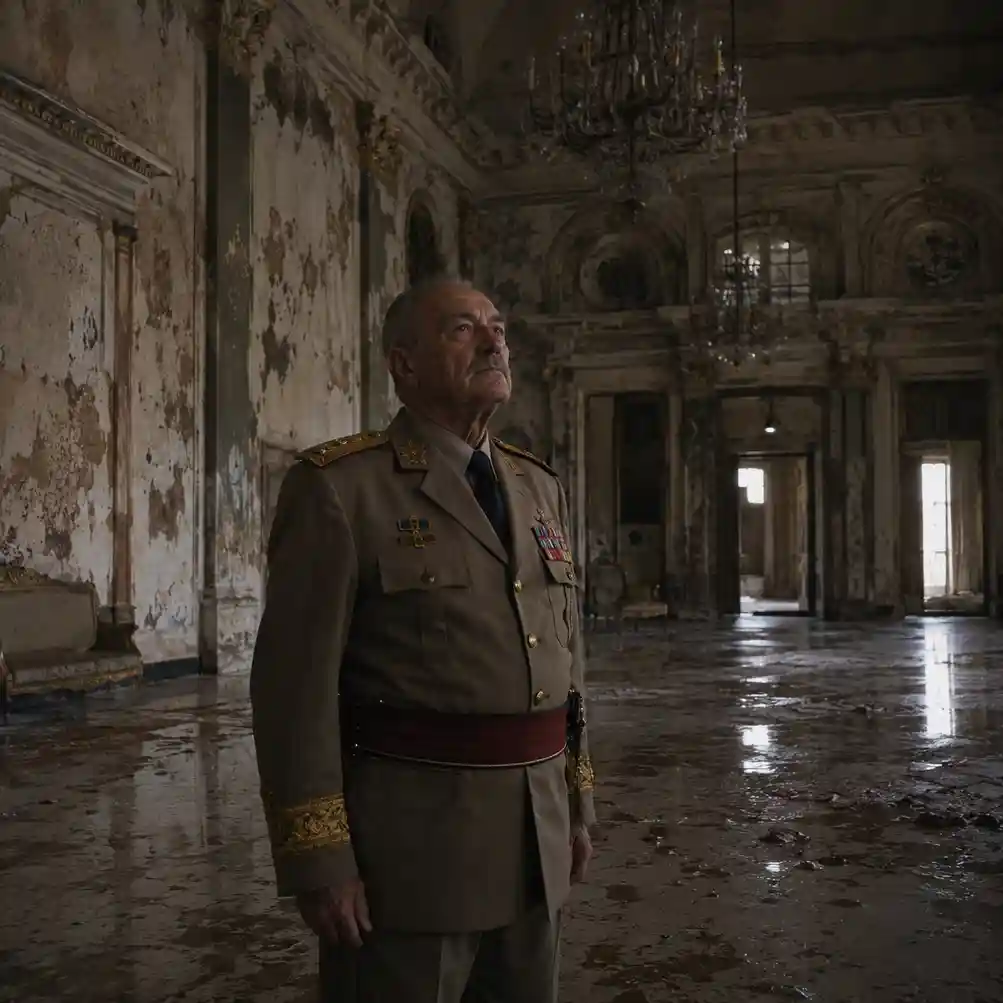
The Autumn of the Patriarch opens after power has apparently ended. People enter a ruined presidential palace, pass cows wandering through ceremonial rooms, and discover the body of the ruler who seemed incapable of dying. Yet death brings no immediate clarity. The corpse may be genuine, another deception, or merely the latest version of a story the country has rehearsed before. The dictator survives as uncertainty even when his body lies exposed.
His supposed immortality has become a national habit. Citizens know that a body can be displayed while the system behind it continues to determine what they are permitted to remember.
Published in Spanish in 1975, Gabriel García Márquez’s novel avoids conventional political biography. Its ruler has no stable name, age, or verifiable history. He is a composite Caribbean tyrant assembled from legends, official inventions, fears, and echoes of multiple dictatorships. He becomes a system condensed into one decaying body.
The narrative returns to his death, then moves backward and sideways through his rule. His double Patricio Aragonés, mother Bendición Alvarado, the nun Leticia Nazareno, officers, citizens, and anonymous voices all remember differently. No witness restores an uncontested past.
This design turns The Autumn of the Patriarch into a novel about political perception. Absolute power damages time, language, memory, and the distinction between fact and fantasy. The book never lets the dictator’s solitude excuse brutality. Isolation is the architecture of his regime.
Six Returns to the Same Death
The novel consists of six movements, each circling back to the patriarch’s death. Events recur with changes in emphasis, sequence, and voice. The result resembles memory under pressure rather than linear history. Time turns instead of advancing. Established facts dissolve into rumor.
This repetition embodies dictatorship more precisely than a chronological plot could. The regime presents itself as eternal, and the people cannot imagine a clean boundary between before and after. Each new return demonstrates how power revises its own origin. Victories become miracles. Failures disappear. Public ceremonies overwrite private suffering. Even the ruler loses access to a past that has not been manufactured for him.
The six-part structure also alters the act of reading. There are few conventional resting places, and recognition replaces suspense. Readers gradually learn to notice images, names, and betrayals as they resurface. The question is not simply what happened. It is who can make an event count as reality.
In The Autumn of the Patriarch, circularity finally reveals the weakness hidden inside permanence. A ruler who must endlessly repeat his authority can never secure it. Every return to the corpse suggests that the regime’s claim to immortality is also a fear of the ending it cannot prevent.
Repetition therefore changes rather than duplicates the material. Each cycle adds another layer of complicity, fantasy, or grief, making the reader revise what appeared settled before.
The Palace Becomes a Body
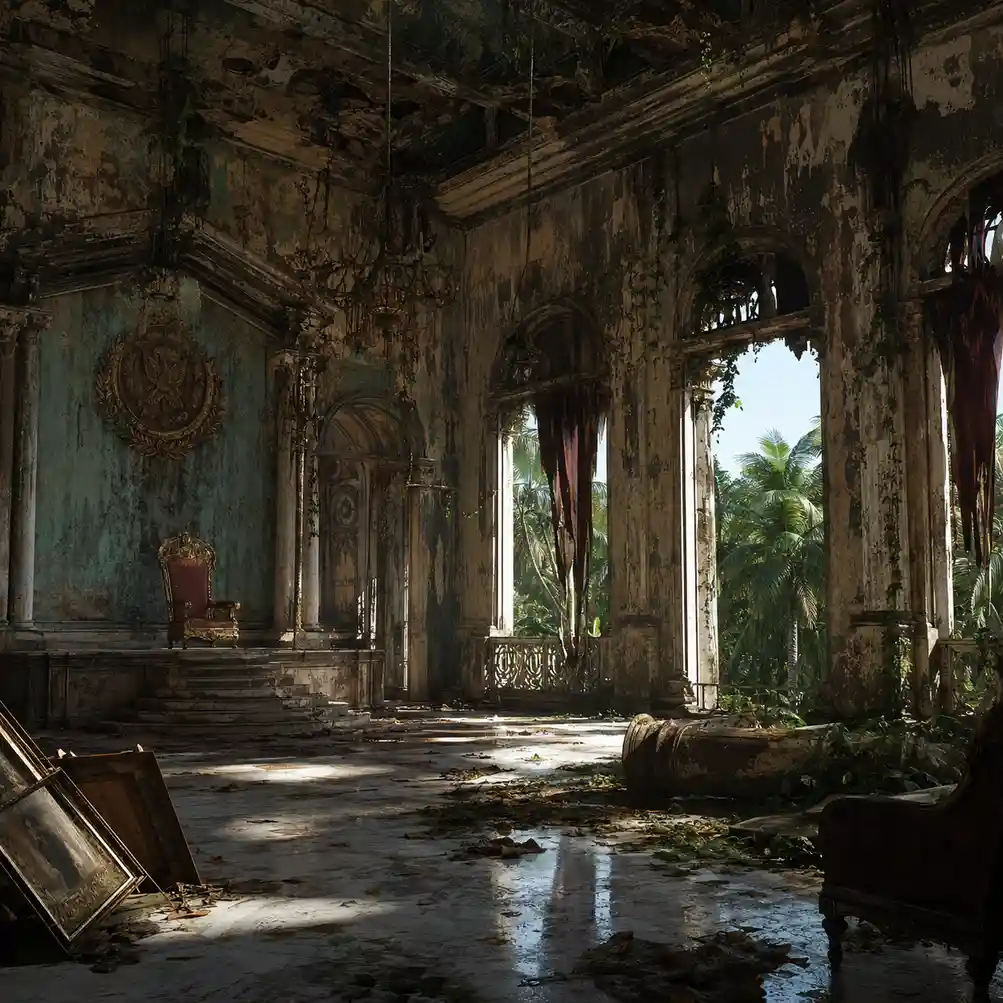
The presidential palace is part stable, barracks, home, and tomb. Cows invade its rooms. Birds, soldiers, papers, food, filth, and ceremonial objects mingle without boundaries. The building mirrors the patriarch: swollen with authority, deteriorating, and closed against honest knowledge.
This grotesque setting gives political decay a texture. Corruption can be smelled in neglected rooms and seen around a corpse. The state rots from its symbolic center. Yet balconies, portraits, guards, and reception rooms preserve majesty after government has become improvisation.
Outside stands an equally unstable country. Technologies and foreign powers change, but the ruler’s age expands beyond probability. The Caribbean Sea can be surrendered to creditors and removed, leaving a barren plain. The impossibility is politically exact: a ruler who owns land, bodies, and history can also sell the sea.
This grotesque history recalls 👉 The Tin Drum by Günter Grass. Both novels use excess, distorted bodies, and improbable images against sanitized accounts of catastrophe.
The palace becomes a machine that converts domination into atmosphere. Everyone inside breathes the ruler’s fear, while ruined surfaces expose what splendor conceals.
Even the absent sea belongs to this architecture. A wind machine imitates what has been sold, turning national loss into a private effect for the palace. The ruler can counterfeit weather, but he cannot restore the world his power has emptied. The landscape becomes an inventory of political theft rather than a neutral setting.
One Tyrant, Many Histories
The patriarch resembles several strongmen without portraying only one. His longevity, isolation, ceremony, foreign dependence, and military suspicion gather features from different histories. This composite prevents readers from containing the violence within one biography. The tyrant is specific and repeatable.
Within the Latin American dictator tradition, The Autumn of the Patriarch creates political mythology instead of orderly realism. Public imagination enlarges the ruler until natural law appears to obey him. Weather, clocks, animals, and national time reflect his presence. Exaggeration reveals how authoritarian culture manufactures awe.
Foreign influence also shapes the regime. Marines, ambassadors, creditors, and imperial interests sustain or exploit the ruler. He performs national sovereignty while bargaining away the country. Power is supported by profitable relationships.
For a more socially detailed dictatorship novel, turn to 👉 Conversation in the Cathedral by Mario Vargas Llosa. Its intersecting lives contrast with Márquez’s incantatory form, yet both examine authoritarian rule inside ordinary consciousness. The composite patriarch cannot be dismissed as an exotic monster. He represents a recurring desire to place one body above law, then call dependence order.
This universality does not erase the Caribbean setting. Heat, coastal imagery, colonial memory, and foreign intervention keep the political myth tied to a recognizable history of unequal sovereignty. The archetype gains force through place, not through abstraction alone. Local texture prevents universality from becoming a convenient escape from responsibility.
Reality Made to Order – The Autumn of the Patriarch
The patriarch appears all-powerful, yet he depends on manipulated information. Newspapers can be produced for his eyes. Officials anticipate what he wants to hear. Crowds are organized, miracles advertised, enemies invented, and inconvenient deaths reassigned to acceptable stories. The ruler commands a world he cannot know. Every protective layer increases his ignorance.
Patricio Aragonés, recruited because he resembles the dictator, exposes the paradox. The double performs public power while the original hides. When the substitute dies, the patriarch observes reactions to his supposed death and discovers hatred beneath ceremony. He still rebuilds the machinery that deceived him.
Military control follows the same logic. Officers are watched, reassigned, disarmed, and eliminated. Loyalty never suffices because the dictator reads every subordinate through his own capacity for betrayal. Security teaches everyone secrecy.
Elias Canetti’s 👉 Crowds and Power offers another route into command, fear, survival, and collective behavior. García Márquez turns those questions into a sensuous nightmare.
The most frightening achievement of The Autumn of the Patriarch is its portrayal of falsehood as an environment. Propaganda does not merely hide reality from the population. It encloses the tyrant too. He becomes the final prisoner of the obedience he demanded. Knowledge becomes dangerous precisely because everyone has learned to produce reassurance. Truth survives only in reactions that authority fails to stage completely.
Women Near the Throne
Women occupy crucial positions near the patriarch, but proximity rarely grants safety. His mother, Bendición Alvarado, remains his central memory of tenderness. He turns her humble life into national legend and seeks her canonization. He cannot love without commanding belief.
Leticia Nazareno brings domestic order to the palace. Manuela Sánchez becomes unattainable desire. Around them stand women subjected to his appetite and authority. Intimacy repeats the structure of rule. Affection, possession, and violence cannot be separated when one person has no limits.
The novel sometimes enters the patriarch’s longing so closely that his vulnerability becomes palpable. He fears abandonment, aging, ridicule, and bodily decline. These moments deepen the character without redeeming him. His loneliness is not evidence of hidden innocence. It is what remains after he has made reciprocal relations impossible.
Female figures reveal how authoritarian mythology uses motherhood, sainthood, and sexual access. Bendición becomes a national mother, Leticia enters dynastic fantasy, and others vanish from public memory. Patriarchy operates through symbols and bodies together.
Domestic life never lies outside politics. Bedroom, family legend, church ceremony, and national spectacle belong to one system. The ruler’s private needs become collective obligations.
The women closest to him thus measure the impossibility of reciprocity. They may alter palace routines, but none can create equality where refusal carries no secure meaning. Domestic influence remains conditional because the patriarch can always revoke it.
The Sound of Absolute Power
The difficulty of The Autumn of the Patriarch lies chiefly in its sentences. They extend across pages, change direction without warning, and pass among first person, third person, collective “we,” rumor, memory, and the ruler’s own consciousness. Speakers enter without formal introduction. Punctuation offers limited shelter. Voice behaves like a crowd, pressing several experiences into one flowing current.
This syntax reproduces a country where no perspective remains private or secure. The patriarch’s thoughts absorb public voices, while popular memory carries official phrases. Readers ask who is speaking, but final answers remain impossible. Domination has entered grammar.
Long sentences also give the prose musical force. Repetition, comic escalation, sensual detail, and cruelty create an incantatory rhythm. Gregory Rabassa’s English translation preserves that momentum and asks readers to follow cadence as well as information.
Readers drawn to fluid, many-voiced narration may find another demanding route through 👉 The Waves by Virginia Woolf, where identity also emerges through recurring verbal rhythms rather than stable exposition.
Slow reading reveals carefully placed returns. Birds, livestock, the sea, decay, clocks, and ritual hold the movements together. Disorientation gradually becomes recognition.
The reader begins by searching for chronology and ends by hearing patterns of command. That shift is the novel’s formal education: rhythm becomes a more reliable guide than sequence. Syntax makes the regime audible before interpretation makes it fully legible.

Quote List for The Autumn of the Patriarch
- “A lie is more comfortable than doubt, more useful than love, more lasting than truth.” This ruthless maxim defines the patriarch’s political method. He does not merely hide facts. Instead, he supplies emotionally convenient falsehoods that outlive both affection and evidence. The sentence also explains why uncertainty threatens autocracy: doubt keeps interpretation open, whereas a durable lie closes public debate.
- “There was always another truth behind the truth.” The sentence captures the novel’s hall-of-mirrors structure. Every death, rumor, document, and memory produces a competing version. Consequently, citizens cannot establish a stable past, and readers experience the same disorientation. Yet the line also cuts both ways, because official certainty may conceal resistance as readily as fear.
- “A fear of death is the ember of happiness.” Here the dictator recognizes, however briefly, that mortality gives pleasure its heat. An ember suggests a small but persistent glow, so happiness survives inside dread rather than outside it. Moreover, the thought exposes his central tragedy: his pursuit of endless rule destroys the very limits that could make life meaningful.
Context-Rich Trivia List for The Autumn of the Patriarch
- A decade in the making: Gabriel García Márquez studied Caribbean strongmen, then transformed his research into a composite tyrant. The Autumn of the Patriarch resists one-to-one allegory while retaining the habits of real dictatorships.
- A witnessed origin: After Marcos Pérez Jiménez fell in 1958, the novelist watched an armed officer leave a Caracas meeting that shaped the new government. The sight prompted his intuition about power’s mystery, according to 🌐 Cambridge University Press.
- A society losing certainty: For a different allegory of civic collapse and coercive authority, read:
👉 Blindness by Jose Saramago. - Six circular movements: Each section returns to the patriarch’s apparent death. However, shifting pronouns, voices, and chronology keep changing what readers know. The form mimics a regime that rewrites reality.
- An ambitious English afterlife: Gregory Rabassa translated the 1976 English edition. Meanwhile, 🌐 Penguin Random House presents The Autumn of the Patriarch as an intricate experiment.
- A family saga under pressure: For a female-centered blend of memory, politics, and the marvelous, try:
👉 The House of the Spirits by Isabel Allende. - Recognition beyond the breakthrough: Although One Hundred Years of Solitude made him famous, the Swedish Academy praised this novel’s epic breadth in its 1982 Nobel 🌐 ceremony speech.
After the Patriarch
When the dictator finally dies, The Autumn of the Patriarch does not offer a detailed program for democratic renewal. Its focus remains on the long psychic occupation created by personal rule. The people must recognize that the figure presented as permanent was mortal, but political time cannot be repaired in an instant. An ending is not yet a recovery.
The novel fuses form and subject. Circular structure expresses false eternity. Shifting voices embody damaged memory. Grotesque fantasy reveals unchecked ownership. The style refuses the clarity dictatorships claim. Readers experience distortion from within.
The book can feel less accessible than the author’s famous family saga. There is no stable household, little conventional dialogue, and no chronological comfort. Yet the concentration has unusual force. The Autumn of the Patriarch is a sustained anatomy of command. For a leaner fictional system of control, 👉 The Method by Juli Zeh offers a clinical contrast. Both books turn official reality into a test of obedience.
The patriarch’s autumn is more than old age. Magnificence reveals decay, permanence reveals terror, and solitude reveals failure. The corpse ends one life. The novel asks how a nation can end the beliefs that sustained it. That unanswered question prevents the final death from becoming an easy liberation. Political mortality must still be translated into a new public language.
More Reviews of Works by the talented writer