The Train Was on Time
The Train Was on Time begins with movement, but the movement feels like a sentence. Heinrich Böll places Andreas, a young German soldier, on a military train heading east during the Second World War. The journey should be routine. Men are transported, orders are followed, the timetable works. Yet Andreas senses that this journey is not simply taking him back to the front. It is carrying him toward his death.
That certainty gives the novella its terrible shape. Andreas does not need battlefield heroics to understand war. He understands it from inside the train, from the rhythm of rails, stations, waiting, exhaustion, and conversations among men who have already been reduced by the machinery around them. The title is cruel because punctuality becomes part of the horror. The train does not fail. It arrives exactly as it should.
Order becomes a form of doom. What should suggest efficiency now suggests inevitability. The railway does not save time; it measures the remaining time before destruction.
The novella is short, but it wastes nothing. Every station feels like a narrowing of possibility. Every casual exchange sits under the knowledge that life is moving toward a point Andreas cannot escape. This is not a war story built around strategy or spectacle. It is a story about anticipation. The front is not yet fully visible, but death is already present. The author makes that waiting more frightening than battle itself, because Andreas has enough time to imagine what is coming and not enough freedom to change it. The train becomes a moving coffin, but also a confessional space, where fear, memory, desire, prayer, and shame begin to surface before the end.
The timetable gives fate a mechanical sound
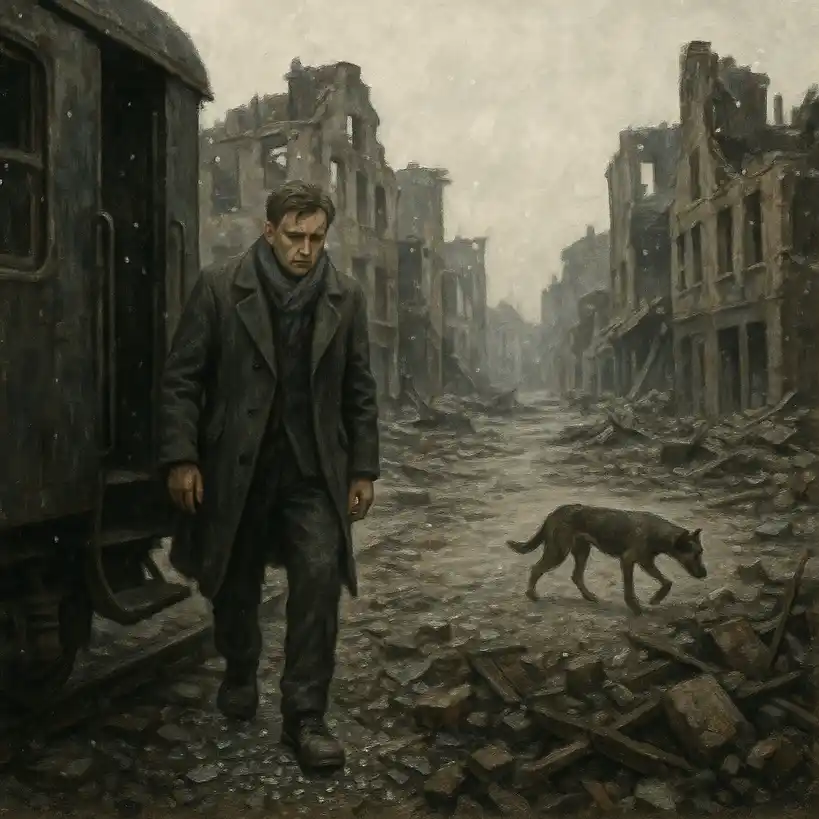
The most disturbing idea in The Train Was on Time is that fate seems to move by schedule. Andreas does not experience destiny as a mythic voice or a battlefield prophecy. He experiences it through time, geography, and military transport. Stations, delays, announcements, stops, and departures turn into signs. The ordinary language of travel becomes the language of death.
This makes the novella modern in a very sharp way. Fate is no longer dressed as ancient tragedy. It appears as bureaucracy, timetable, transport, and obedience. Andreas is not carried by gods. He is carried by institutions. That difference matters. The horror of the story lies partly in how little personal hatred is needed for destruction to continue. The system moves because it is designed to move. The train makes death administrative. Nobody on board has to fully understand the whole war for the war to use them. They only have to board, wait, obey, and arrive.
This logic gives the book a strong relation to 👉 The Trial by Franz Kafka. Kafka’s world turns guilt into an unreadable procedure; his novella turns death into scheduled transport. In both works, the individual is trapped inside a structure that feels impersonal and intimate at the same time. It does not merely surround the person. It enters the mind.
Andreas begins to calculate time almost obsessively because calculation is the last form of control available to him. Yet the more precisely he thinks, the less free he becomes. The timetable does not comfort him. It confirms that the world can be exact without being humane. The train’s punctuality becomes a sound of fate made mechanical.
Companionship appears too late to save anyone
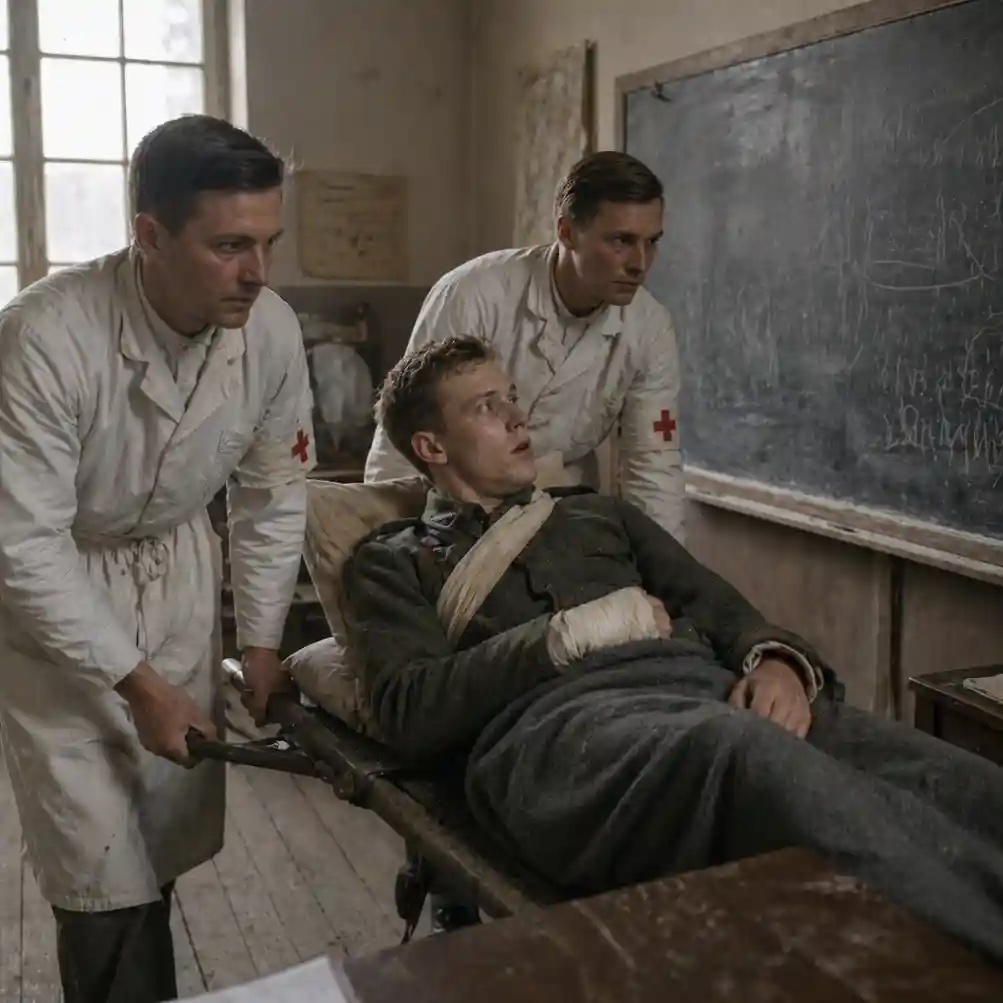
The soldiers Andreas meets on the train give the novella warmth, but not rescue. Their conversations matter because they interrupt isolation. They share food, talk, joke, confess, and drift into temporary fellowship. For a few hours, the train becomes more than a transport device. It becomes a fragile community of men who know, even if they do not always say it plainly, that the war has already damaged them.
This companionship is one of the novella’s most painful elements. It arrives late, under pressure, and without a future. The men can give each other attention, recognition, and brief human presence, but they cannot stop the train. Their bond is real precisely because it is temporary. Nothing about it becomes sentimental.
War reduces friendship to borrowed time. These men do not build a future together. They share the present because the future has almost disappeared. That gives even ordinary talk a tragic weight.
The novella avoids heroic camaraderie. Its soldiers are tired, frightened, compromised, and often spiritually exhausted. What connects them is not glory, but proximity to the same destructive machine. Their friendship is less a celebration of soldierly brotherhood than a last defense against complete erasure.
This is why the conversations feel so important. Speech becomes a way of remaining human. A joke or confession can briefly push back against the anonymity of military movement. Yet the train keeps moving while they speak. That contrast defines the book’s emotional power. Human contact exists, but it exists inside a system that does not care about it. The soldiers may recognize each other, but recognition does not equal salvation.
Fear makes Andreas more awake than heroic in The Train Was on Time
Andreas is not a conventional war hero. His fear is central to the story, and the novella respects that fear. He does not move toward death with clean courage or patriotic certainty. He is terrified, restless, and inwardly divided. His dread makes him more alive, not less. It strips away slogans and leaves him with the basic fact that he does not want to die.
That honesty gives the novella much of its force. The writer does not present fear as shameful cowardice. He presents it as a form of truth. Andreas knows that the war has stolen the future from men like him. His fear is therefore not a failure of character. It is a refusal, however powerless, to accept the lie that death in war is naturally meaningful.
Fear becomes a protest of the body. The body wants to live before the mind can make a noble argument. Andreas’ terror breaks through the language of duty and exposes the raw injustice of being sent toward death.
This inward pressure can be compared with 👉 All Quiet on the Western Front by Erich Maria Remarque. Remarque follows soldiers through the grinding experience of war; he compresses the terror into a journey toward the front. Both works reject heroic decoration and insist on the vulnerability of young men caught inside military systems.
Andreas’ fear is also morally clarifying. He sees with a painful sharpness because he is afraid. Ordinary things gain intensity: time, landscape, faces, prayer, memory, desire. The approaching end makes him more awake to life than he may have been before. That awakening is not enough to save him, but it makes the novella devastating. The closer death comes, the more precious life becomes.
Olina offers escape and another kind of truth
Olina changes the emotional temperature of the novella. When Andreas meets her, the story opens toward intimacy, tenderness, and possible escape. She is not merely a romantic interruption. She brings another history into the train’s fatal movement: occupied Europe, exploitation, resistance, disillusionment, and the suffering of those trapped beneath military power.
Her presence matters because she sees the war from another angle. Andreas is a soldier being carried east. Olina is a Polish woman whose life has been shaped by occupation, violence, and political despair. Their encounter does not erase the distance between them, but it creates a moment in which both can imagine stepping outside the roles forced upon them.
Love appears as a door that may already be closing. The possibility of escape becomes more painful because it appears so late. For a moment, the future seems imaginable again: the Carpathians, flight, a life outside the machinery of war. But the novella has trained the reader to distrust hope that arrives inside a timetable.
Olina also prevents the story from becoming only Andreas’ private death meditation. She reminds us that the war contains many kinds of captivity. Soldiers suffer, but they are also part of an occupying force. Civilians suffer in different, often more exposed ways. The novella does not fully resolve that moral imbalance, and it should not. It lets the meeting remain tender and troubled.
This encounter gives the book one of its deepest wounds. Andreas wants to live, and Olina briefly makes life feel particular again. Not abstract survival, but a possible shared world. That is why the hope hurts. It arrives not as consolation, but as another proof of what war destroys.
Prayer enters where ideology has collapsed
Religion in The Train Was on Time does not appear as easy comfort. It appears in fragments, need, guilt, fear, and the presence of a priest. Andreas is not protected from death by prayer, but prayer gives language to a crisis that politics and military duty can no longer explain. The war has emptied official meanings. Spiritual language remains, though damaged and uncertain.
This gives the novella a quiet theological tension. Andreas is not simply asking whether he will die. He is asking what his life has meant, what he has done with his time, and whether anything can still be addressed beyond the machinery carrying him forward. Prayer becomes less a solution than a desperate opening.
Faith appears as a last form of speech. When ordinary explanations fail, Andreas turns toward words that can hold fear, remorse, and longing together. That does not make the world just. It only keeps the inner life from going completely silent.
The religious dimension also deepens the question of guilt. Andreas is both victim and participant. He is a frightened young man, but he is also a German soldier moving through a war of aggression. The novella’s power lies in not simplifying that position. His suffering is real, and his historical location is morally compromised.
This tension recalls 👉 The Stranger by Albert Camus in an inverted way. Camus stages a conflict between death, meaning, and religious expectation; the novelist writes from within a world where prayer still matters, but cannot undo reality. Both works show a human being pressed against death and forced to confront the emptiness or weight of available meanings. In his novella, prayer survives as a fragile gesture toward judgment, mercy, and truth.
Quote List for The Train Was on Time
- “I don’t want to die” This line gives the novella its rawest emotional pressure. Andreas does not face death with heroic calm. Instead, fear arrives in ordinary speech, and that simplicity makes The Train Was on Time feel painfully direct.
- “This Soon is like a thunderclap.” The capitalized “Soon” turns time into a physical shock. Because the train moves forward with mechanical certainty, the word becomes almost louder than battle itself. In The Train Was on Time, fate feels less like prophecy than like a timetable closing in.
- “Everything bad comes from those resounding voices” This sentence attacks the public language of war. Speeches, commands, announcements, and railway voices create pressure before the front even appears. Therefore the novella treats sound as part of violence, not just as background noise.
- “My life is now nothing but a specific number of miles” The image reduces existence to distance. Andreas no longer measures life by hope, memory, or future plans. Instead, the railway line becomes a countdown, which makes The Train Was on Time unusually claustrophobic.
- “His pain is too great for tears.” This short observation avoids melodrama. Pain has moved beyond visible expression, and that restraint suits the book’s bleak moral atmosphere. The sentence also shows how war empties the body before it ends life.
- “The ones you love are the ones you’re bound to hurt the most” The line widens the novella beyond the battlefield. Although the plot moves toward death, the emotional damage also reaches love, memory, and guilt. Consequently, The Train Was on Time becomes a story about doomed movement and the wounds left behind.
Context-Rich Trivia from The Train was on Time
- First-book force: The Train was on Time appeared in 1949 and already shows the writer’s lasting subject: ordinary people trapped inside the moral wreckage of war. Britannica links the early novels to the grimness and despair of soldiers’ lives.
- Eastern Front pressure: Andreas travels toward the Eastern Front, a vast and brutal theatre of World War II. Therefore the journey feels less like movement than a sentence being carried out. For context, see 🌐 Britannica’s overview of the Eastern Front.
- Train as death clock: The title matters because punctuality becomes horrifying. In The Train was on Time, schedule, fate, and military obedience collapse into the same track.
- Rubble-literature kinship: The book belongs near Trümmerliteratur, the postwar “rubble literature” that documented a shattered change of values in Germany. For background, see on 20th-century German literature.
- Soldier without glory: Andreas is not heroic in the usual sense; consequently, the novella drains war of spectacle and leaves fear, fatigue, and clairvoyant dread.
- Concentration of form: Its short length intensifies every station, drink, and delay. For another CSV-safe war text about survival under extreme historical pressure, compare 👉 The Spark of Life by Erich Maria Remarque.
- German memory: The train route turns geography into guilt; moreover, later German fiction also used fragmented form to face inherited damage. See 👉 Dog Years by Günter Grass.
- Historical war frame: World War II began in Europe with Germany’s invasion of Poland in 1939; that context shadows the eastward movement in The Train was on Time. 🌐 Britannica gives the broader war chronology.
The novella refuses battlefield spectacle
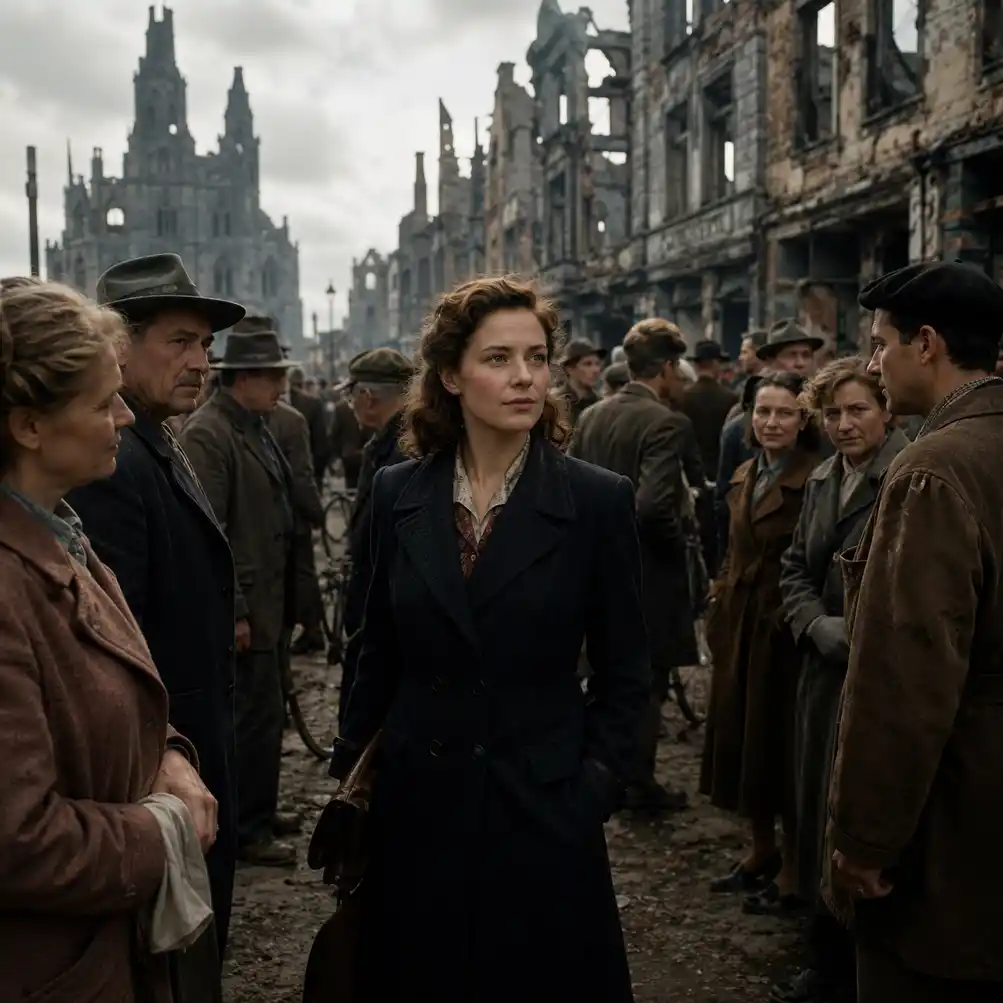
One of the strongest features of The Train Was on Time is what it refuses. It does not depend on long battle scenes, heroic action, strategic explanation, or large historical panorama. The war is present everywhere, but often indirectly: in the train, the soldiers’ exhaustion, the geography, the fear of the Eastern Front, and the sense that private life has been swallowed by movement toward death.
This restraint makes the novella more powerful. A more spectacular book might allow readers to distance themselves through action. Here, there is very little distance. The suspense is inward and temporal. The question is not how a battle will unfold, but how a mind endures the knowledge that time is running out.
The absence of spectacle sharpens the terror. The writer does not need explosions on every page. The train itself is enough. Its motion carries the pressure that battle scenes might otherwise provide.
The style also reflects this restraint. The prose is direct, compressed, and haunted by repetition. Names, places, times, and fears return like the sound of wheels. The novella feels narrow because Andreas’ options are narrow. Its form matches his condition.
That narrowness can feel almost claustrophobic. Readers are kept close to a man who cannot step out of the line that history has drawn for him. The war is not explained from above, but experienced from inside a corridor of time. This is why the book remains memorable despite its brevity. It shows that a war novel does not need a battlefield to expose war. A train compartment can be enough if everyone inside it is being carried toward destruction.
Why The Train Was on Time still matters
The Train Was on Time still matters because it turns war into a question of time, obedience, fear, and moral awakening. It does not ask readers to admire soldiers or condemn them from a safe distance. It asks them to sit beside one frightened man as he travels toward a death he believes is already waiting for him.
The novella’s power lies in compression. It takes a journey, a premonition, a few encounters, a possible escape, and a final movement toward fate, then makes them carry the weight of a broken century. Nothing feels wasted. Every detail serves the pressure of arrival. The book is short because the sentence is already passed. That is why it feels so severe. The story does not sprawl. It tightens.
It also remains important as postwar literature because it looks at German soldierhood without easy absolution or simple denunciation. Andreas suffers, but the world around him has been shaped by a criminal war. His fear is human, yet his uniform cannot be ignored. This moral discomfort is part of the novella’s honesty.
The book can stand beside 👉 The Death of Ivan Ilyich by Leo Tolstoy as another brief work about a person forced to see life under the pressure of approaching death. Tolstoy’s dying man is trapped in a room; his soldier is trapped in motion. Both discover that time becomes merciless when life has been lived under false arrangements.
What remains after the novella is not a lesson in courage. It is the sound of a train that keeps moving because systems often do. Against that motion, one human being briefly feels everything more clearly: fear, longing, guilt, tenderness, prayer, and the unbearable wish to live.
More Reviews of Books by the famous contemporary german writer