Spilt Milk by Chico Buarque
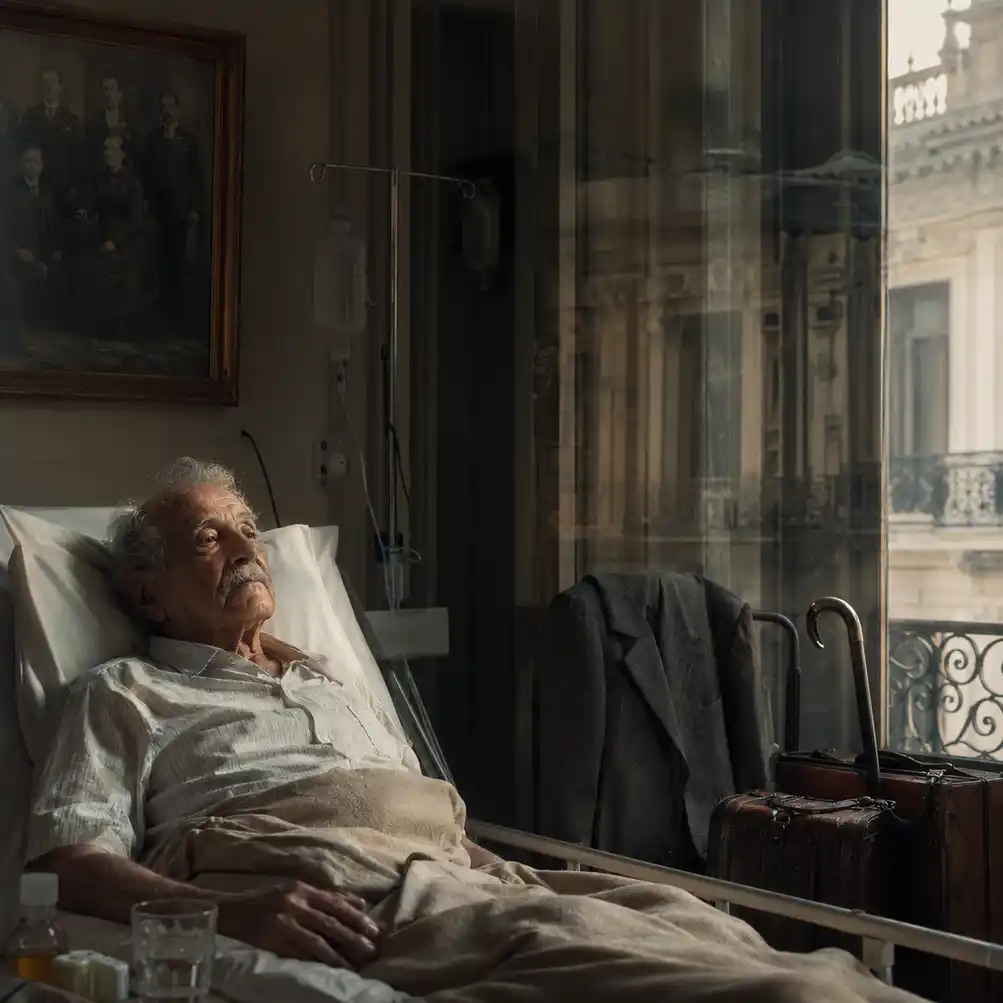
At the opening of Spilt Milk, Eulálio d’Assumpção lies in a crowded public hospital in Rio de Janeiro. About a hundred years old and eager to talk, he addresses nurses, his elderly daughter, absent relatives, and imagined listeners. Whether anyone attends remains uncertain.
Eulálio once belonged to a powerful family. His ancestors included slave traders, landowners, an imperial baron, and a senator of the Brazilian Republic. Their name opened doors, their property seemed permanent, and their habits reflected generations of entitlement. Almost everything has disappeared by the time he speaks. The family saga begins after the family has collapsed.
Published in Portuguese in 2009 as Leite derramado, the novel compresses more than a century of Brazilian change into one wandering monologue. Chico Buarque does not arrange that history as a stable chronology. Eulálio drifts between childhood, marriage, political violence, financial failure, and the uncomfortable present. A person mentioned as alive may soon be remembered as dead.
That instability gives Spilt Milk its unusual form. The hospital bed resembles a final stage from which one speaker tries to summon an entire vanished world. Memory expands as the future contracts. Yet recollection offers no reliable refuge. Each return changes the story, exposing what the narrator cannot understand or refuses to admit. The result is intimate and historical at once. A dying man speaks about himself, while the ruins of his self-image reveal the society that created him.
Memory Moves in Circles
Eulálio does not remember in a straight line. Images return like musical refrains: a family mansion, his father’s death, Matilde’s clothing, a childhood estate, the names of descendants, and possessions that no longer exist. Each repetition adds or removes a detail. Contradiction becomes the rhythm of recollection.
The form may feel confusing. Generations share names, listeners change without warning, and separate periods merge. Gradually, patterns emerge. What Eulálio repeats matters, but so does what he alters.
This circular narration keeps Spilt Milk close to consciousness. Old age does not provide serene wisdom. It loosens the boundaries between memory, fantasy, desire, and inherited story. Eulálio may be reporting something he witnessed, repeating family mythology, or repairing an injury to his pride.
A more severe family labyrinth appears in 👉 Absalom, Absalom! by William Faulkner. Both novels reconstruct the decline of a privileged house through unstable accounts. Yet Buarque’s shorter work uses comic lightness and quick recurrence where Faulkner creates monumental density.
The reader therefore becomes an active listener. We assemble a life from variations rather than accepting one definitive version. Unreliability is not a puzzle with a final solution. It is the novel’s way of showing how identity survives through stories that have been told too often to remain untouched. By the end, uncertainty does not make Eulálio’s memories meaningless. It makes them human, revealing the emotional pressures that repeatedly bend the past.
Matilde Remains and Disappears
At the emotional center of Spilt Milk stands Matilde, Eulálio’s young wife. She is lively, sensual, musically responsive, and less restrained than the women his family respects. Her presence unsettles the codes of color, class, and behavior supporting his inherited identity.
Eulálio insists on his love, but his memories expose possessiveness. He watches Matilde, interprets her clothes, resents attention, and tries to control her body’s social meaning. Desire repeatedly becomes surveillance. His jealousy turns every action into evidence for his fears.
Then she disappears. The narrator offers several possible explanations. She may have left, become ill, died, or entered another life beyond his knowledge. None becomes secure. The missing woman turns into the blank around which his century of speech revolves.
The Brazilian world of 👉 Gabriela, Clove and Cinnamon by Jorge Amado offers a useful contrast. Both novels connect female vitality with racial and class boundaries, although Gabriela occupies a more expansive social comedy. Matilde reaches readers through a husband whose longing continually distorts her.
That limitation is deliberate. The absent woman reveals the limits of male memory. Eulálio describes Matilde’s gestures but cannot grant her a voice independent of his desire. Genuine grief does not make his account complete.
What first appears to be a chronicle of lost status gradually becomes a love story damaged by ownership. Matilde survives most vividly where Eulálio fails to possess her meaning.
Privilege Outlives the Fortune
Eulálio has lost the world that confirmed his rank, but not its language. He invokes family names, European connections, servants, property, and refined customs. Even in hospital, he expects ancestry to restore service.
This gap produces much of the comedy in Spilt Milk. His offers and promises depend on houses already demolished and land already expropriated. The future he proposes is financed by vanished wealth. Entitlement survives its economic foundation.
The humor never makes the decline innocent. Eulálio’s family accumulated status through slavery, political influence, unequal labor, and proximity to power. Later generations squander wealth, enter corrupt arrangements, or fail to understand the society forming around them. The fall is personal, but its origins are structural.
Property takes a different meaning in 👉 A House for Mr Biswas by V. S. Naipaul. Mr Biswas seeks a home that might secure independence, while Eulálio remembers houses as proof of inherited superiority. One builds identity against dependence. The other cannot imagine identity after privilege.
The novel avoids a simple reversal in which poverty automatically creates moral insight. Eulálio’s reduced circumstances do not correct his worldview. Loss teaches him regret more readily than justice. He mourns what disappeared but rarely asks who paid for its existence.
That blindness sharpens the satire. A social class may lose its mansion while preserving the habits that made the mansion possible. Decline changes Eulálio’s surroundings, yet his inner hierarchy remains stubbornly furnished.
Race Hides Inside Affection
The sharpest contradictions in Spilt Milk concern race. Eulálio considers himself unprejudiced while reproducing the assumptions of a white elite. He treats attraction or fondness toward Black people as proof that prejudice has disappeared. The surrounding power imbalance remains invisible.
Matilde’s darker complexion intensifies this conflict. Eulálio desires her, but he also measures her against family expectations and social categories. His jealousy carries racial anxiety, especially when her freedom threatens the identity he inherited. Love does not automatically undo prejudice. It may coexist with the urge to classify and control.
The same blindness appears in memories of servants and descendants of enslaved people. Eulálio recalls intimacy across racial lines without fully recognizing coercion or inequality. His affectionate tone can therefore become more disturbing than open hostility. It allows him to place himself outside the history from which he benefited.
Spilt Milk handles this through exposure rather than correction. No external narrator pauses to explain every prejudice. Readers must hear the distance between what Eulálio believes about himself and what his speech reveals. His innocence is one of his most powerful fictions.
This approach gives the novel historical depth. Slavery is not confined to a completed past. Its hierarchies pass through property, domestic relations, family memory, and ideas about respectable appearance. The old man’s voice becomes an archive of attitudes that survive political modernization. Race is not secondary to the family story. It shapes who can possess, marry, command, inherit, and be remembered.

Brazil Changes Around One Family – Spilt Milk
Eulálio’s life crosses republican ambition, urban expansion, dictatorship, resistance, and contemporary inequality. These periods appear through family fortunes, deaths, vanished neighborhoods, and altered violence. National history enters through domestic damage.
The d’Assumpção family adapts badly because it treats historical privilege as a natural law. Each generation repeats part of the old pattern in a changed setting. Titles lose authority, property disappears, and political influence becomes less secure. Yet corruption and hierarchy find modern forms.
One descendant becomes involved in resistance to dictatorship. Another belongs to a world of drugs and urban violence. Similar names make individual fates blur together, suggesting both continuity and Eulálio’s failing memory. The family does not simply descend from aristocracy to poverty. It travels through the transformations of Brazilian power.
The broad social histories of 👉 Rabbit is Rich by John Updike proceed through a very different American setting, but the comparison clarifies how a private household can register national change. Updike follows material confidence in a particular era, while Spilt Milk tracks prestige long after its supporting world has vanished.
Buarque keeps the political design subtle. The novel never reduces Eulálio to a symbol with only one meaning. His private longing remains emotionally real. A nation is present without swallowing the individual. That balance strengthens Spilt Milk. Brazilian history becomes pressure on language and memory. One voice reveals a century it cannot fully understand.
A Monologue with Musical Memory
The novel’s short chapters unfold as continuous blocks of speech. Transitions occur through sound, association, and repeated images rather than formal explanation. A word opens an earlier scene; an object calls forth a person; a name slips into another generation. The prose remembers like a song.
This musical quality suits a novel by a writer also known for songwriting, but Spilt Milk does not depend on knowledge of Buarque’s music. Its effects are fully literary. Repetition creates expectation, then a changed detail unsettles what the reader thought had been established.
The intimate fragments of 👉 The Book of Disquiet by Fernando Pessoa offer another model of identity created through discontinuous speech. Pessoa’s fragments are more meditative and abstract. Eulálio’s monologue is social, embodied, and crowded with family ghosts. Both books, however, make instability part of the speaker’s truth.
Alison Entrekin’s English translation preserves a voice that can sound refined, childish, arrogant, tender, and confused within a few sentences. The tonal movement is essential. If Eulálio were only hateful, the novel would become a simple indictment. If he were merely charming, its critique would dissolve.
Instead, humor and discomfort remain together. The voice seduces while exposing itself. Readers may feel tenderness for an abandoned old man while rejecting the world he idealizes.
That divided response is the novel’s formal achievement. The monologue does not ask us to trust Eulálio. It asks us to keep listening closely enough to hear history inside his evasions.

Quotes from Spilt Milk
- “When I get out of here, we’ll get married on the farm where I spent my happy childhood.” Eulálio addresses a nurse as though desire could erase age, illness, and circumstance. However, the promised farm belongs to memory, not to his present. The sentence therefore establishes his monologue’s governing habit: he converts recollection into an imagined future and expects another person to enter it.
- “My Portuguese great-great-great-grandfather’s name Eulálio, passing down through great-great-grandfather, great-grandfather, grandfather and father, was for me less of a name than an echo.” The genealogy sounds grand, yet “echo” turns inheritance into diminishing repetition. Moreover, one name crossing generations suggests a family unable to imagine itself outside lineage and status. By the narrator’s lifetime, continuity has become both identity and trap.
- “As the future narrows, younger people have to pile up any which way in some corner of my mind.” This spatial metaphor makes aging feel architectural. While the past expands into a drawing room, descendants crowd into a shrinking corner, and Eulálio values them chiefly for their place in his private history. Consequently, the line captures his wit, self-absorption, and increasingly unstable chronology at once.
Trivia for Spilt Milk
- The novel began as Leite derramado: Companhia das Letras released Chico Buarque’s fourth novel in Brazil on March 25, 2009. The 🌐 original publisher record confirms the Portuguese title behind the English idiom.
- A hospital bed becomes the narrative stage: Centenarian Eulálio Assumpção addresses nurses, his daughter, and sometimes nobody identifiable. Consequently, Spilt Milk feels intimate yet performative because each recollection seeks an audience.
- Translation carries the book’s musical timing: Alison Entrekin rendered the novel into English, as 🌐 Grove Atlantic confirms. Her version preserves its repetitions, pivots, and insinuating rhythm without artificially ordering Eulálio’s memories.
- One family charts Brazil’s transformations: The Assumpção line descends from colonial privilege and slaveholding wealth toward collapse and criminality. Therefore, genealogy doubles as history. Readers who value dynastic decline can continue with 👉 Buddenbrooks by Thomas Mann.
- Memory works by revision, not retrieval: Eulálio repeats episodes with altered details, especially when explaining Matilde’s disappearance. Moreover, each version exposes desire, jealousy, or self-protection. This recursive design creates a natural affinity with 👉 Swann’s Way by Marcel Proust.
- The title condenses irreversible loss: “Spilt milk” names wasted privilege and vanished love, yet milk imagery also shadows Matilde, maternity, and memory. As a result, the familiar proverb becomes less consoling each time Eulálio circles back.
- Major prizes recognized the experiment: The book won the Portugal Telecom Award and the Jabuti Book of the Year honor. Meanwhile, Roberto Alvim adapted it for the stage, and a 🌐 Cambridge study examines how performance exposed its oligarchic legacy.
What Cannot Be Gathered Again
The English title evokes the familiar instruction not to cry over spilt milk. Regret cannot return what has been wasted. In Spilt Milk, however, the losses are too serious for that proverb to provide easy comfort. Love, wealth, political opportunity, family knowledge, and entire lives have passed beyond recovery.
Eulálio speaks as if narration might gather them again. Every repetition briefly restores a house, a social position, or Matilde’s presence. Yet words also confirm the distance. Memory recovers images but not possession.
The compassion of Spilt Milk allows this impossible effort without endorsing Eulálio’s self-image. He is lonely, funny, prejudiced, loving, and dishonest with himself. Vulnerability cannot erase his responsibility.
Spilt Milk also refuses nostalgia for the declining elite. The lost world contained beauty and intimacy, but it rested on exploitation. Mourning it without judgment would repeat Eulálio’s mistake. Treating its collapse as pure justice would ignore the human wreckage carried by later generations.
The ending leaves the voice near its beginning, circulating through ancestral death and personal disappearance. The past has no final corrected version. It remains a drawing room in which old stories change seats whenever the speaker looks away.
This is why the novel’s modest length holds such breadth. A hospital monologue becomes a love story, family chronicle, and national reckoning. Spilt Milk finds history in the prejudices, repetitions, and unfinished grief of those who misunderstand their place within it.