The Cannibal’s Daughter by Rosa Montero
The Cannibal’s Daughter begins with a disappearance that is almost absurd in its simplicity. Lucía and Ramón are about to travel to Vienna. He goes to the airport restroom and does not return. In a few minutes, an ordinary marriage becomes a mystery, and Lucía’s controlled life loses its shape.
Rosa Montero uses this opening with great skill. The scene is not grand, violent, or melodramatic. It is banal. That banality makes it disturbing. Airports are places of schedules, gates, passports, and public order. A person should not disappear there. Yet Ramón does, and the disappearance exposes how fragile Lucía’s sense of reality has always been.
The mystery begins as domestic rupture. Lucía is not simply looking for a missing husband. She is forced to ask what kind of marriage she had, how much she knew, and how much of her life was routine disguised as certainty.
The novel’s premise naturally invites comparison with 👉 A Murder is Announced by Agatha Christie. Christie begins with an event that turns social order into investigation. The writer does something more intimate. She turns a missing man into a mirror for a woman who has not fully looked at herself.
The Cannibal’s Daughter and Lucía’s voice
The Cannibal’s Daughter belongs to Lucía before it belongs to the mystery. Her narration is sharp, nervous, funny, wounded, and full of self-correction. She does not speak like a neutral detective. She speaks like someone trying to survive the collapse of her own assumptions.
That voice is the novel’s true engine. Ramón’s disappearance creates the plot, but Lucía’s consciousness gives it texture. She is afraid, angry, vain, insecure, intelligent, and often painfully honest. She lets her be contradictory. That makes her far more convincing than a tidy heroine.
Lucía narrates herself into motion. At the start, she seems trapped in habit and dissatisfaction. As the search develops, she becomes less passive, not because she suddenly becomes fearless, but because fear itself pushes her into action.
This is where the book becomes more than a mystery. Lucía is forced to become the author of her own life. The investigation becomes a form of self-writing. In that sense, the novel can sit beside 👉 Memoirs of a Dutiful Daughter by Simone de Beauvoir, another work concerned with a woman’s slow break from inherited roles and obedient self-images.
A marriage built on habit
The relationship between Lucía and Ramón is not presented as a great romance interrupted by crime. That choice gives The Cannibal’s Daughter much of its emotional bite. Their marriage has lasted, but duration is not the same as intimacy. They are joined by routine, shared history, and weariness more than by living passion.
Ramón’s disappearance therefore produces an uncomfortable double reaction. Lucía fears for him, but she also begins to see the emptiness that surrounded them. The missing husband becomes more present than the living husband may have been. His absence turns him into a question.
The marriage is exposed by absence. What did Lucía know about Ramón? So what did she avoid knowing? What did she accept because it was easier than changing anything? The novel does not treat these questions as secondary to the external plot. They are part of the plot.
The author understands that the end of certainty can be terrifying and liberating at the same time. Lucía suffers because Ramón is gone. Yet his disappearance also breaks the spell of domestic inertia. The crisis becomes a door, even before she knows where it leads.
Adrián and Fortuna enter the search
Lucía does not investigate alone. Adrián and Fortuna give the novel its unusual rhythm. Adrián brings youth, ambiguity, attraction, and unease. Fortuna, the elderly anarchist, brings memory, political history, vitality, and a life larger than Lucía first expects.
These companions prevent the novel from becoming a closed psychological monologue. With them, the search turns outward. Lucía enters other lives, other versions of Spain, other ways of surviving age, desire, defeat, and disappointment. The disappearance opens a social field as much as a detective story.
The amateur trio changes the novel’s tone. What might have been a bleak domestic thriller becomes stranger, warmer, and more comic. The novelist is interested in fear, but she is also interested in eccentric alliances. Lucía, Adrián, and Fortuna do not form a polished investigative team. They form a temporary community built from need, curiosity, and chance.
Fortuna is especially important because he carries the past into the present. His anarchist history and old age give the book another scale. Lucía’s crisis is personal, but it unfolds beside memories of political struggle, lost ideals, and stubborn survival.

Mystery as reinvention
The mystery plot in The Cannibal’s Daughter is engaging, but it is not the only reason the novel works. She uses suspense as a tool of reinvention. Each discovery about Ramón also becomes a discovery about Lucía’s own limits. The search outside and the search inside move together.
That structure can feel playful, even chaotic. The novel mixes crime, comedy, confession, memory, and emotional awakening. Sometimes the shifts are abrupt, but they fit Lucía’s situation. Her life has not become a neat police file. It has become a mess of fear, fantasy, desire, bureaucracy, and improvisation.
The search gives Lucía a new grammar. Before Ramón disappears, her life seems governed by habit. Afterward, she must act, ask, distrust, imagine, and risk embarrassment. The missing husband forces her into verbs she had not been using.
This is why the book avoids becoming just another kidnapping plot. The suspense matters, but the transformation matters more. Lucía is not simply trying to restore the old life. Gradually, she begins to understand that the old life may not deserve restoration.
Comedy under pressure
One of her strongest gifts in The Cannibal’s Daughter is tonal flexibility. The premise is frightening, but the novel often moves with comic energy. Lucía’s self-awareness, Fortuna’s vitality, and the absurdities of the investigation keep the book from sinking into melodrama.
That humor is not decorative. It reveals character. Lucía survives partly because she can narrate disaster with irony. Fortuna survives because he has turned age into a kind of defiant performance. The novel suggests that laughter is not denial. It can be a form of resistance against humiliation and fear.
The comedy protects the wound. She lets readers laugh, then reminds them why the laughter was needed. Loneliness, aging, marital emptiness, and political disappointment remain present. The jokes do not erase them. They make them bearable enough to examine.
This balance creates a lively reading experience. The book can be suspenseful, eccentric, tender, and sharp within a few pages. That mixture may not satisfy readers who want pure crime fiction. But it gives the novel a personality that is harder to forget than a more mechanical thriller.
The title’s strange appetite
The title The Cannibal’s Daughter is deliberately unsettling. It does not announce a conventional crime plot. It suggests appetite, inheritance, violence, and grotesque family mythology. The phrase feels larger and stranger than the airport disappearance, and that gap is part of its appeal.
Her title points toward the novel’s interest in stories people inherit and stories they invent. Lucía is not only Ramón’s wife. She is also a woman shaped by memory, imagination, cultural scripts, and private distortions. To become free, she must learn which stories have been feeding on her.
The title works as symbolic provocation. It makes the reader expect darkness, but the darkness is not only external. It lies in dependence, self-deception, emotional hunger, and the ways people consume one another through love, habit, fear, or memory.
This symbolic appetite gives the novel more depth than its plot summary suggests. The book is not about cannibalism in a literal sensationalist sense. It is about being eaten by roles, marriages, fantasies, and past versions of the self. Lucía’s task is to stop being consumed.
A Spanish novel of masks
The Cannibal’s Daughter is also a novel about masks. Ramón may not be the man Lucía thought he was. Lucía may not be the woman she thought she was. Fortuna may look like a relic of the past, but he carries a fierce present-tense vitality. Adrián’s youth does not make him simple. Everyone is partly hidden.
This interest in concealment gives the book its social intelligence. The author understands that people are rarely unknown because they are mysterious in a glamorous way. They are unknown because daily life encourages shortcuts. We accept roles. Husband. Wife. Old man. Young man. Victim. Helper. Then crisis breaks the label.
The plot strips away labels. The investigation reveals not only secrets, but also the laziness of earlier perception. Lucía must learn to see others more clearly, and that includes seeing herself with less vanity and less fear.
A useful comparison here is 👉 Chronicle of a Death Foretold by Gabriel García Márquez. García Márquez builds a community around a known death and a fractured reconstruction. The writer builds around a disappearance, but both novels show how truth emerges through competing narratives, evasions, and belated recognition.
Fortuna and the dignity of old age
Fortuna is one of the novel’s most memorable presences. He brings age without surrender. His past as an anarchist and adventurer gives him color, but his real value lies in how he disrupts Lucía’s assumptions about usefulness, desire, and vitality.
Older characters in fiction are often turned into symbols of wisdom or decline. Fortuna is livelier than that. He is comic, stubborn, excessive, and emotionally active. He reminds Lucía that a life can contain many lives, and that age does not automatically reduce someone to memory.
Fortuna refuses to become background. That refusal gives the novel warmth. His friendship with Lucía expands her world and makes the investigation less solitary. He also brings political history into a story that might otherwise remain private.
Through him, she suggests that reinvention is not only for the young. Lucía’s awakening and Fortuna’s persistence mirror each other in unexpected ways. Both resist being reduced to the roles others might assign them. Both prove that life can restart in untidy, inconvenient forms.
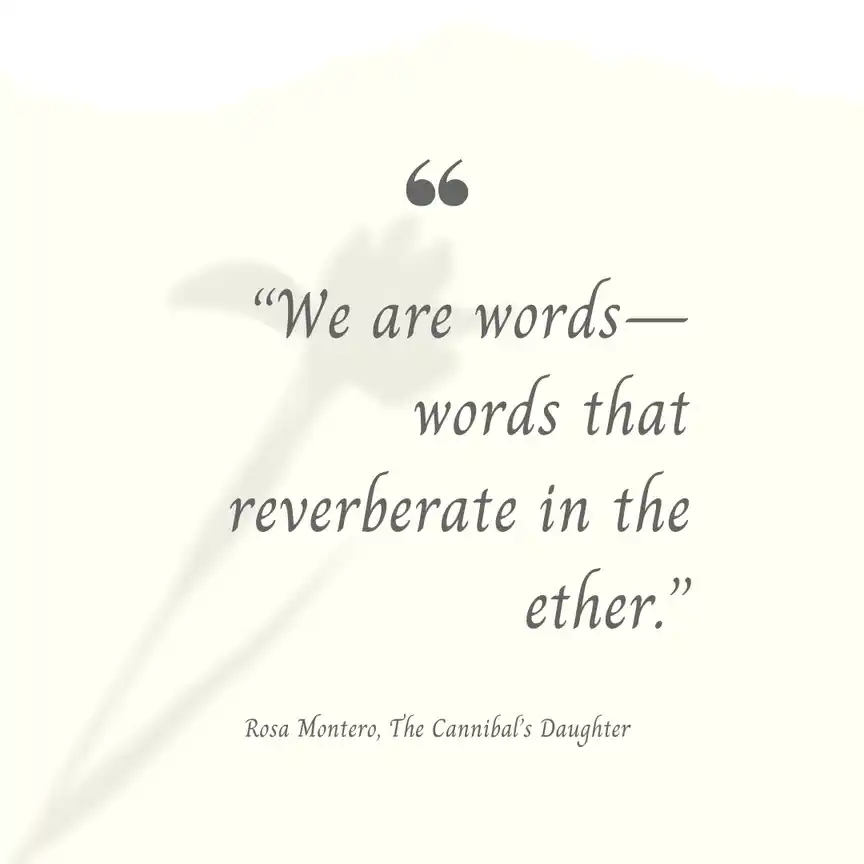
Reflective Quotes from The Cannibal’s Daughter
- “We all carry our own hell inside.” This short line turns The Cannibal’s Daughter inward; consequently, the disappearance plot becomes a map of private fear as much as public mystery.
- “I am as afraid as you.” The sentence strips Lucía of heroic pose; therefore the novel lets courage begin as shared panic, not confidence.
- “Silence can be deafening.” Absence becomes an active force; moreover, The Cannibal’s Daughter makes Ramón’s vanishing invade rooms more loudly than speech.
- “Resignation is the great defeat.” The thought fits Lucía’s turn from passive wife to investigator; as a result, action becomes self-rescue.
- “Knowledge does take up space.” This wry remark suits her method, because every clue changes the emotional room Lucía must inhabit.
- “My former life… began to seem the best of lives.” The fragment catches crisis nostalgia; consequently, The Cannibal’s Daughter shows how fear can beautify even a dull past.
- “I am alone, and I like it.” This key phrase marks transformation rather than abandonment; therefore Lucía’s solitude becomes chosen space.
- “We are more than the mere moment we live.” The line expands the novel’s mystery into philosophy; finally, The Cannibal’s Daughter asks what kind of self survives shock, desire, and time.
Context-Rich Trivia from The Cannibal’s Daughter
- Airport as rupture:The Cannibal’s Daughter begins with Ramón’s disappearance at Madrid-Barajas; consequently, an ordinary transit space becomes a threshold between wifehood and investigation. For broader airport context, see 🌐 AENA’s history of Madrid-Barajas.
- Fortuna’s anarchist memory: The old anarchist widens the story beyond marriage; consequently, private fear meets Spanish political memory. For background on that tradition, see 🌐 Anarchism in Spain.
- Amateur detectives: Lucía investigates with Adrián and the old anarchist Fortuna; consequently, the book treats detection as emotional education, not only clue work. For a playful crime-structure counterpoint, see 👉 The ABC Murders by Agatha Christie.
- Anarchist memory: Fortuna’s past links private panic to Spanish political history; moreover, his revolutionary stories widen Lucía’s crisis beyond marriage. For an echo of rebellion and outlaw ethics, compare 👉 The Robbers by Friedrich Schiller.
- Identity after shock: Lucía’s search forces a reconstruction of the self; therefore 👉 A Clergyman’s Daughter by George Orwell works as a useful parallel on female dislocation and self-recovery.
- Film afterlife: The story became the 2003 film Lucía, Lucía, which shifted the novel into crime-comedy-drama territory.
- Liminal space logic: Airports suspend normal identity because passengers wait, cross borders, and lose routine; therefore The Cannibal’s Daughter uses its opening location as emotional architecture. For a general study of airports as liminal spaces, see 🌐 Airports as Liminal Space
- Title irony: Finally, The Cannibal’s Daughter uses a shocking title for a book about emotional hunger: who consumes whom, and what remains of a life after habit has eaten love.
Where The Cannibal’s Daughter feels uneven
The Cannibal’s Daughter is energetic, but it is not perfectly balanced. Its mixture of mystery, self-discovery, comedy, and political memory can feel crowded. Some readers may want the crime plot to stay sharper. Others may prefer the introspective material and find the suspense machinery less convincing.
The novel’s openness is both strength and weakness. She lets Lucía’s mind roam. She follows side paths, tonal shifts, and eccentric encounters. This gives the book life, but it also loosens the thriller structure. The investigation sometimes feels less important than the transformations it causes.
The messiness is part of the design. Lucía’s life has been interrupted, and the book reflects that interruption. Still, the reader should not expect a clean detective novel. This is a hybrid work, and its best rewards come from voice, character, and emotional movement.
The novel has a distant link to 👉 The Fall by Albert Camus in its use of self-narration as exposure. Camus is colder and more philosophical. The author is warmer and more chaotic. Yet both writers understand that telling one’s story can become a trial of the self.
When disappearance becomes freedom
The final power of The Cannibal’s Daughter lies in its reversal. Ramón’s disappearance begins as catastrophe. Yet the search gradually becomes Lucía’s passage into a wider life. This does not make the pain false. It means that crisis can reveal the poverty of a previous stability.
She does not offer a simple empowerment fable. Lucía is too flawed, funny, and self-questioning for that. Her transformation is uneven. She does not become a heroic detective or a perfectly liberated woman. She becomes more awake. That is enough.
Lucía learns to inhabit uncertainty. This may be the novel’s most lasting idea. Before Ramón vanishes, uncertainty hides beneath habit. Afterward, it becomes visible, frightening, and finally usable. The world is less safe than she believed, but also larger.
The Cannibal’s Daughter succeeds because it treats disappearance as both plot and metaphor. A husband vanishes. A marriage dissolves. A false self begins to disappear too. In the space left behind, Lucía finds danger, friendship, absurdity, memory, and a stranger form of freedom. The novel’s charm lies in that movement: from panic to investigation, from investigation to self-recognition, and from self-recognition to the possibility of living with more appetite for life.
More Reviews of Spanish Literature