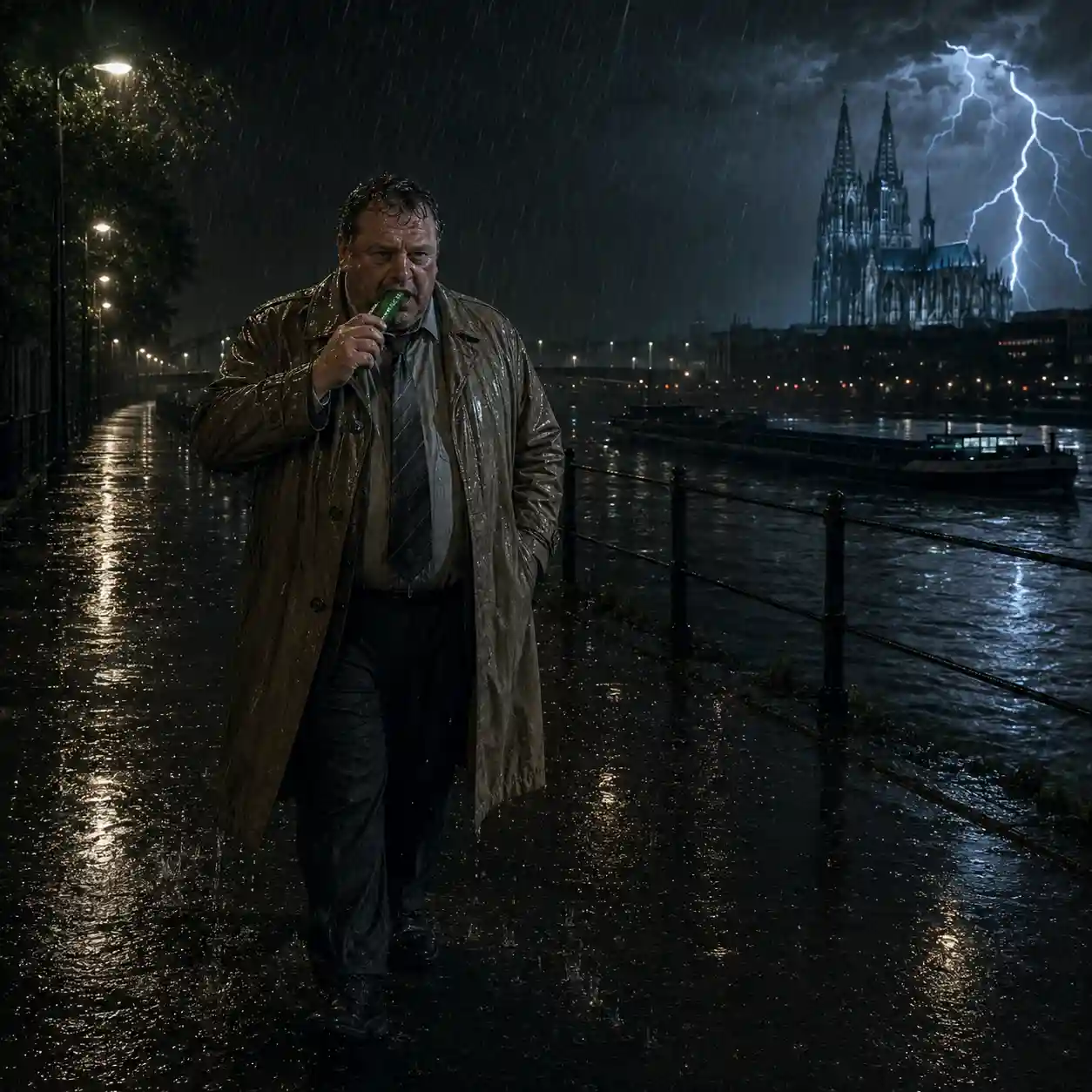
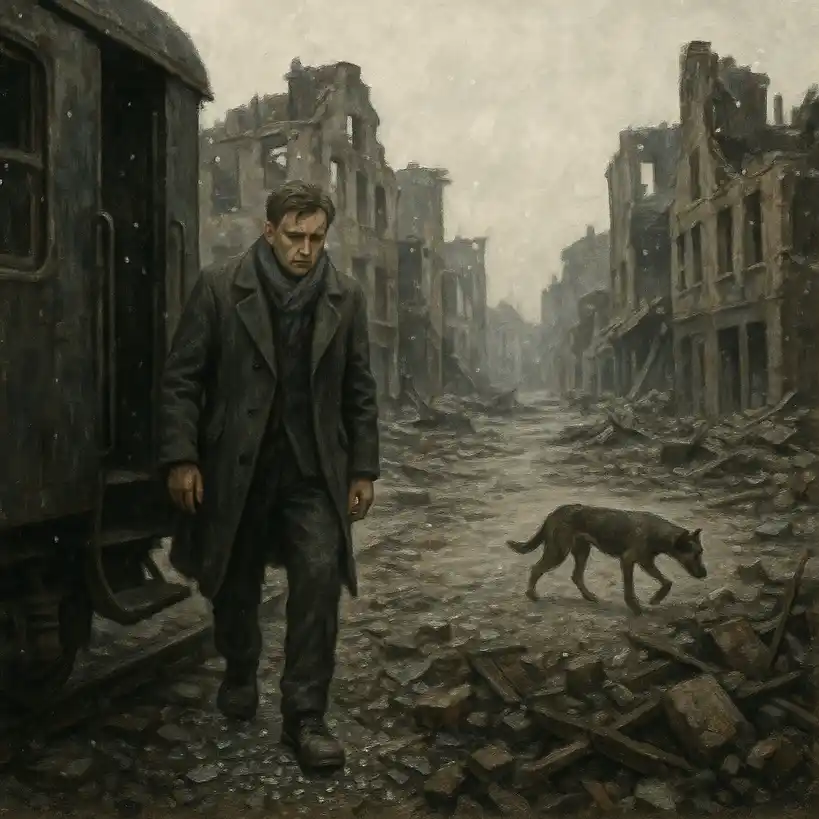
Measuring the World by Daniel Kehlmann
Measuring the World opens in 1828 with an event the novel has been delaying before its chronology even begins. Carl Friedrich Gauss reluctantly travels from Göttingen to Berlin with his son Eugen. Alexander von Humboldt has invited him to a congress of German natural scientists and physicians.
Daniel Kehlmann makes the meeting comic before making it grand. Gauss dislikes travel, crowds, ceremony, and most conversation. Humboldt thrives on public organization and disciplined performance. Equal fame produces no natural friendship. Each man recognizes intelligence in the other while finding his habits almost unbearable.
The Berlin encounter frames the alternating life stories that follow. The narrative moves backward to childhood, then advances through two careers until both paths return to the congress.
Parallel intellectual lives also organize 👉 Point Counter Point by Aldous Huxley, where contrasting characters and ideas create meaning through juxtaposition. The writer narrows the counterpoint to two famous minds whose incompatible temperaments illuminate the same desire for knowledge.
Their differences are immediately physical. Humboldt has crossed continents, climbed mountains, entered caves, and navigated rivers. Gauss has traveled through abstraction while resisting unnecessary movement. One measures by going out, the other by thinking through. The joke never cancels achievement. Measuring the World admires both men while denying them heroic composure.

Humboldt Makes Discovery a Discipline
The young Humboldt treats self-education as a campaign. Born into privilege, he studies instruments, mines, plants, anatomy, geology, and languages with relentless purpose.
In Measuring the World, exploration is less a romantic escape than a mobile laboratory. Humboldt records altitude, temperature, magnetism, species, currents, and coordinates. He carries tools into heat, illness, dangerous water, thin air, and unfamiliar terrain. Wonder must submit to notation.
Bonpland provides an essential counterweight. He possesses expertise and courage, but he also notices hunger, fatigue, absurdity, and other people more readily than his companion. Humboldt’s drive often converts shared danger into another entry in the record.
Travel becomes reflective and culturally observant in 👉 Italian Journey by Johann Wolfgang von Goethe. Goethe uses the journey to reshape artistic identity. His Humboldt pursues comparison and universal pattern, measuring landscapes as parts of an interconnected natural order.
The expedition scenes balance exhilaration with critique. Humboldt opposes slavery and recognizes colonial brutality, yet he still moves with European access, money, and confidence. Local knowledge enters his project without always receiving equal narrative authority.
Classification can widen vision and reproduce hierarchy. Measuring the World keeps both possibilities present. Humboldt’s measurements challenge myth and enlarge scientific understanding. His compulsive method can also turn people and places into surfaces for his own achievement. The explorer wants the world to become legible. The novel keeps asking what legibility costs.
Gauss Travels Without Leaving Thought
Gauss grows up in modest circumstances and reveals mathematical ability so extraordinary that patrons make education possible. Where Humboldt accumulates observations, Gauss sees structures that do not require distant landscapes.
Measuring the World presents his discoveries with comic speed. Problems that occupy others for years seem obvious to him, which makes ordinary instruction intolerable. Insight isolates as much as it elevates. Gauss cannot easily explain how he knows, and he has little patience for minds that need intermediate steps.
Land surveying brings abstraction into fields and villages. He measures actual territory while thinking about curved space, probability, astronomy, and forms that resist common intuition. The contrast complicates the title. To measure is not merely to record what exists. It can mean discovering the conceptual order through which existence becomes thinkable.
The relation between scientific insight and public authority drives 👉 A Life of Galileo by Bertolt Brecht. Brecht stages the pressures placed on knowledge by institutions and personal compromise. He uses irony and biography to show a genius who resists ceremony but still depends on patrons, universities, and the state.
Gauss’s domestic life reveals the cost of his inward travel. He loves Johanna, but calculation interrupts intimacy. After her death, grief deepens his withdrawal. His second marriage is practical and unhappy.
A mind can cross infinity while failing the person nearby. Measuring the World does not treat that failure as the unavoidable price of genius. It treats it as a human choice genius does not excuse.
Movement and Stillness Reverse Expectations
The central contrast in Measuring the World initially appears simple. Humboldt moves through forests, rivers, mountains, courts, and empires. Gauss prefers home and enters remote dimensions through thought. The author gradually unsettles that opposition.
Humboldt’s constant movement follows rigid routines. He measures, records, and compares with such discipline that travel can resemble confinement inside a method. Gauss remains geographically limited, yet his imagination breaks through established geometry and conventional space. The traveler can be fixed, the homebody boundless.
Their approaches also depend on different relations to error. Humboldt trusts the accumulation of observations and the reliability of instruments, though conditions repeatedly disrupt both. Gauss distrusts imperfect measurement and searches for mathematical ways to calculate uncertainty itself.
Measuring the World makes the two methods complementary without pretending they are harmonious. Empirical data requires conceptual form. Theory needs some relation to what instruments and bodies encounter. Neither man possesses the complete route to truth.
This dual design keeps the novel from becoming two biographies placed side by side. Details echo across chapters. A mountain corresponds to a mathematical curve. A difficult journey answers a thought experiment. An instrument in Humboldt’s hand finds its counterpart in a formula inside Gauss’s mind.
Comparison becomes the novel’s real narrator. Readers continually measure one life against the other, even as the book warns that no shared scale can capture personality, achievement, kindness, or damage. By the time the men meet, their opposition feels accurate and insufficient.
Comedy Brings Monumental Figures Down to Size
The prose of Measuring the World is restrained, fast, and consistently ironic. Historic achievements appear beside bodily inconvenience, failed conversation, vanity, lust, fear, and social embarrassment. The tone shrinks monuments back into fallible people.
Much dialogue is rendered through indirect speech. Characters seem to speak through a narrator who keeps their words at a slight distance. Reported language turns certainty into comedy. Grand declarations acquire the faint suspicion that they may have been remembered, simplified, or invented.
His humor depends on contrast rather than mockery alone. Humboldt behaves with perfect formality in situations where formality is absurd. Gauss sees through intellectual pretension but remains blind to the pain caused by his contempt. Both are right often enough to make their failures sharper.
Scientific episodes move quickly because the novel rarely stops for textbook explanation. It gives readers the shape of a discovery, then shifts toward the person making it. Compression is a form of interpretation. Decades pass through selected scenes, and a famous life becomes a chain of revealing collisions. The omissions prevent the narrative from pretending to be complete.
Some readers may find that the wit cools emotional intimacy. Bonpland, Johanna, Minna, and Eugen sometimes appear chiefly through their proximity to the two celebrated men. Yet this limitation also becomes thematic. Measuring the World shows how the gravitational field of genius can reduce surrounding lives, and its irony keeps that reduction visible.
Measurement Promises Control and Reveals Limits
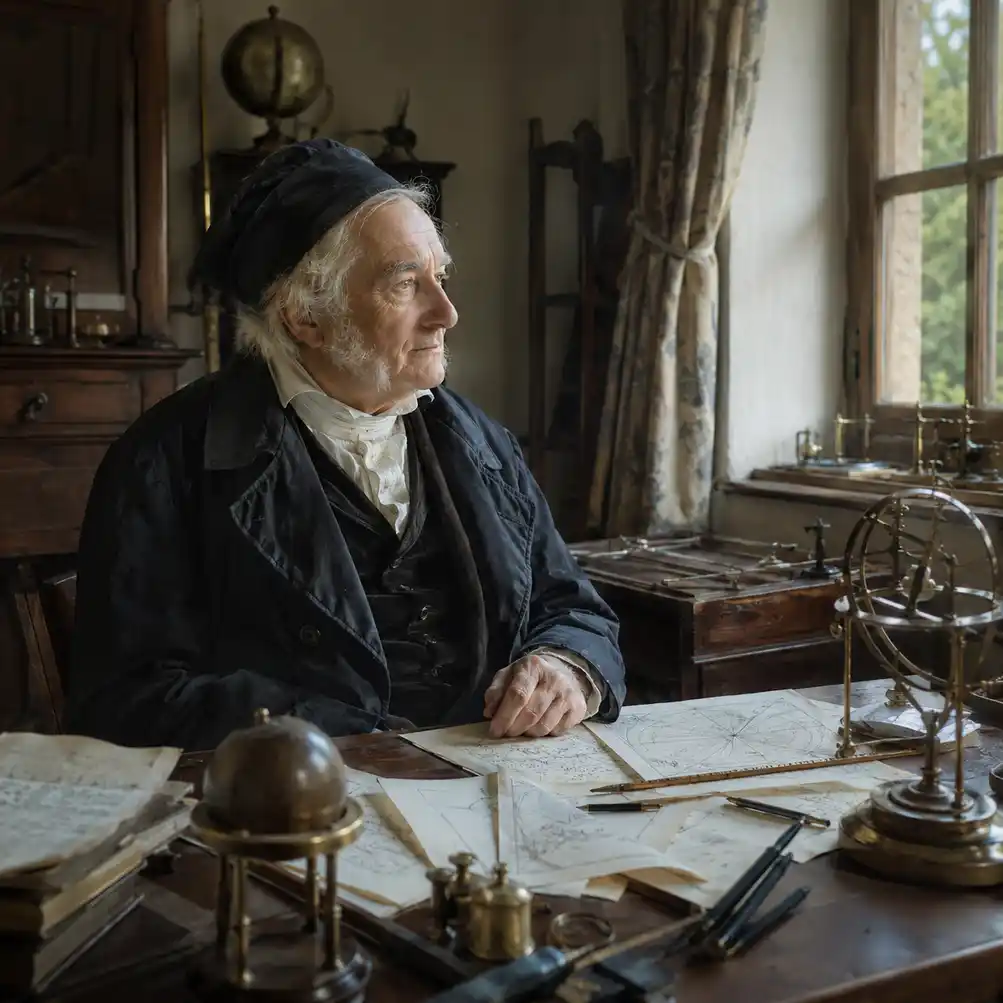
Maps, instruments, equations, stars, land surveys, bodily measurements, and magnetic readings fill Measuring the World. The repeated acts suggest Enlightenment confidence that nature can become intelligible through rational method. They also expose how much escapes every scale.
A number answers only the question built into it. Altitude does not explain what a mountain means to those who live near it. Coordinates locate a river without exhausting its history. Mathematical precision can describe probability without making human behavior predictable.
The rule-bound society of 👉 The Method by Juli Zeh takes confidence in quantification toward a dystopian endpoint. Zeh imagines health data becoming political authority. He remains in the nineteenth century, but both novels ask when measurement changes from a tool of knowledge into a claim over reality.
Humboldt’s project seeks connection as well as control. His observations support an understanding of nature as an interacting whole. The problem arises when the measuring self disappears from the record, as if instruments operated outside culture, ambition, and power.
Gauss knows more clearly that measurement includes uncertainty. His work accounts for imperfect observations and challenges flat, intuitive space. Still, intellectual humility toward numbers does not make him humble toward people.
The measurable and the valuable never fully coincide. Measuring the World returns to this gap through love, aging, colonial violence, parenthood, and political freedom. Science can disclose patterns within each domain. It cannot decide what obligations follow. The title therefore contains admiration and warning. The world becomes more knowable, but never becomes the measurer’s possession.
Historical Fact Enters a Comic Invention
Measuring the World uses the lives of real scientists but announces itself through style as a novel, not a double biography. Meetings, conversations, private reactions, and comic incidents combine research with invention. The historical figures become characters designed around patterns and contrasts.
That freedom has generated debate, especially where fictional traits threaten to replace the documented people in popular memory. Kehlmann’s Humboldt can appear colder and more mechanical than the historical opponent of slavery and wide-ranging humanist. His Gauss becomes a concentrated figure of brilliance and misanthropy.
Distortion is part of the book’s measuring device. Caricature enlarges selected features so readers can see the myth of genius being built and dismantled. Yet every enlargement leaves something outside the frame.
Self-invention takes a more openly unreliable form in 👉 The Confessions of Felix Krull by Thomas Mann. Mann’s charming narrator constructs identity through performance. His historical narrator performs certainty on behalf of famous men, then quietly undermines that certainty through absurdity.
The book occupies an unusual place in modern German Literature because it makes intellectual history comic and accessible without surrendering philosophical pressure.
Readers should therefore resist using Measuring the World as a factual substitute for biography. The deviations are not accidental noise around a historical lesson. They are the means through which the novel asks how later generations turn complex people into usable legends. Fiction measures the distance between a life and its monument. That distance is where his comedy works.

Quotes from Measuring the World
- “The fine curve of space was almost visible from here.” Fiction gives young Gauss an impossible balloon ride, so mathematical insight becomes a physical vision.
- “Things never happened this fast down there.” Height compresses sunset and gives discovery a speed that ordinary life cannot match.
- “Only one thing endured.” Beside an ancient tree, Humboldt briefly encounters permanence beyond the reach of instruments.
- “Everything died, every human being, every animal, every moment.” Measurement cannot protect the explorer from mortality, grief, or the passage of time.
- “Quietly he asked Joanna if he had said something wrong.” Gauss treats happiness as an arithmetic error, then fails to understand why his wedding speech unsettles everyone.
Trivia List for Measuring the World
- Publication created a literary phenomenon: Daniel Kehlmann released Die Vermessung der Welt through Rowohlt on September 23, 2005. The 🌐 original publisher records more than 2.5 million German sales and rights in fifty languages.
- Two lives form parallel lines: Alexander von Humboldt travels through the Americas with Aimé Bonpland, while Carl Friedrich Gauss explores space and number largely from Göttingen. Their methods finally intersect in Berlin in 1828.
- The meeting rests on history: Humboldt organized that year’s congress of German naturalists and physicians, which Gauss attended. However, the writer converts documented contact into a comic collision of temperaments, as a 🌐 mathematical review explains.
- Measurement becomes bodily ordeal: His Humboldt tastes poisons, climbs mountains, enters caves, and measures waves during a storm. That feverish expeditionary energy connects with 👉 The Lost World by Arthur Conan Doyle.
- Science never defeats mortality: Gauss calculates from home, while Humboldt gathers instruments abroad. Yet aging, grief, family conflict, and loneliness resist quantification. 👉 The Glass Bead Game by Hermann Hesse offers another critique of intellect detached from ordinary life.
- English readers received a specific voice: Carol Brown Janeway translated the novel for Pantheon in 2006. Her brisk reported dialogue preserves the contrast between scientific grandeur and deadpan comedy.
- Cinema visualized the measurements: Detlev Buck directed the 2012 German-Austrian adaptation, turning the novel’s parallel structure into contrasting landscapes, interiors, journeys, and scientific spectacles.
Eugen Reveals the Cost of Greatness
Eugen, Gauss’s son, travels with his father to Berlin and absorbs a steady stream of contempt. He lacks the mathematical gifts Gauss values and becomes interested in language, nationalism, and liberal student politics.
Measuring the World gradually shifts attention toward this less celebrated figure. Eugen becomes involved with a student gathering and is arrested. Political authority enters the story not as an abstract system but as a force capable of redirecting an ordinary young life.
Humboldt uses status and diplomacy to help secure his release, while Gauss’s bluntness makes matters worse. The contrast complicates their moral profiles. Social skill can achieve what pure intelligence cannot. Humboldt’s comfort with institutions, often presented comically, becomes useful when another person is endangered.
Eugen’s eventual departure for America changes the novel’s scale. The son treated as a disappointment becomes the figure who moves toward an unwritten future. He will not inherit his father’s genius, but he may escape his judgment.
The generational turn also questions national greatness. Scientific achievement flourishes beside censorship and political repression. Celebrating remarkable Germans cannot substitute for examining the society in which they worked.
The minor figure carries the open ending. Gauss and Humboldt approach age with their reputations established. Eugen crosses the ocean without knowing what his life will become. In Measuring the World, uncertainty is no longer merely a problem for mathematics. It becomes a condition of freedom.
The World Exceeds Every Final Calculation
Age changes both protagonists. Humboldt’s later Russian expedition is more controlled, ceremonial, and constrained than his American journey. Gauss feels younger minds approaching discoveries that once belonged to him. Their methods survive, but their bodies and historical moment move toward an end.
This decline gives Measuring the World an emotional weight beneath its comedy. The men who pursued universal knowledge cannot negotiate with time. Mortality is the limit no instrument removes.
THe novelist avoids a sentimental reconciliation between the two geniuses. Their meeting does not merge their methods or repair their personal failures. Recognition remains partial, which suits a novel suspicious of total accounts.
The achievement of Measuring the World lies in making thought adventurous. Rivers and mountains provide obvious danger, but an idea can also overturn the shape of space. At the same time, the novel refuses to equate intellectual range with emotional maturity.
Knowledge enlarges responsibility rather than replacing it. Humboldt and Gauss transform how the world can be described. They remain capable of impatience, blindness, vanity, and neglect. Their greatness is real, and so are the people reduced by its demands.
The final movement belongs to departure rather than completion. Eugen’s voyage suggests that the next world will be measured by different minds, institutions, and ambitions. No map will be final because every method selects, excludes, and eventually ages. The title’s grand project thus ends in productive incompleteness. The world can be measured again and again. It cannot be finished.